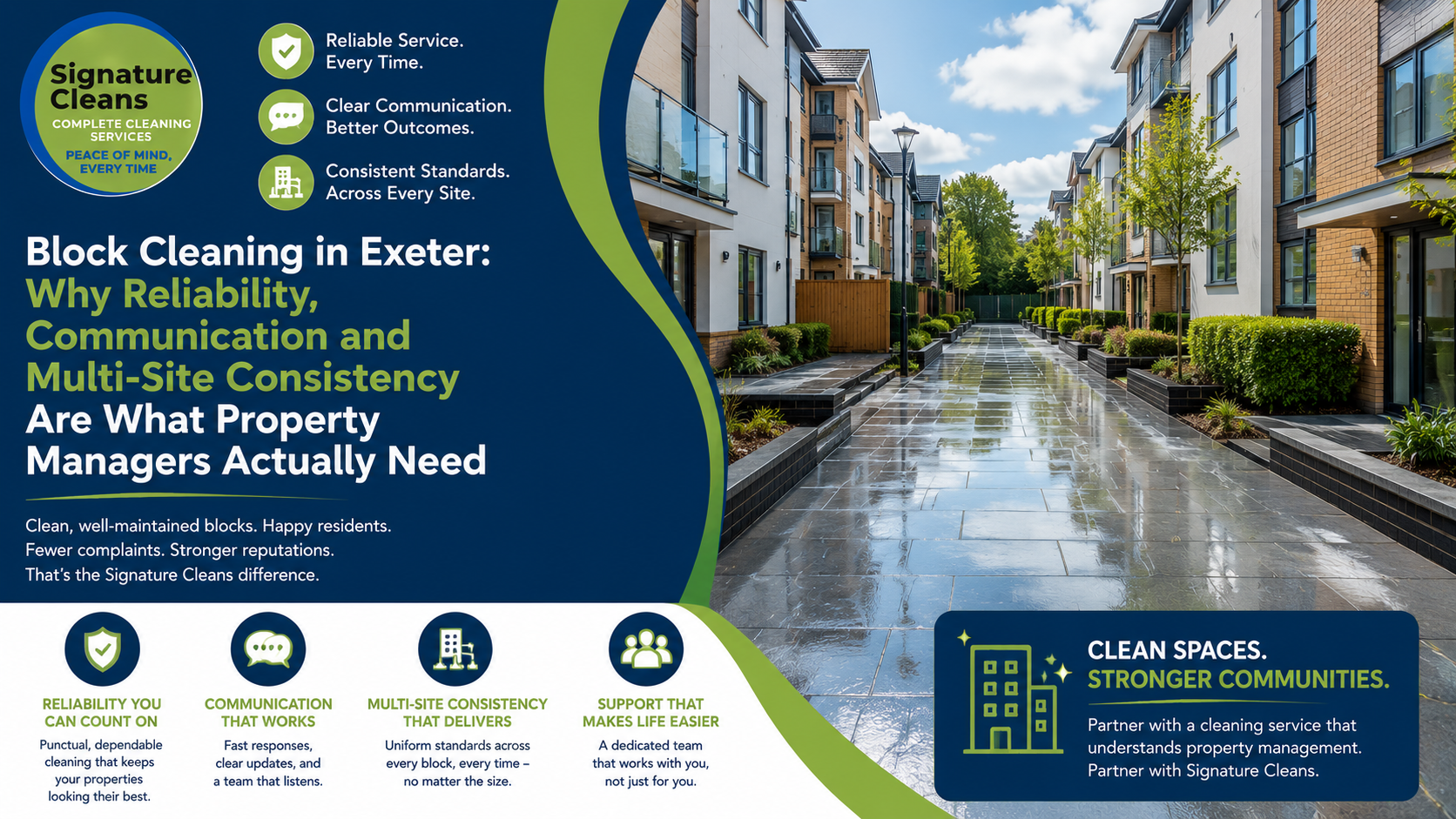
What Exeter Property Managers Actually Need From a Block Cleaning Provider
Ask any property manager in Exeter what they want from their block cleaning provider and the answer is rarely complicated: turn up when expected, deliver the same standard every time, and communicate clearly when something changes.
These are not ambitious expectations. They are the basics. And yet, for too many property managers overseeing residential blocks across Exeter and Devon, these basics are where most providers fall short — not dramatically, not all at once, but gradually and consistently enough to create the kind of low-level operational friction that consumes time, generates resident complaints, and erodes confidence in the service.
This guide is written for property managers who want to understand what professional block cleaning in Exeter should look like in practice — whether you are managing a single residential block in St Leonards or overseeing multiple developments across the wider Devon area. It covers reliability, communication, multi-site management, and the systems that make all three possible to sustain over time.
Q: What do property managers need from a block cleaning company in Exeter?
Property managers in Exeter consistently identify three core requirements from a block cleaning provider: reliability (turning up as scheduled and delivering a consistent standard every visit); clear communication (proactive updates about schedule changes, issues, and completion without the manager having to chase); and — for those managing multiple sites — the operational systems to maintain the same standard across every block in their portfolio. Providers who cannot deliver all three create management overhead rather than reducing it.
1. Reliability: The Foundation That Everything Else Depends On
The insight: In communal cleaning, reliability is everything. Turning up when expected. Delivering the same standard every time. It sounds simple — but it's where many providers fall short.
Reliability in block cleaning is not just about whether a provider shows up. It is about whether they show up consistently, at the right time, delivering the right standard — visit after visit, week after week, across the full duration of the contract.
The reason reliability matters so much in communal residential environments is that the consequences of unreliability are highly visible and highly social. A missed clean in an office affects the people who work there. A missed clean in a residential block affects residents at home — in their most personal space — and the reaction is proportionally more emotional and more likely to escalate.
For block cleaning in Exeter, reliability has three distinct dimensions:
Schedule reliability
Visits happen on the agreed days, at the agreed times, without requiring the property manager to chase, confirm, or verify. When something affects the schedule — operative absence, a bank holiday, adverse weather — the property manager is notified in advance with a clear rescheduled date, not informed after the fact that a visit was missed.
Standard reliability
Every visit delivers the same level of cleanliness. Not excellent on the first visit and acceptable thereafter. The same standard — entrance hall, stairwells, lifts, corridors, bin stores — every time. This requires a named operative who knows the building, a documented specification that defines what that standard looks like, and a quality audit process that detects drift before it becomes visible to residents.
Personnel reliability
The same operative, or small consistent team, attends the building regularly. Not a different face every week. Consistency of personnel is a direct driver of standard reliability: an operative who knows a building knows where issues tend to arise, what the property manager's priorities are, and what the residents expect. That institutional knowledge cannot be transferred by a checklist.
Q: Why is reliability so important in residential block cleaning?
Reliability is the most critical quality in residential block cleaning because unreliability is immediately visible to residents in their home environment — where the emotional stakes are higher than in a commercial setting. A missed clean or inconsistent standard generates resident complaints, service charge disputes, and reputational damage for the property manager. Reliability requires three specific operational disciplines: schedule consistency, standard consistency, and personnel consistency — all of which depend on the provider's systems, not just their intentions.
2. Clear Communication: What Property Managers Should Never Have to Chase
The insight: Property managers don't need surprises. They need clear communication and quick responses. The best providers keep everything straightforward so you're always in the loop — without having to ask.
Communication in a block cleaning relationship is not a supplementary feature — it is a core operational requirement. A property manager who has to chase their cleaning provider for confirmation of visits, responses to queries, or explanations of missed areas is carrying a management burden that the cleaning contract was supposed to remove, not create.
The standard for communication that Exeter property managers should expect — and hold providers to — is straightforward: proactive rather than reactive, specific rather than vague, and fast enough to be useful rather than delivered after the problem has already generated a resident complaint.
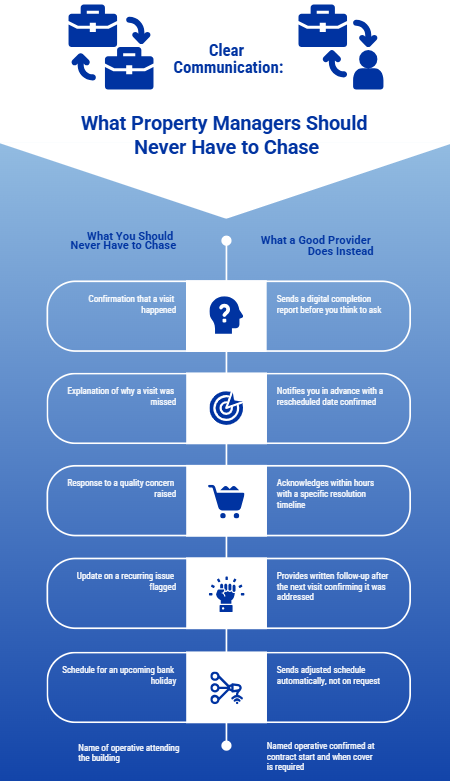
The communication standard above is not aspirational — it is the baseline of a professionally managed block cleaning contract in Exeter. Any provider who cannot deliver it consistently is creating administrative work for your team that compounds over time.
What good communication infrastructure looks like in practice:
• Digital visit logs: Time-stamped completion records accessible to the property manager without having to request them — a digital log that updates automatically after each visit.
• A named account manager: One person with genuine accountability for your contract — not a general customer service number that routes to whoever is available.
• A defined response SLA: A clear, documented commitment to acknowledge queries and concerns within a specific timeframe — typically same-day for urgent issues and within 24 hours for routine matters.
• Regular written reporting: Monthly or quarterly written summaries of service delivery, quality audit findings, and any issues identified and resolved — not just verbal assurances during a phone call.
• Advance notice of all schedule changes: Any change to visit dates, operative assignments, or service scope communicated before it takes effect — never retrospectively.
Q: How should a block cleaning company communicate with property managers?
A professional block cleaning company should communicate with property managers proactively — not reactively. This means: digital visit logs sent automatically after each clean; a named account manager as the single point of contact; a documented response SLA (same-day for urgent issues, 24 hours for routine queries); advance notice of all schedule changes; and regular written reporting on service delivery and quality audit outcomes. Property managers should never have to chase their cleaning provider for information that should have been sent automatically.
3. Managing Multiple Sites: The Systems Challenge That Separates Good Providers from Great Ones
The insight: Cleaning across multiple blocks requires organisation and consistency. Without the right systems, standards can vary quickly between sites. Every block in your portfolio deserves the same level of service — and maintaining that at scale requires more than good intentions.
For property managers overseeing multiple residential blocks across Exeter and the wider Devon area — whether that is two developments or twenty — the challenge of block cleaning is fundamentally different from managing a single site. The question is not simply whether each block is being cleaned well. It is whether every block is being cleaned to the same standard, on the same schedule, with the same accountability infrastructure in place across all of them.
This is the point at which most cleaning providers begin to struggle. Delivering a strong service to one block is a staffing and scheduling challenge. Delivering a consistent service across multiple sites in different locations, with different access arrangements, different resident demographics, and different cleaning specifications, is a systems challenge. And systems — not goodwill — are what determine whether consistency holds.
The specific challenges of multi-site block cleaning:
• Operative allocation and cover: Each site needs a consistently assigned operative who knows the building. When cover is required — due to absence, illness, or planned leave — the cover operative needs to be briefed on the site-specific specification, not sent in with a generic checklist.
• Schedule coordination: Multiple sites with different visit frequencies, access requirements, and resident-sensitive time windows require a scheduling infrastructure that manages complexity without producing errors. A missed visit at one site should not be masked by strong performance at others.
• Quality audit coverage: Every site in a portfolio needs to be audited regularly — not just the ones that have recently generated complaints. A quality programme that only activates in response to problems is reactive, not managed.
• Reporting across the portfolio: A property manager overseeing multiple blocks needs consolidated, site-specific reporting — not a single monthly call that covers everything vaguely. Each site should have its own documented audit trail, accessible independently.
• Consistent specification management: When a site's cleaning specification changes — a new access arrangement, an additional area coming into scope, a change in visit frequency — that change needs to be documented, communicated to the operative, and reflected in the audit standard immediately.
Q: How do you maintain consistent block cleaning standards across multiple sites in Exeter?
Maintaining consistent block cleaning standards across multiple sites requires four operational systems: site-specific cleaning specifications for every block, with changes documented and communicated immediately; a named operative assigned to each site with a structured cover briefing process; regular independent quality audits conducted at every site on a rotating schedule; and consolidated, site-specific digital reporting accessible to the property manager for each block in the portfolio. Providers who manage multiple sites through informal coordination rather than documented systems will always produce inconsistent results.
4. What a Professional Block Cleaning Specification Should Cover in Exeter
One of the most consistent gaps in underperforming block cleaning contracts is the absence of a properly developed, site-specific cleaning specification. A specification is not a generic task list applied uniformly across every block a provider services. It is a document that reflects the specific layout, surface types, occupancy pattern, and access arrangements of a particular building — and defines clearly what is cleaned, how often, to what standard, and how completion is verified.
For property managers in Exeter managing blocks across areas including St Leonards, Heavitree, Pinhoe, Topsham, and the wider city and Devon region, the variation between buildings can be significant. A Victorian-era converted apartment block in the city centre has different communal cleaning requirements from a modern purpose-built development on a new-build estate on the city's edge. Both deserve a specification written for them — not a standard package applied to both.
A comprehensive Exeter block cleaning specification should include:
• Entrance halls and lobbies: Frequency, specific tasks (mopping, vacuuming, glass cleaning on entrance doors, letterbox areas, notice boards), and standard for completion — including how the area should look under both natural and artificial light.
• Stairwells and corridors: Floor cleaning method appropriate to the surface type (hard floor, carpet, or mixed), handrail sanitisation, skirting board maintenance, and high-level cobweb removal on a defined periodic basis.
• Lifts: Interior floor, wall panels, door surrounds, call buttons, and floor track — with a specific frequency reflecting the lift's usage and the building's occupancy.
• Bin stores: Floor cleaning, odour management, and overflow clearance — one of the most complaint-generating areas in any residential block, and one that requires a specific rather than generic approach.
• Car parks and external communal areas: Litter collection, seasonal debris management, and any hard floor treatment — with frequency adjusted for the specific exposure of the site.
• Periodic deep clean items: High-level dusting, internal window cleaning of communal areas, carpet extraction in carpeted stairwells — listed with frequency and included or excluded from the base contract scope.
• Verification method: How each visit is recorded, what constitutes completion, and how the property manager accesses the record.
Q: What should a block cleaning specification include for a residential building in Exeter?
A residential block cleaning specification in Exeter should cover: entrance halls and lobbies with defined tasks and frequency; stairwells and corridors with surface-appropriate cleaning methods; lifts including floor track, buttons, and wall panels; bin stores with odour management and overflow protocols; car parks and external areas with seasonal adjustment; periodic deep clean items listed separately with frequency; and a defined verification method for each visit. Generic task lists applied without a site survey are not adequate for professional block management contracts.
5. The Resident Experience: Why Block Cleanliness Is a Property Management Issue, Not Just a Facilities One
For property managers in Exeter, the standard of communal area cleaning in a residential block is not a back-office operational detail. It is one of the most visible and most commented-upon aspects of the service charge residents are paying for — and in a leasehold or managed development context, that makes it a relationship issue as much as a facilities one.
Residents do not typically distinguish between the property manager's responsibilities and the cleaning contractor's performance. If the block looks poorly maintained, the complaint comes to the property manager. If the entrance hall smells stale on a Monday morning, it is the property manager's problem to resolve — regardless of whether the cleaning operative was the direct cause.
How block cleanliness affects the resident relationship:
• First impressions for new residents: The communal areas of a block are the first thing a new resident experiences when they move in. A well-maintained entrance hall and clean stairwells set a tone of care and professionalism that is difficult to establish later if the initial impression is poor.
• Day-to-day quality of life: Residents in communal buildings pass through shared spaces multiple times a day. Consistent cleanliness — entrance halls, corridors, lifts — contributes directly to how they feel about where they live. Persistent issues in these areas erode that feeling steadily.
• Service charge value perception: Residents paying a service charge expect visible evidence that their contribution is being applied effectively. Communal cleaning is one of the most tangible and visible services in the service charge budget. If it is not being delivered to a clear standard, it becomes the focus of service charge challenges.
• Online reviews and block reputation: Increasingly, residents of managed blocks leave reviews — on Google, Trustpilot, and property platforms — that comment on communal maintenance. A block with consistently poor cleaning standards accumulates negative reviews that affect resale values, lettings velocity, and the overall desirability of the development.
Q: How does communal area cleanliness affect residents in a managed block?
Communal area cleanliness directly affects resident satisfaction, service charge value perception, and the overall reputation of a managed block. Residents pass through shared spaces multiple times daily, and consistent cleanliness — or persistent neglect — shapes their view of the property management service they are receiving. Poor communal cleaning standards are among the most common triggers for service charge challenges, formal complaints to the First-tier Tribunal, and negative online reviews that affect property values and letting appeal.
6. Choosing the Right Block Cleaning Provider in Exeter: What Actually Matters
For property managers evaluating providers for block cleaning in Exeter — whether for a single development or a multi-site portfolio — the following questions will quickly separate providers with the operational infrastructure to deliver reliably from those who are willing but structurally unprepared for the demands of communal residential cleaning.
The questions that matter most:
1. How do you ensure the same operative attends our building consistently, and what is your cover process when they are absent? The answer should describe a specific briefing process for cover operatives — not a reassurance that cover will be provided.
2. Can you provide digital visit logs accessible to us after every clean, without us having to request them? If the answer is no, or involves a manual sign-in sheet, the communication infrastructure is not at the required level.
3. Who is our named account manager, and how often will they conduct a site audit? A named individual with a defined audit frequency is essential — not a general customer service contact.
4. For multi-site portfolios: how do you manage scheduling and quality consistency across different buildings? The answer should describe specific systems — scheduling software, site-specific specifications, portfolio-level reporting — not general reassurances about experience.
5. What accreditations do you hold? SSIP, CQMS, and PQS are the procurement accreditation baseline. Providers such as Signature Cleans holding all three have been independently assessed against professional standards. ISO 9001 and BICSc affiliation are strong additional markers.
6. Can you provide references from property managers currently using your service for residential block cleaning? References from managing agents or RMCs with comparable portfolios are the most useful — follow them up directly.
7. What is the notice period in your contract, and what are the price review terms? A fair, transparent contract with a reasonable notice period signals a provider confident in their service. Excessive lock-in periods signal the opposite.
Q: What should I look for when choosing a block cleaning company in Exeter?
When choosing a block cleaning company in Exeter, prioritise: a consistently assigned named operative with a structured cover process; digital visit logs sent automatically after every clean; a named account manager who conducts regular site audits; for multi-site portfolios, documented systems for scheduling and quality consistency across all buildings; SSIP, CQMS, and PQS accreditations; and references from current property management clients. A provider who cannot answer each of these questions specifically is not yet operating at the level residential block management requires.
Your Pre-Contract Checklist: 10 Confirmations Before You Sign
Block Cleaning Exeter — Pre-Contract Checklist
✓ Named operative confirmed for each building, with structured cover briefing process
✓ Digital visit logs confirmed — automatically delivered, not on request
✓ Named account manager identified with defined audit frequency
✓ Site-specific cleaning specification to be developed after physical site survey
✓ Multi-site portfolio reporting confirmed as site-specific, not consolidated only
✓ SSIP, CQMS, and PQS accreditations confirmed and current
✓ ISO 9001 certification and public liability insurance (min. £5m) verified
✓ DBS checks confirmed for all operatives accessing occupied buildings
✓ References from current residential block management clients provided
✓ Contract notice period and price review terms reviewed and accepted
Frequently Asked Questions
Q: How much does block cleaning cost in Exeter?
Block cleaning costs in Exeter vary depending on the size of the development, number of communal areas, visit frequency, and whether specialist services (lift cleaning, bin store deep cleans, car park maintenance) are included. Most small-to-medium residential blocks of 10 to 40 units can expect a monthly contract cost of between £200 and £700. Multi-site portfolio contracts may attract a consolidated rate. Always request itemised quotes based on physical site surveys — quotes without a survey are not reliable for residential block environments.
Q: How often should communal areas in a residential block be cleaned in Exeter?
In most Exeter residential blocks, entrance halls and high-traffic corridors benefit from two to three cleans per week; lifts typically require daily or five-day cleaning given their usage intensity; bin stores should be cleaned at least weekly; and stairwells are usually maintained two to three times per week depending on occupancy. Car parks and external areas are typically cleaned fortnightly or monthly. The right frequency for any specific building should be determined by a site survey and occupancy assessment, not a standard package.
Q: Who is responsible for communal area cleaning in a leasehold block in Exeter?
In leasehold residential blocks in Exeter, responsibility for communal area cleaning typically sits with the freeholder, the residents management company (RMC), or the appointed managing agent — depending on the specific terms of the lease. The cost is ordinarily recovered through the service charge. Property managers acting on behalf of freeholders or RMCs are responsible for procuring, managing, and evidencing the cleaning service to the standard required by the lease, relevant legislation, and RICS professional standards where applicable.
The Standard Your Residents See Every Day
The entrance hall. The stairwell. The lift. The bin store. These are the spaces residents of a managed block pass through every day — and their condition, consistently maintained or consistently neglected, is one of the most immediate reflections of the quality of the property management service being provided.
Professional block cleaning in Exeter that turns up reliably, communicates proactively, and maintains the same standard across every building in a portfolio does not happen by accident. It happens because the right provider has the right systems behind their service — systems that make reliability a structure rather than an aspiration, and communication a discipline rather than an afterthought.
For Exeter property managers who are tired of chasing, tired of inconsistency, and tired of managing their cleaning provider as much as their buildings — the right standard is achievable. The checklist above will help you find the provider who can deliver it.
Managing one block or ten — let's talk about what reliable looks like.
Signature Cleans provides professional block cleaning across Exeter and Devon — named operatives, digital visit logs, documented quality audits, and a single account manager across your entire portfolio. Get in touch for a free, no-obligation site assessment for each of your buildings.
Ready for better cleaning?
Signature Cleans provides tailored commercial cleaning across Exeter and Devon. Get in touch for a free, no-obligation quote.
Get a Quote