The Cleaning Challenge That's Unique to Automotive Retail
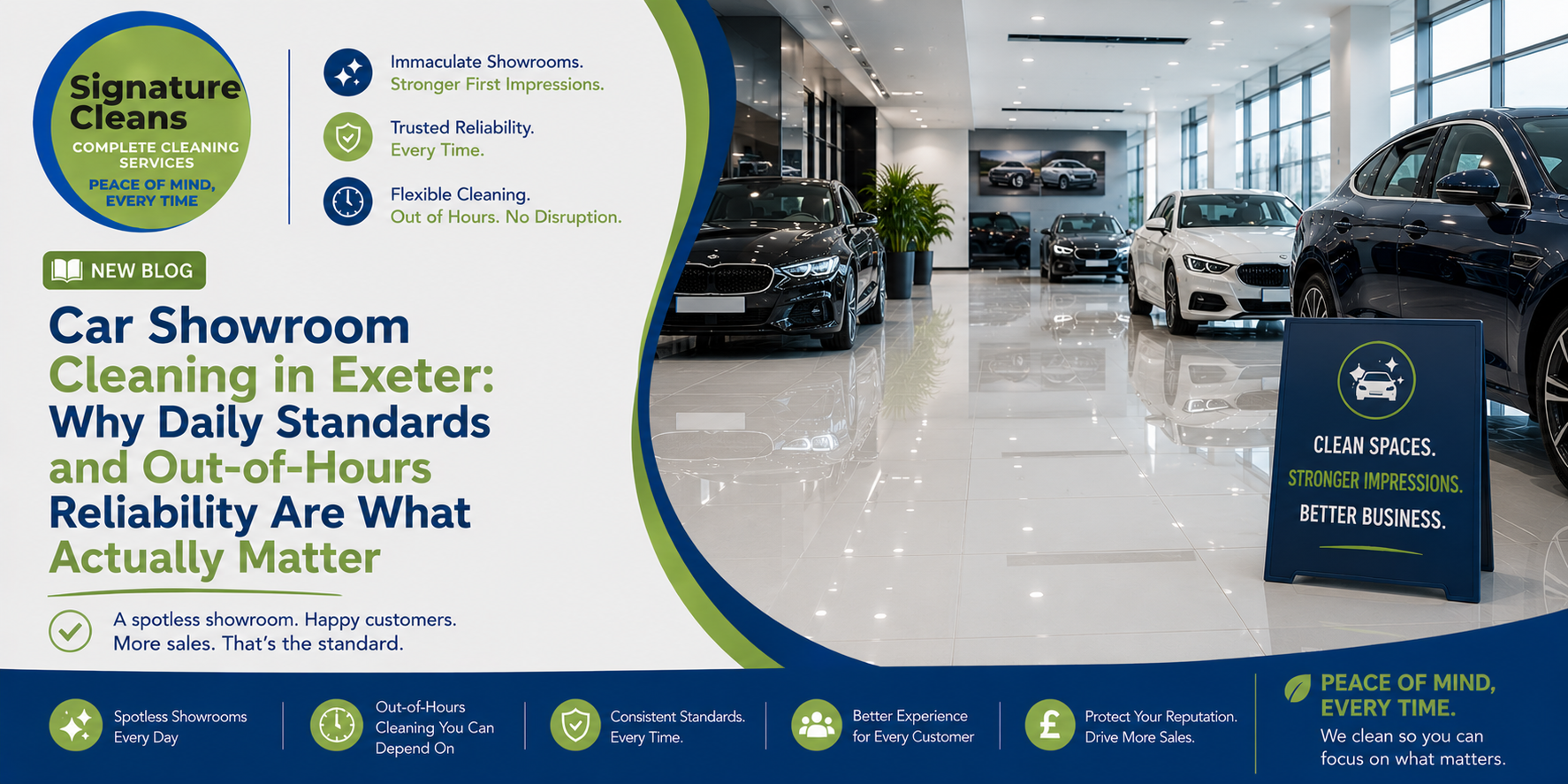
Running a car showroom in Exeter presents a cleaning challenge that most commercial environments simply do not face. The floor needs to be immaculate — but vehicles are constantly moving across it. The glass needs to be streak-free — but customer traffic leaves fingerprints by the hour. The entire space needs to communicate precision and premium quality — but it has to be cleaned without disrupting the sales operations that run through it every day.
This is why car showroom cleaning in Exeter is a specialist discipline, not a variation of standard office cleaning. The products are different. The protocols are different. The scheduling demands are different. And the standard — because everything in the showroom is engineered to look perfect — is unforgiving.
This guide is written for Exeter dealership managers who want to understand what professional car showroom cleaning should look like in practice: how it works around your sales environment, how daily standards are maintained rather than just achieved once, and what separates a truly reliable provider from one that simply shows up and hopes for the best.
Q: What makes car showroom cleaning different from standard commercial cleaning?
Car showroom cleaning differs from standard commercial cleaning in three key ways: the environment contains high-value display stock that must be protected during every clean; surfaces — including polished floors, large-format glass, and chrome fixtures — require specialist products and techniques to maintain their finish; and cleaning must take place outside of trading hours without disrupting sales operations. Providers without specific automotive retail experience routinely underestimate these requirements.
Working Around Sales: The Out-of-Hours Imperative
The insight: A busy showroom can't be disrupted. That's why professional car showroom cleaning works around your operations — early mornings or out of hours. No interference. Just a clean, ready-to-go environment when your doors open.
A car showroom in full operation is not a space that cleaning can share. Customers are walking the floor, salespeople are conducting demonstrations, and vehicles are being moved, inspected, and presented. Introducing cleaning operatives into that environment — with equipment, chemicals, and the inevitable disruption that comes with them — creates friction that no well-managed dealership should tolerate.
The answer is not complex, but it requires a provider with the operational discipline to deliver it consistently: cleaning happens outside of trading hours, every time, without exception.
For most Exeter car dealerships, this means one of two windows: early morning cleans completed before the showroom opens — typically between 5am and 8am — or evening and overnight cleans following close of business. Both are viable. Both require a provider who can staff them reliably, manage access and security protocols professionally, and deliver a finished result that is ready for customers without requiring any preparation from your team.
What out-of-hours showroom cleaning should deliver:
• A showroom floor that is clean, dried, and safe before a single member of your sales team arrives.
• All glass — internal partitions, external windows, and display cases — cleaned and checked under showroom lighting before opening, not just under ambient conditions.
• Customer-facing areas — reception, waiting lounge, handover bay — reset and presented to a standard consistent with the brand environment around them.
• No cleaning equipment, chemical residue, or operational evidence left in the showroom when your doors open.
• A confirmed completion record accessible to your manager before the start of trading, not provided retrospectively on request.
The last point matters more than it might seem. A digital, time-stamped completion record that confirms what was cleaned and when is not just an administrative convenience — it is the evidence that the clean actually happened, delivered to the standard agreed, at the time scheduled. For dealership managers responsible for franchise compliance, it is also part of your audit trail.
Q: When should car showroom cleaning take place to avoid disrupting sales?
Car showroom cleaning should take place outside of trading hours — either early morning before the showroom opens (typically 5am–8am) or in the evening following close of business. Cleaning during trading hours creates friction with sales operations and risks disrupting customer interactions. A professional out-of-hours cleaning provider will manage access independently, deliver a confirmed completion record before trading begins, and ensure the showroom is fully ready without requiring preparation from your team.
Daily Standards: Why Anyone Can Clean a Showroom Once
The insight: Anyone can deliver a good clean once. The challenge — and where most providers fall short — is maintaining that standard daily. That's where systems, processes, and accountability come in.
This is the central challenge of professional car showroom cleaning in Exeter, and the one that most dealership managers have experienced the hard way: the first clean is excellent. The provider is attentive, thorough, and clearly understands the environment. And then, gradually, the standard that seemed so clearly established begins to drift.
It is not a dramatic failure. It is the slow accumulation of small compromises — a section of floor that gets mopped rather than properly treated, a glass panel that gets wiped rather than cleaned to a streak-free finish under full lighting, a wheel arch surround that gets skipped because it is behind a vehicle and nobody will notice. Each one is minor. Together, over days and weeks, they represent a showroom that no longer looks the way it did.
The difference between a provider who maintains daily standards and one who does not is not effort or intention — it is structure. Specifically, three things:
1. A documented, site-specific cleaning specification
Every area of your showroom — floor zones, glass surfaces, reception, waiting areas, washrooms, handover bay, sales desks — should have a specific task list with defined methods, products, and quality criteria. This specification is the standard against which every clean is measured, and the document that makes 'good enough' an objective question rather than a subjective one.
2. Regular, independent quality audits
Quality audits should be conducted by someone other than the operative who performed the clean — typically a named account manager who visits the site on a scheduled and unannounced basis. Audits compare delivery against specification, document findings formally, and create an escalation pathway when the standard is not met. Without audits, there is no mechanism to detect drift before it becomes visible to your team or your customers.
3. A named operative with genuine site familiarity
Consistency of personnel is not a minor preference — it is a fundamental quality driver. A named operative who cleans your showroom regularly develops an intuitive understanding of what it requires: where tyre marks accumulate, which glass panels take longest to clean correctly under the showroom lighting, how long the floor treatment needs before it can be walked on safely. That knowledge cannot be imported by a new face with a generic checklist, however willing they are.
Q: How do you maintain consistent cleaning standards in a car showroom every day?
Consistent daily cleaning standards in a car showroom require three structural elements: a documented, site-specific cleaning specification that defines tasks, methods, and quality criteria for every area; regular independent quality audits that compare delivery against the specification and document findings; and a consistently assigned named operative who develops genuine familiarity with the site. Providers who rely on goodwill and general competence without these systems in place will always drift from the standard over time.
Reliable, Not Reactive: The Proactive Standard That Protects Your Brand
The insight: The best showroom cleaning is proactive — not waiting for issues to be raised, but preventing them in the first place. That's the difference between a provider who manages your standard and one who reacts to its failure.
Reactive cleaning in a car showroom context means this: an issue develops, a member of your team notices it, it is raised with the cleaning provider, there is a temporary improvement, and the cycle begins again. This pattern is familiar to too many dealership managers — and it represents a fundamental misalignment between what a professional cleaning contract should deliver and what it is actually providing.
Proactive cleaning operates differently. Issues are identified and resolved by the cleaning provider before your team notices them. Schedule adjustments are communicated before they affect service delivery. Seasonal changes — increased footfall in spring and summer, additional mud and moisture in autumn and winter — are anticipated and built into the cleaning programme rather than addressed retrospectively. The cleaning provider is, in the truest sense, managing your standard — not merely responding to its absence.
What proactive showroom cleaning looks like in practice:
• Pre-trading inspection: A brief walkthrough of the showroom on arrival, before cleaning begins, to identify any areas requiring additional attention — tyre marks from the previous day, glass that has been affected by overnight condensation, surfaces that need treatment beyond the standard routine.
• Seasonal programme adjustment: Exeter's climate — wet winters, increased visitor footfall during summer — creates predictable patterns of additional cleaning demand. A proactive provider adjusts the cleaning programme in advance, not in response to complaints about muddy entrance matting or streaked windows.
• Consumables management: Waiting lounge supplies — refreshments area surfaces, magazine displays, seating — managed and restocked as part of the routine, not flagged as a separate issue.
• Advance communication: Any change to schedule, personnel, or scope is communicated to your manager before it affects service delivery — not reported after the fact.
• Franchise audit preparation: For franchised dealerships subject to manufacturer presentation audits, a proactive provider understands audit requirements and adjusts the cleaning programme to ensure the showroom is audit-ready at all times — not only in the days before an inspection.
Q: What is the difference between reactive and proactive car showroom cleaning?
Reactive showroom cleaning addresses problems after they have been identified — typically through complaints from sales staff or management. Proactive showroom cleaning uses structured systems to prevent problems before they arise: pre-trading inspections, seasonal programme adjustments, consumables management, advance communication about schedule changes, and franchise audit readiness maintained continuously. Proactive cleaning requires stronger operational infrastructure but produces consistently better results and significantly reduces the management burden on dealership staff.
The Specific Cleaning Challenges of an Exeter Car Showroom
Every car showroom presents cleaning challenges that standard commercial environments do not. But Exeter dealerships — serving a market that includes both high-volume franchise operations and prestige independents across the city and surrounding Devon area — face a specific combination of factors that any cleaning provider must understand before they can serve the environment effectively.
High-finish flooring
Polished concrete, large-format porcelain, and resin floors are standard in modern automotive showrooms — and each requires a specific maintenance programme to preserve its appearance. The wrong cleaning product can cause micro-etching, dulling, or chemical staining that accumulates invisibly over months before the floor simply stops looking the way it should. Professional scrubber-dryer equipment, appropriate for the specific floor finish, is essential — a mop-and-bucket approach is not adequate for a showroom floor under display lighting.
Large-format glass
Showroom glazing — external windows, internal partitions, and display cases — presents one of the most demanding regular cleaning tasks in any retail environment. Streak-free results require the right products, the right technique, and — critically — the right lighting conditions during the cleaning process. Glass cleaned under ambient light that appears clean will often show streaks and smears when the showroom's display lighting is switched on. Professional glass cleaning in a showroom environment must be checked and finished under full trading light conditions.
Display vehicles and surrounding floor areas
Every wheel arch surround, tyre sidewall, and floor panel adjacent to a display vehicle is part of that vehicle's presentation. Cleaning around display stock without touching it requires discipline, appropriate equipment, and an operative who understands that the vehicle and its immediate environment are a single visual unit. Cleaning the floor between vehicles while leaving the area beneath and around them unattended is not adequate — and in a premium environment, it is immediately visible.
Customer touchpoints
Reception surfaces, sales desk counters, digital displays, refreshment areas, and waiting lounge seating are high-frequency touchpoints that accumulate visible use rapidly through a trading day. These areas require both regular attention and the right products — particularly for touchscreen surfaces and upholstered seating — to maintain the standard that customers expect from a premium automotive retail environment.
Workshop and forecourt interfaces
Where a showroom connects to a service workshop or vehicle forecourt, the risk of contamination — oil residue, tyre rubber, road grime — is significant and ongoing. Managing this interface requires specific cleaning protocols for transition zones, appropriate matting systems, and a cleaning programme that treats these boundaries as a primary focus rather than an afterthought.
Q: What are the specific cleaning requirements for a car showroom floor?
Car showroom floors — typically polished concrete, large-format porcelain, or resin — require professional scrubber-dryer equipment appropriate for the specific surface finish, pH-neutral cleaning solutions to avoid micro-etching or chemical staining, regular maintenance treatments to preserve the floor's reflective quality, and targeted attention to tyre marks and scuff marks that accumulate daily around display vehicles. Generic mopping is not adequate for a showroom floor under display lighting.
Franchise Compliance: Why Cleaning Is Part of Your Audit Score
For franchised car dealerships in Exeter — operating under manufacturer agreements with BMW, Mercedes-Benz, Audi, Toyota, and other brands — showroom presentation is not simply a customer experience consideration. It is a compliance requirement with direct financial and contractual implications.
Manufacturer audits assess presentation standards alongside sales and aftersales performance. A showroom that consistently fails presentation criteria does not just receive a lower audit score — it risks affecting bonus structures, territory agreements, and the renewal terms of the franchise itself. Cleaning is not peripheral to this assessment. In a precision-engineered brand environment, it is central to it.
What franchise auditors typically assess in relation to cleanliness:
• Showroom floor condition — appearance, maintenance standard, and freedom from marks under display lighting.
• Glass and glazed surfaces — streak-free finish on all internal and external glass.
• Vehicle presentation areas — floor condition around and beneath display stock.
• Customer areas — reception, waiting lounge, refreshments area, and washrooms.
• Signage and branded elements — display stands and model identifiers cleaned and maintained.
• Handover bay — presentation standard at the point of vehicle collection.
A car showroom cleaning provider in Exeter who understands the franchise audit environment will align their cleaning specification to the brand standard requirements of your manufacturer agreement — not apply a generic programme and hope it passes. The difference, at audit time, is measurable.
Q: How does car showroom cleaning affect franchise manufacturer audits?
Franchise manufacturer audits for car dealerships assess showroom presentation as a formal scoring criterion, alongside sales and aftersales performance. Poor presentation scores — including cleaning standard findings — can affect dealer bonus structures, territory terms, and franchise renewal conditions. A cleaning provider aligned to the brand's presentation requirements and maintaining audit-ready standards continuously is a material advantage for any franchised dealership, rather than one that improves its programme reactively in advance of an inspection.
Choosing the Right Provider: Questions Exeter Dealership Managers Should Ask
Not every commercial cleaning company is equipped to deliver professional car showroom cleaning in Exeter. The questions below will quickly identify whether a provider has the specific experience, operational infrastructure, and accountability systems your environment requires.
• Do you have specific experience cleaning automotive showrooms or prestige retail environments? Ask for examples of comparable contracts and, if possible, contact references directly.
• Can you operate on an early morning or out-of-hours schedule, every visit, without exception? Confirm staffing reliability for unsociable hours — not just a theoretical willingness.
• What equipment do you use for showroom floors? The answer should reference professional scrubber-dryer equipment appropriate for the specific floor type — not manual mopping.
• How do you handle glass cleaning in a showroom environment? The answer should reference checking under display lighting, not just ambient conditions.
• What does your quality audit process look like? A named account manager conducting documented audits on a scheduled basis is the standard — not informal reviews triggered by complaints.
• What accreditations do you hold? SSIP, CQMS, and PQS are the procurement accreditation baseline. ISO 9001 and BICSc affiliation are strong additional markers. Providers such as Signature Cleans holding all three procurement accreditations have been independently assessed against standards that many companies only self-declare.
• Will the same named operative be assigned to our showroom consistently? Consistency of personnel is a direct quality driver — not just a preference.
• Can you align your cleaning specification to our manufacturer's presentation standards? For franchised dealerships, this is a specific and important question — not all providers will understand what it means.
Q: What should I look for when choosing a car showroom cleaning company in Exeter?
When choosing a car showroom cleaning company in Exeter, look for: demonstrable experience in automotive or prestige retail environments; confirmed out-of-hours operational capability; professional floor equipment (scrubber-dryers, not mops); a documented quality audit process with a named account manager; SSIP, CQMS, and PQS accreditations; consistently assigned named operatives; and the ability to align their cleaning specification to your manufacturer's franchise presentation standards if applicable.
Your Pre-Contract Checklist: 10 Confirmations Before You Sign
Car Showroom Cleaning — Pre-Contract Checklist
✓ Provider has confirmed experience in automotive showroom or prestige retail environments
✓ Out-of-hours schedule confirmed — early morning or evening, every visit
✓ Professional scrubber-dryer equipment specified for your floor type
✓ Glass cleaning protocol includes check under full display lighting
✓ Named operative assigned to your showroom consistently
✓ Site-specific cleaning specification developed after physical survey
✓ Named account manager identified with regular audit commitment
✓ SSIP, CQMS, and PQS accreditations confirmed and current
✓ Digital visit logs accessible to your manager before trading begins
✓ Franchise presentation standards incorporated into specification (if applicable)
Frequently Asked Questions
Q: How often should a car showroom be professionally cleaned?
Most car showrooms require a professional clean every trading day — either early morning before opening or following close of business. High-footfall days and periods around major launches or manufacturer events may require additional or more intensive cleans. Periodic deep cleans — typically monthly or quarterly — address floor maintenance treatments, high-level surfaces, and detail-level attention to display areas that daily cleaning does not cover. The frequency should be determined by a site survey, not a standard package.
Q: How much does car showroom cleaning cost in Exeter?
Car showroom cleaning in Exeter typically costs more than standard commercial cleaning, reflecting the specialist equipment, out-of-hours scheduling, and higher standard required. Most showrooms of 3,000 to 8,000 sq ft can expect a monthly contract cost of between £600 and £2,000, depending on trading hours, floor type, frequency, and scope. Always request itemised quotes based on a physical site survey — quotes provided without a visit are not reliable for showroom environments.
Q: Can a standard commercial cleaning company clean a car showroom?
A standard commercial cleaning company can perform basic cleaning tasks in a showroom environment, but is unlikely to have the specialist equipment, product knowledge, or protocols required to maintain a premium automotive retail standard. Key gaps typically include: inadequate floor equipment for high-finish surfaces, glass cleaning that does not account for display lighting conditions, and no experience working around display vehicles without risk to paintwork. For a franchise-standard result, a provider with specific automotive retail experience is strongly recommended.
The Standard That Sells Before Anyone Says a Word
A car showroom in Exeter that is cleaned to the right standard — every morning, without disruption, without your team having to think about it — does something that no amount of sales training or marketing can replicate: it communicates quality at the moment a customer walks through the door.
That communication happens in seconds. The floor. The glass. The environment around the vehicles. The waiting area. All of it is processed before a salesperson has made eye contact. And all of it is a direct reflection of the standard your cleaning provider is maintaining — or failing to maintain — day after day.
Professional car showroom cleaning in Exeter that works around your sales operations, sustains daily standards through systems rather than goodwill, and prevents issues rather than reacting to them is not a premium. It is the baseline that a premium automotive environment requires.
The right provider for that standard exists. The checklist above will help you find them.
Ready for a showroom that's ready before you are — every morning?
Signature Cleans provides specialist car showroom cleaning across Exeter and Devon — out-of-hours delivery, named operatives, documented quality audits, and a cleaning specification built around your brand standard and franchise requirements. Get in touch for a free, no-obligation site assessment.
Ready for better cleaning?
Signature Cleans provides tailored commercial cleaning across Exeter and Devon. Get in touch for a free, no-obligation quote.
Get a Quote