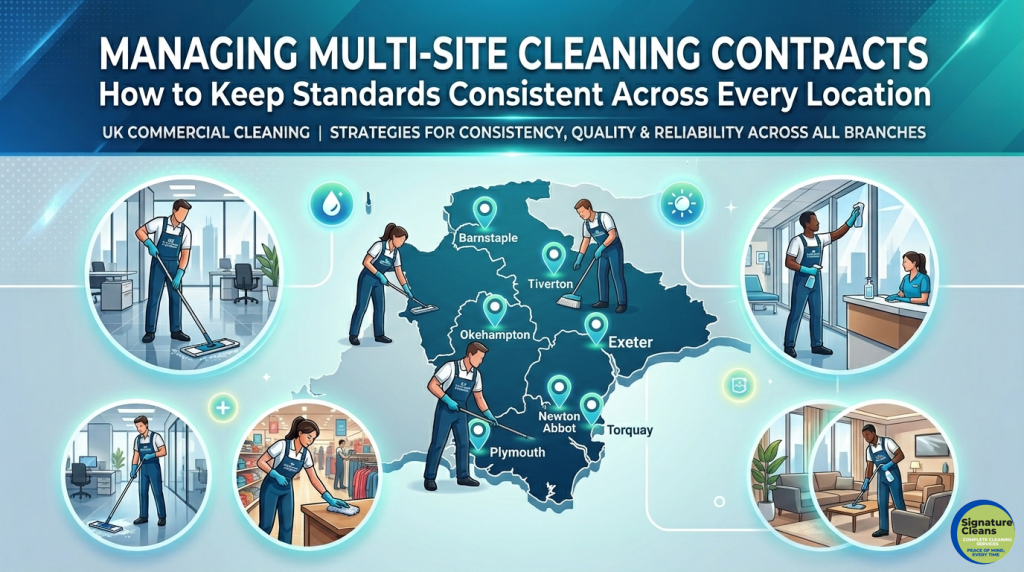
If you manage facilities across more than one site, you already know the challenge: keeping cleaning standards consistent when you can’t be everywhere at once. A head office might look immaculate while a satellite branch quietly deteriorates. Different cleaners interpret specifications differently. Communication breaks down between sites.
For businesses with multiple premises across Exeter and Devon, getting your contract cleaning right is one of the most practical steps you can take to protect your brand, your people, and your reputation. Here’s how to do it well.
Build a Core Specification That Scales — But Still Flexes
The foundation of consistent multi-site cleaning is a standardised core specification — a baseline that every location receives — combined with site-specific adjustments where needed. Think of it as your non-negotiables, with room built in for the quirks of each building.
A typical core specification might cover:
• Daily tasks – Vacuuming, surface wiping, kitchen cleaning, washroom sanitisation, and bin emptying at every location.
• Weekly tasks – Detailed dusting, internal glass cleaning, and hard floor mopping.
• Periodic tasks – Deep carpet cleaning, high-level dusting, and hard floor treatments on a monthly or seasonal schedule.
Site-specific factors — a busy public reception at one location, a workshop or laboratory at another — should be clearly documented as addendums to the core spec. That way, every cleaner at every site knows exactly what’s expected of them, with no room for interpretation.
Staff Management: The Human Side of Multi-Site Cleaning
Staff consistency is one of the biggest factors in cleaning quality — and one of the most overlooked. When the same operative works at the same site regularly, they learn the building. They know which meeting rooms get the most use, which kitchen is always busy on a Thursday, and which areas matter most to the client. That knowledge is hard-won, and it’s lost every time staff are rotated without good reason.
Effective multi-site staff management means:
• Dedicated site teams – Assigning regular staff to each location wherever possible, rather than drawing from a rotating general pool.
• Site-specific inductions – Covering not just the cleaning schedule but the practical details: alarm codes, restricted areas, security protocols, and client preferences.
• Pre-inducted cover arrangements – When regular staff are unavailable, cover cleaners should already know the site so they’re never walking in blind.
• Regular supervision – A mobile supervisor or area manager who visits each site on a scheduled basis, not just when a complaint comes in.
Communication: The Thread That Holds Multi-Site Cleaning Contracts Together
Poor communication is behind most multi-site cleaning failures. When an issue is raised at one location, it needs to reach the right person quickly and be resolved before it becomes a pattern. When standards change at one site, the rest need to know.
The most effective communication structures for multi-site cleaning contracts include:
1. A single point of contact – One account manager who understands all your sites and can coordinate across them. You should never be chasing different people for different locations.
2. Regular scheduled reviews – Monthly or quarterly meetings covering all sites, identifying trends and addressing issues before they escalate.
3. Digital communication tools – Shared platforms where site-specific issues can be logged, tracked, and resolved transparently.
4. Rapid escalation processes – A clear path for urgent issues that bypasses the normal review cycle when time is critical.
Quality Auditing at Scale: Don’t Wait for a Complaint
If regular auditing matters for a single site, it’s essential for multi-site operations. Without systematic quality checks, complaints become your only feedback mechanism — and by the time someone raises one, standards have usually been slipping for weeks.
An effective audit programme across multiple sites should include:
• Consistent scoring criteria – The same audit form and scoring system across all locations, so results are directly comparable.
• Regular frequency – Monthly audits at each location, with additional spot-checks on a rotating basis.
• Photographic evidence – Visual documentation that removes ambiguity and creates a clear, time-stamped record.
• Trend analysis – Reviewing scores over time to catch gradual decline before it becomes a serious problem.
• Shared reporting – Audit results communicated to the client promptly, with action plans for any areas that fall below standard.
Why a Single Provider Makes Commercial Cleaning Contracts Easier to Manage
Some multi-site businesses use different cleaning companies at different locations — often because each site was set up independently over time. While this can work, it creates significant management overhead and inconsistency risks that are easy to underestimate.
Consolidating into a single set of cleaning contracts across all your sites offers tangible advantages:
• One specification, one standard – A unified approach to quality across every location, with no gaps or grey areas.
• Simplified facilities management – One invoice, one contract, one point of contact. Less admin for your team.
• Better pricing – Multi-site contracts give cleaning companies room to achieve efficiencies in staffing, supplies, and logistics — savings that are passed on to you.
• Clear accountability – When one provider is responsible for everything, performance is transparent and measurable. There’s nowhere to shift blame.
• Knowledge sharing – Best practices discovered at one site can be rolled out across all locations quickly.
Getting Multi-Site Cleaning Right: The Bottom Line
Managing cleaning across multiple sites well comes down to the same principles as any operational challenge: clear specifications, good people, strong communication, and systematic quality control. The businesses that get their cleaning contracts right don’t just have cleaner premises — they have fewer complaints, stronger compliance, and one less operational headache to deal with.
If you’re currently juggling different providers across different sites, or finding it hard to maintain standards consistently, it may be time to review your approach. A single specialist provider with genuine multi-site experience can make a bigger difference than you might expect.