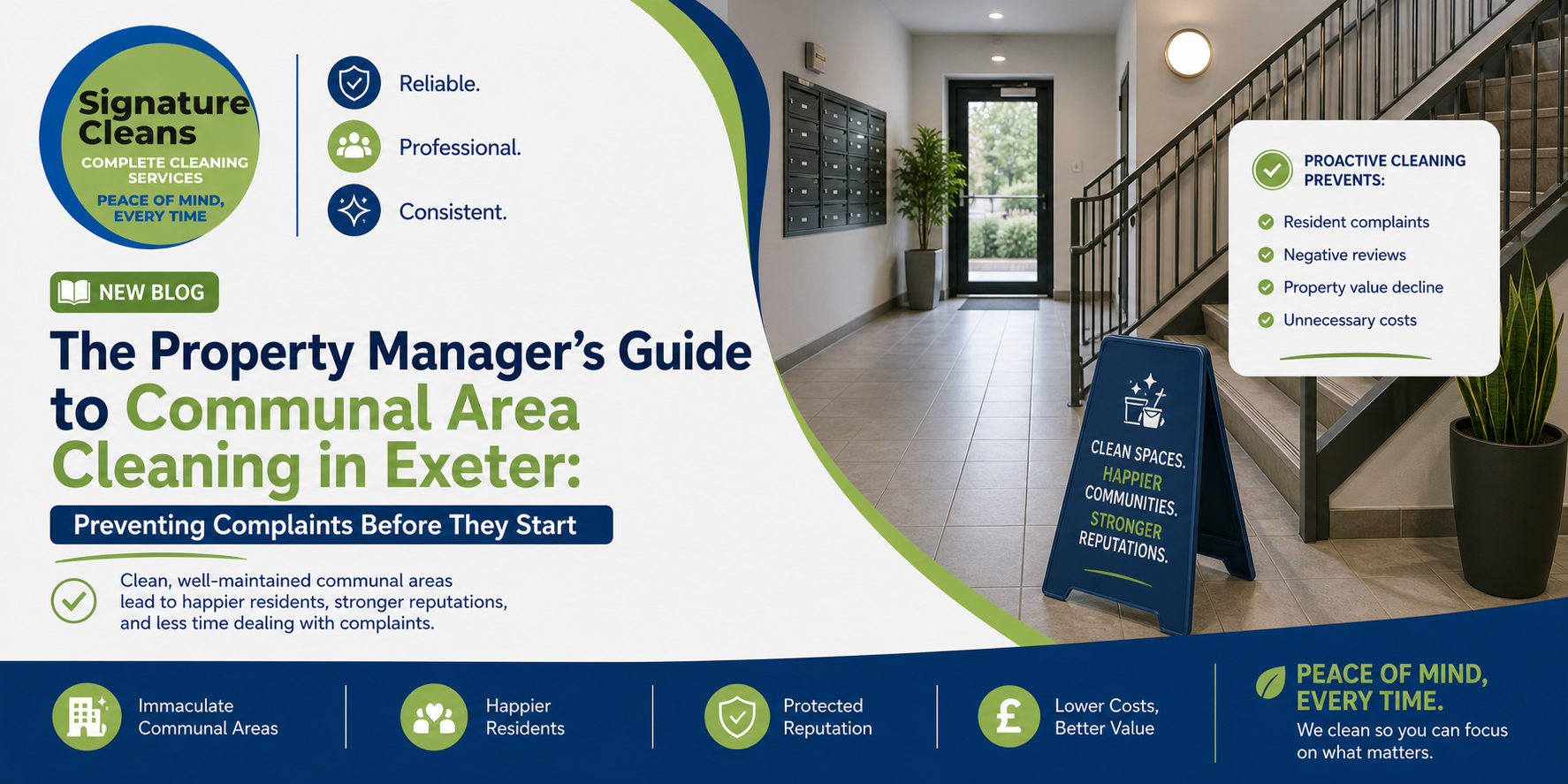
Where Resident Complaints Really Come From
Most complaints that land on a property manager's desk do not come out of nowhere. They build. A resident notices something once and says nothing. They notice it again and mention it to a neighbour. By the third or fourth time, they write an email — and that email rarely reflects only the single issue it describes.
In communal blocks and residential developments across Exeter and Devon, cleaning standards are consistently one of the primary triggers for resident dissatisfaction. Not the only trigger — but one of the most preventable. Missed visits, inconsistent results, poorly communicated schedules, and areas that get overlooked week after week gradually erode the trust that residents have in their managing agent or block manager.
This guide is for property managers and block managers who want to get ahead of that curve. It covers what professional communal area cleaning in Exeter should look like in practice, how to identify when standards are slipping before residents do, and what to look for in a cleaning provider that operates with the systems to sustain quality over time.
Q: What is communal area cleaning and why does it matter for property managers?
Communal area cleaning covers all shared spaces in a residential block or development — entrance halls, stairwells, lifts, corridors, bin stores, and car parks. For property managers, it matters because communal cleanliness is one of the most visible and frequently cited factors in resident satisfaction, service charge disputes, and block management reviews. Consistent communal cleaning directly reduces complaint volume and supports positive landlord-tenant relationships.
Where Complaints Start: The Anatomy of a Cleaning-Related Resident Complaint
The insight: Most complaints from residents don't come out of nowhere. They usually start with cleaning standards slipping — missed areas, inconsistent visits, poor communication. The goal is to prevent those issues before they arise.
Understanding how cleaning complaints develop is the first step to preventing them. In most cases, the complaint that reaches a property manager's inbox is not the beginning of the problem — it is the point at which a resident's tolerance ran out.
The typical complaint escalation pattern:
1. A cleaning visit is missed or abbreviated — a stairwell is skipped, a bin store is left unattended, a corridor is not mopped.
2. The affected area deteriorates visibly over the following days. Residents notice but assume it will be addressed on the next visit.
3. The next visit either misses the same area again, or catches it without addressing the accumulated buildup.
4. A resident raises the issue informally — to a neighbour, in a residents' group chat, or verbally to a concierge or building manager.
5. The issue is not resolved or communicated about, and a formal complaint is submitted — often accompanied by photographs.
6. The complaint now requires a response, an investigation, and potentially a service charge credit discussion. What began as a missed cleaning visit has become an hour or more of management time.
The pattern is consistent because the underlying cause is consistent: a cleaning contract without robust systems for tracking completion, flagging missed areas, and communicating proactively with the managing agent. The best providers of communal area cleaning in Exeter have these systems built into their operation — not bolted on as an afterthought.
Q: Why do residents complain about communal cleaning?
Residents most commonly complain about communal cleaning when visits are missed or inconsistent, when specific areas are repeatedly overlooked, when standards deteriorate between visits, or when there is no communication about schedule changes. Complaints rarely arise from a single incident — they typically reflect accumulated frustration over a period of weeks or months during which the issue went unaddressed.
Reactive vs. Proactive: The Systems That Separate Good Providers from Great Ones
The insight: Reactive cleaning means waiting for complaints. Proactive cleaning means preventing them. The difference is in the systems behind the service.
The distinction between reactive and proactive cleaning is not simply about attitude or effort. It is structural. A reactive cleaning operation responds to problems when they are reported. A proactive one has systems in place to identify and resolve issues before they become visible to residents — or to the property manager.
Reactive Cleaning
• Waits for a complaint before investigating missed areas
• Schedule is fixed regardless of seasonal or footfall changes
• Communicates with property manager only when problems arise
• Staff turnover leads to inconsistency as new cleaners learn the building
• No formal process for recording or escalating quality issues
• Property manager discovers issues through resident complaints
Proactive Cleaning
• Conducts regular documented audits between visits
• Schedule adapts to occupancy, seasons, and building usage patterns
• Provides regular completion reports and flags issues proactively
• Named operative assigned to the building with full site induction
• Structured quality management system with documented sign-off
• Property manager is informed before residents notice a problem
When evaluating any provider for block cleaning services in Exeter, the questions to ask are not simply about frequency or price. They are about systems: how does the provider track what was cleaned, how do they document quality, how do they communicate with you, and what happens when something is missed?
The systems a proactive provider should have in place:
• Digital visit logs with time-stamped completion records accessible to the property manager — not just a paper sign-in sheet in the communal cupboard.
• A named operative or small, consistent team assigned to each building, with a formal handover process when cover is required.
• A named account manager who conducts periodic site audits and communicates findings in writing — not just by phone.
• A clear escalation pathway: if a visit is missed or an issue is identified, who is notified, within what timeframe, and how is it resolved?
• A schedule review mechanism — at minimum annually, ideally quarterly — to ensure the cleaning programme reflects the current usage and condition of the building.
Q: What is the difference between reactive and proactive communal cleaning?
Reactive communal cleaning responds to complaints and visible problems after they occur. Proactive communal cleaning uses scheduled audits, documented completion records, and regular communication to identify and resolve issues before residents notice them. Proactive cleaning requires stronger operational systems — including digital visit logs, named operatives, and structured account management — and consistently produces better outcomes for property managers and residents alike.
When It Becomes Visible: Understanding the Threshold That Matters
The insight: If residents are noticing the cleaning, it usually means something has already gone wrong. The goal is to keep standards high enough that cleanliness is never the thing residents are thinking about.
There is a useful way to think about the standard a communal cleaning contract should aim for: if residents are actively aware of the cleanliness of their building — if they are noticing it, commenting on it, photographing it — then the cleaning programme has already fallen below the threshold that matters.
This is not to say that residents should be indifferent to their environment. It is to say that in a well-managed building with consistent communal area cleaning, cleanliness becomes invisible in the best possible sense. It is simply the baseline condition. Residents do not think about it because there is nothing to think about.
The moment it becomes visible — the moment a resident notices a mark on the wall that has been there for three weeks, or a lift that smells stale, or an entrance hall that looks tired — the threshold has already been crossed. The question at that point is not whether there is a problem. It is how long it has been building.
The areas most likely to trigger visibility-threshold complaints in residential blocks:
• Entrance halls and lobby areas: The first and last communal space residents pass through every day. Scuff marks on walls, dirty doormats, and fingerprinted glass panels accumulate quickly in high-footfall entrances.
• Stairwells and corridors: Often cleaned less frequently than entrance halls but used just as regularly. Cobwebs in upper corners, marks on handrails, and debris in stairwell corners are common early indicators of standard drift.
• Lifts: Enclosed, high-touch environments that deteriorate rapidly between cleans. Floor tracks, door surrounds, and panel surfaces are particularly prone to visible buildup.
• Bin stores and waste areas: Among the most complaint-generating areas in any residential block. Odour control, regular clearing of overflow, and floor washing are non-negotiable in a well-managed building.
• Car parks and external communal areas: Often treated as lower priority but frequently cited in resident feedback, particularly around litter, oil staining, and seasonal debris accumulation.
Q: Which communal areas in a residential block cause the most resident complaints?
The communal areas most frequently cited in resident complaints are bin stores and waste areas (odour and overflow), lift interiors (high-touch surfaces deteriorating quickly between cleans), entrance halls and lobby areas (visible daily to all residents), and stairwells and corridors (often undercleaned relative to their usage). Car parks and external areas are also common sources of complaints, particularly around litter and seasonal maintenance.
What a Professional Communal Cleaning Specification Should Cover
One of the most common gaps in communal cleaning contracts is the absence of a detailed, site-specific cleaning specification. A specification is not a schedule — it does not simply say how often a cleaner will visit. It says exactly what will be cleaned on each visit, to what standard, using what method, and how completion will be verified.
Without a specification, there is no objective basis for assessing whether a visit met the required standard. This makes quality conversations with a provider difficult and complaint investigations almost impossible to resolve fairly.
A robust communal cleaning specification for a residential block should include:
• A zone-by-zone breakdown of every communal area, with specific tasks listed for each zone on each visit frequency (daily, weekly, monthly, periodic).
• Surface-specific cleaning methods — distinguishing, for example, between hard floor mopping, carpet vacuuming, and entrance matting maintenance.
• High-touch surface protocols: door handles, lift call buttons, intercom panels, and handrails should be specifically listed with their required sanitisation frequency.
• Consumables management: toilet roll, soap, and hand sanitiser restocking in any communal washrooms should be clearly scoped and costed.
• Periodic deep clean items: high-level dusting, communal window cleaning (internal), bin store deep cleans, and carpet extraction should be listed with their frequency and included or excluded from the base contract.
• Verification method: how visit completion is recorded and made available to the property manager.
A provider offering communal area cleaning in Exeter who cannot produce or work to a specification of this detail is not operating at the level required for effective block management. This is a practical threshold, not an unreasonably high one.
Q: What should a communal area cleaning specification include?
A communal area cleaning specification should cover: a zone-by-zone task list for every communal space; surface-specific cleaning methods; high-touch surface sanitisation protocols (door handles, lift buttons, handrails); consumables management; periodic deep clean items with frequencies; and a defined verification method for recording visit completion. Without a written specification, there is no objective standard against which to assess service quality or investigate complaints.
Choosing the Right Provider: What Property Managers in Exeter Should Look For
Not all commercial cleaning companies have the experience or operational infrastructure to manage communal residential contracts effectively. The requirements are distinct from office or retail cleaning — not harder, but different. When evaluating providers, property managers should look specifically for the following:
Residential block experience
Ask for examples of comparable contracts — ideally residential blocks or mixed-use developments of a similar size and tenure type. A provider experienced in communal residential environments understands the sensitivities of cleaning occupied buildings: working around residents, respecting quiet hours, handling access responsibly, and communicating professionally when issues arise.
Relevant accreditations
As with any commercial cleaning contract, the accreditation baseline matters. Look for SSIP accreditation (independent health and safety assessment), CQMS verification (quality management systems), and PQS certification. Providers holding all three — such as Signature Cleans — have been independently assessed against professional standards that many companies simply self-declare. ISO 9001 certification and confirmed public liability insurance of at least £5 million should accompany these.
DBS-checked and consistently assigned staff
Communal residential cleaning involves access to occupied buildings, often outside of business hours. All staff should be DBS-checked as standard. Equally important is consistency: a named operative or small regular team assigned to your building builds familiarity with the site, reduces the risk of missed areas, and creates accountability that rotating agency staff cannot provide.
Transparent reporting and communication
Your cleaning provider should be able to tell you, at any point, what was cleaned on the last visit, by whom, and at what time. Digital visit logs accessible to the property manager are now a standard expectation for professional block cleaning services. Regular written reports — not just phone calls — create the audit trail you need if a complaint ever requires investigation.
A contract structure that protects your position
Review the contract carefully before signing. Notice periods, price review clauses, scope change processes, and complaint resolution procedures should all be clearly defined. A provider confident in their service will offer fair, transparent terms — not clauses designed to make it difficult to exit if standards slip.
Q: How do I choose a communal area cleaning company in Exeter?
When choosing a communal area cleaning company in Exeter, prioritise providers with demonstrable residential block experience, SSIP, CQMS, and PQS accreditations, DBS-checked and consistently assigned staff, digital visit logging and transparent reporting, and a detailed site-specific cleaning specification. A named account manager who conducts regular audits is essential for maintaining standards over the duration of the contract.
The Service Charge Dimension: Why Cleaning Standards Have Financial Consequences
For property managers operating under a service charge structure, communal cleaning is not merely a quality issue — it is a financial one. Residents paying a service charge have a legal right to expect that the services included are delivered to a reasonable standard. When cleaning standards fall short, the consequences extend beyond complaints.
• Section 20 and service charge disputes: Poor communal cleaning is among the most commonly cited justifications in service charge challenges brought to the First-tier Tribunal (Property Chamber). A well-documented, professionally delivered cleaning contract is a practical defence against such challenges.
• RICS compliance: Property managers operating under RICS accreditation are expected to procure services to a demonstrable standard of value and quality. A communal cleaning contract with no written specification and no audit trail does not meet that standard.
• Lease obligations: Many residential leases include specific obligations on the landlord or managing agent regarding the maintenance of communal areas. Persistent cleaning failures can constitute a breach of lease, with associated legal exposure.
• Property value and saleability: Communal areas form part of a leasehold property's overall condition and presentation. A well-maintained block commands stronger valuations and sells more quickly than one with visible maintenance deficits.
For block managers in Exeter and Devon, the decision to invest in professional, accredited communal area cleaning services is therefore not purely operational. It is risk management.
Q: Can poor communal cleaning lead to service charge disputes?
Yes. Poor communal cleaning is a frequent basis for service charge challenges at the First-tier Tribunal (Property Chamber). Residents paying a service charge are entitled to expect services delivered to a reasonable standard, and persistent cleaning failures — particularly where no written specification or completion records exist — are difficult to defend. A professionally contracted, accredited communal cleaning service with documented quality management significantly reduces this exposure.
Frequently Asked Questions
Q: How often should communal areas in a residential block be cleaned?
Frequency depends on the size of the block, the number of residents, and the type of communal areas involved. As a general guide: entrance halls and lifts in medium to large blocks benefit from daily or five-day-a-week cleaning; stairwells and corridors typically require two to three visits per week; bin stores should be cleaned at least weekly; and car parks and external areas are usually maintained fortnightly or monthly. A site-specific assessment is the only reliable basis for determining the right schedule.
Q: Who is responsible for communal area cleaning in a leasehold block?
In most leasehold residential blocks, responsibility for communal area cleaning sits with the freeholder, the residents management company (RMC), or the appointed managing agent — depending on the terms of the lease. The cost is typically recovered through the service charge. Property managers acting on behalf of freeholders or RMCs are responsible for procuring and overseeing the cleaning contract to the standard required by the lease and applicable legislation.
Q: What accreditations should a communal cleaning company hold?
For communal residential cleaning, look for SSIP accreditation (health and safety), CQMS verification (quality management), and PQS certification (pre-qualification standard covering insurance, financials, and H&S policies). ISO 9001 quality management certification and public liability insurance of at least £5 million are additional markers of a professionally operated company. BICSc affiliation indicates ongoing investment in staff training and cleaning standards.
Preventing Problems Before They Arise: The Standard That Matters
The most effective communal cleaning programme is one that residents never have to think about. Not because the work is invisible — it is being done, carefully and consistently — but because the standard is high enough that there is nothing to notice, nothing to photograph, and nothing to complain about.
Achieving that standard requires more than good intentions from a cleaning operative. It requires a provider with the right systems, the right accountability structures, and the right operational discipline to deliver consistently — on the first visit of the contract and on the hundredth.
For property managers and block managers across Exeter and Devon, the investment in professional, accredited communal area cleaning in Exeter is one of the most direct levers available for reducing complaint volume, protecting service charge income, and maintaining the resident relationships that make block management sustainable.
Proactive is always better than reactive. And the time to put the right contract in place is before the first complaint arrives — not after.
Ready to put a proactive cleaning programme in place?
We work with property managers and block managers across Exeter and Devon to deliver consistent, accredited communal area cleaning with full digital reporting and a named account manager for every contract. Get in touch for a free site assessment and tailored cleaning proposal.
Ready for better cleaning?
Signature Cleans provides tailored commercial cleaning across Exeter and Devon. Get in touch for a free, no-obligation quote.
Get a Quote