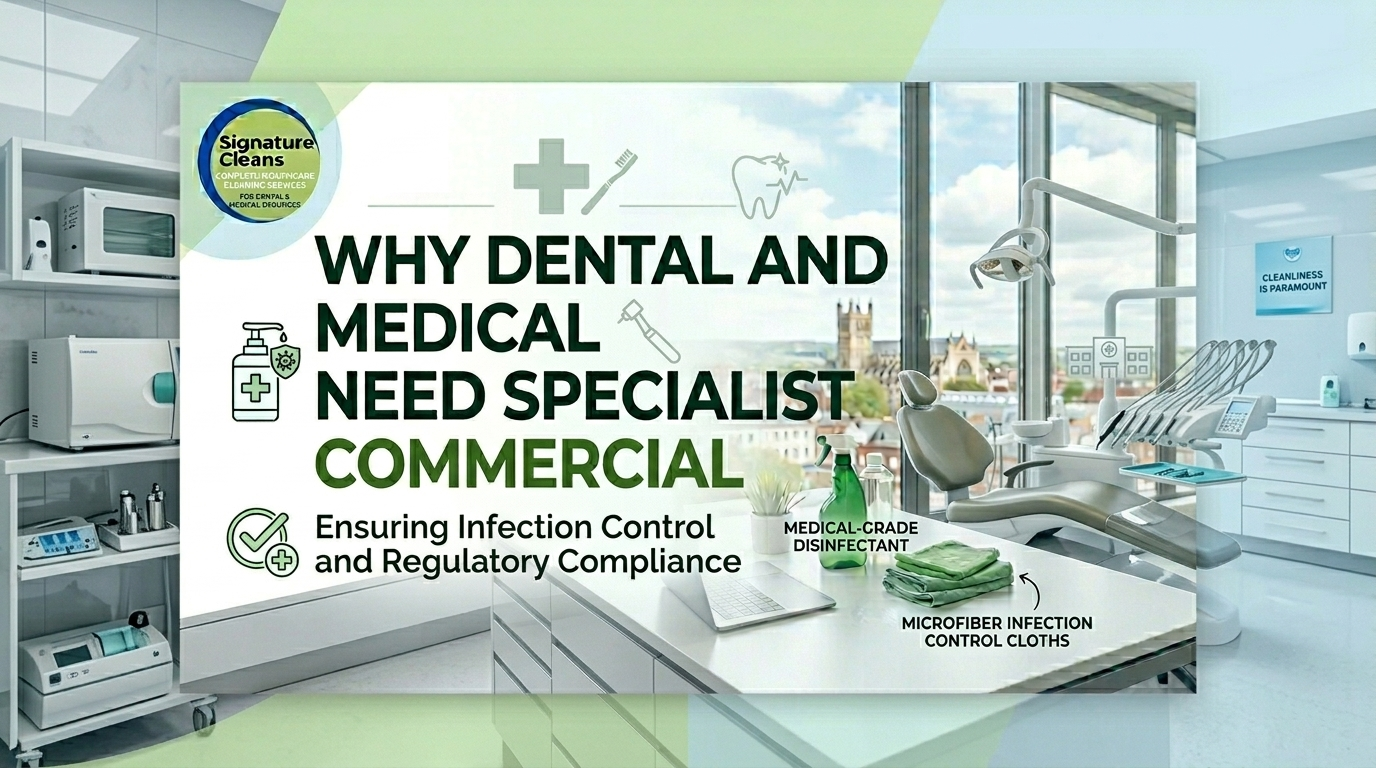
Cleaning a dental surgery or medical practice is nothing like cleaning a standard office. The stakes are simply higher. Inadequate hygiene in a clinical setting doesn't just look bad — it can lead to healthcare-associated infections, CQC compliance failures, and real risk to the patients and staff you're responsible for.
For practice managers across Exeter and Devon, investing in the right commercial cleaning services isn't optional — it's a core part of running a safe, compliant practice. Here's what you need to know.
CQC Standards and What They Mean for Your Cleaning Provider
The Care Quality Commission inspects practices against five key questions. Cleanliness sits firmly under the "Safe" domain — and inspectors don't just take your word for it. They expect documented evidence that your premises meet appropriate infection prevention and control (IPC) standards.
In practical terms, your commercial cleaning services provider needs to demonstrate:
• Written cleaning schedules – Detailed task lists specifying what is cleaned, how often, and to what standard, covering every room and surface type.
• Appropriate chemical selection – Use of hospital-grade disinfectants that are effective against the pathogens relevant to your clinical environment.
• Staff training records – Evidence that cleaning operatives have received IPC training specific to healthcare environments.
• Audit trails – Regular documented checks confirming that cleaning standards are consistently maintained.
A generic cleaning company using off-the-shelf products and untrained staff simply won't meet these requirements. If your cleaning fails during a CQC inspection, the consequences can range from a formal action plan to enforcement notices — neither of which you want to be dealing with.
Clinical vs Non-Clinical Areas: Why One-Size-Fits-All Doesn't Work
One of the most common mistakes practices make is treating the entire premises the same way. Effective professional office cleaning and healthcare cleaning are not the same thing — and a specialist provider will clearly distinguish between different zones.
Clinical Areas (Surgeries, Treatment Rooms)
These spaces need the highest level of attention. Surfaces must be decontaminated between patients, floors cleaned with dedicated mops that are never used elsewhere, and clinical waste segregated and disposed of in line with HTM 07-01 guidelines. High-level surfaces and air vents also need regular scheduled attention, since airborne contaminants settle on them over time.
Semi-Clinical Areas (Decontamination Rooms, Labs)
These areas handle contaminated instruments and materials, so cleaning must account for potential exposure to blood-borne pathogens. Your cleaning team needs to understand the workflow in these rooms to avoid interfering with instrument processing.
Non-Clinical Areas (Reception, Waiting Rooms, Offices)
Even here, healthcare-specific considerations apply. Waiting room chairs and reception desks — where patients sign in, hand over documents, and make payments — are high-touch surfaces that need regular sanitisation. Washrooms in clinical environments must meet a higher hygiene standard than a typical office environment.
Colour-Coded Cleaning: The Industry Standard for Preventing Cross-Contamination
Cross-contamination is the single biggest hygiene risk in a clinical setting. The industry-standard solution is a colour-coded system for all cloths, mops, and buckets:
• Red – Washrooms and sanitary areas
• Blue – General low-risk areas (offices, corridors)
• Green – Kitchen and food preparation areas
• Yellow – Clinical areas and isolation rooms
It sounds straightforward, but without a rigorous colour-coded protocol and trained staff who follow it every single time, cross-contamination is more likely than you'd think. When evaluating commercial cleaning services for your practice, always ask providers to walk you through their colour-coding protocol — and how they enforce it.
Training and Competency: What Specialist Cleaners Should Know
Cleaning operatives working in dental and medical environments need training that goes well beyond standard janitorial services. At a minimum, your provider's team should be trained in:
• Infection prevention and control principles – Understanding how infections spread and the role cleaning plays in breaking the chain of transmission.
• COSHH awareness – Healthcare cleaning chemicals are more potent than standard products. Staff need to understand safe handling, correct dilution rates, and contact times.
• Clinical waste recognition – Knowing the difference between clinical and domestic waste, and the correct disposal route for each.
• Blood and bodily fluid spill procedures – A documented protocol for dealing with spills safely, including spill kits and proper use of personal protective equipment.
• Hand hygiene protocols – Cleaners working in clinical spaces should follow the same hand hygiene standards as clinical staff.
The Documentation That Protects Your Practice
In a regulated environment, what you can prove matters just as much as what you do. A quality commercial cleaning services provider should supply documentation that stands up to scrutiny — whether that's a CQC inspection, a complaint, or an incident investigation.
Here's what to ask for:
• Signed cleaning schedules – Completed and signed after every visit, confirming all specified tasks were carried out.
• Chemical data sheets – COSHH assessments for every product used on your premises.
• Training certificates – Evidence of IPC training for every operative working in your practice.
• Audit reports – Regular quality checks with scored assessments and photographic evidence.
When CQC inspectors arrive, having this pack readily available demonstrates that you take infection control seriously. It also shows that the commercial cleaning services you've invested in are delivering real, evidenced results — not just a clean-looking surface.
Choosing the Right Cleaning Partner for Your Practice
Not every cleaning company is equipped to work in a dental or medical environment — and the difference really matters. When you're evaluating providers, look beyond price. Ask about their healthcare-specific training, their IPC protocols, their colour-coded systems, and the documentation they provide as standard.
The right commercial cleaning services partner won't just keep your practice looking presentable. They'll help you protect your patients, support your CQC compliance, and give you one less thing to worry about when inspection day comes around.
Ready for better cleaning?
Signature Cleans provides tailored commercial cleaning across Exeter and Devon. Get in touch for a free, no-obligation quote.
Get a Quote