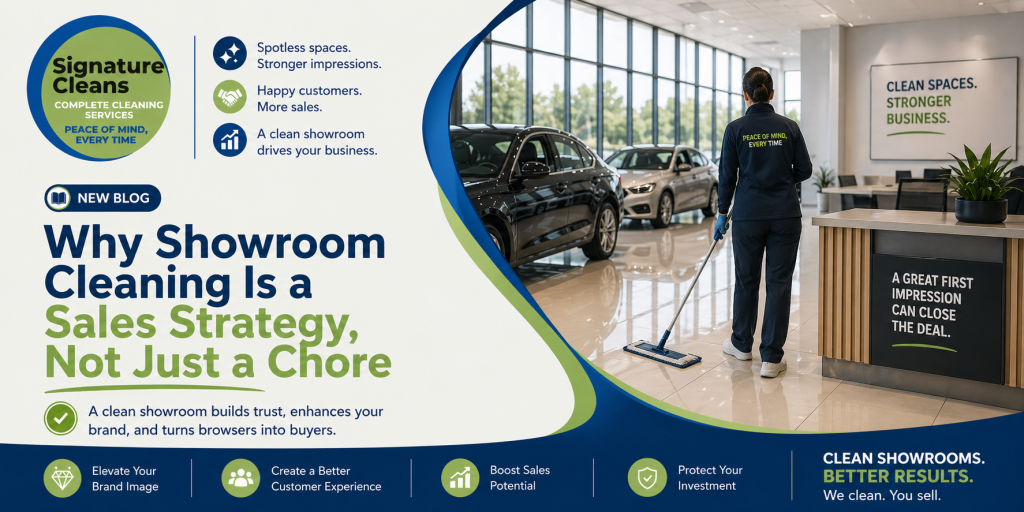
The Detail That Changes Everything
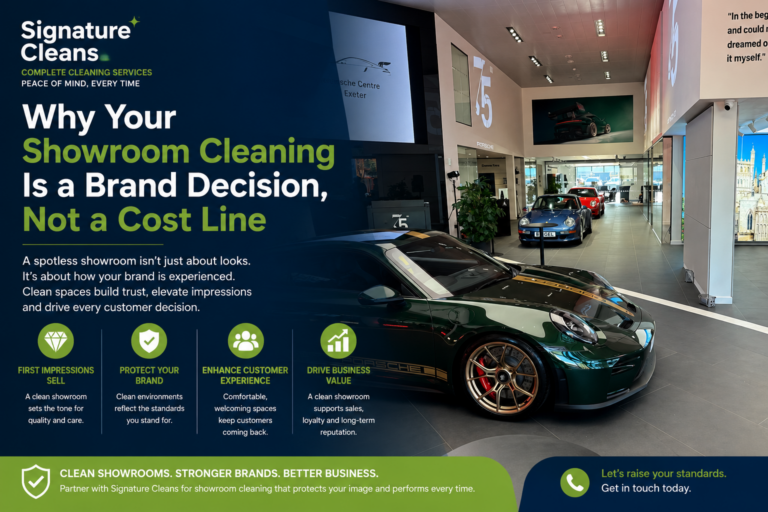
In most professional environments, a missed cleaning detail is inconvenient. In a car showroom, it is immediately visible because everything else around it has been engineered to be perfect.
The vehicles on your floor are polished, positioned, and lit with precision. The signage is considered. The customer journey has been mapped. And then a customer notices a dusty sill, a smeared glass panel, or a scuff mark on the floor near a vehicle priced at £60,000.
That single detail does not just create an eyesore. It creates doubt. And in a high-value retail environment, doubt is the last thing you want in a customer’s mind at the moment they are considering a purchase.
This is why showroom cleaning in Exeter is not a support function to be managed on a budget. It is an active component of your sales environment and it deserves the same standard of thinking that goes into every other element of your customer experience.
Why is professional showroom cleaning important for car dealerships?
A car showroom is a precision-engineered retail environment. Every surface, finish, and detail communicates the quality of the brand and builds or erodes customer confidence. Professional showroom cleaning ensures that the physical environment consistently matches the premium standard of the vehicles on display, directly supporting customer trust and purchase decisions.
The Disconnect That Customers Feel (Even If They Can’t Explain It)
A spotless car sitting in a dusty showroom creates a disconnect and customers feel it, even if they cannot articulate why.
Customers who walk into a car showroom are not consciously evaluating the cleanliness of the floor, the glass, or the display surfaces. But they are subconsciously processing all of it.
Decades of consumer psychology research confirm that environmental cues shape perception of quality and value. When those cues are inconsistent, a gleaming vehicle surrounded by a space that feels tired or overlooked, the premium experience fractures. The customer may not be able to tell you what felt wrong. They will simply feel less confident about the brand, less certain about the price, and less likely to commit.
Consistency across the entire environment is what creates and sustains a premium experience. This is not a marketing observation, it is a practical sales one. And it is why the standard applied to your showroom cleaning in Exeter must match the standard applied to every other element of your customer environment.
The areas that matter most to customer perception:
• Showroom floor: Particularly around and beneath vehicles. Visible dust, scuff marks, or product residue near a display vehicle directly undermines its presentation.
• Glass and glazed surfaces: Fingerprints on showroom glass, smeared panels, or cloudy display cases are among the most immediately noticeable imperfections in a retail environment.
• Reception and waiting areas: Often the first indoor environment a customer encounters. A relaxed, clean, and well-presented waiting space builds confidence before a salesperson has said a word.
• Restrooms: Consistently rated as the single strongest indicator of a business’s broader standards by retail consumers. A well-maintained restroom signals care and professionalism throughout.
• Handover bays and delivery areas: The moment of vehicle collection is a high-emotion touchpoint. The environment around it should reinforce the quality of the product being handed over.
Which areas of a car showroom need the most cleaning attention?
The highest-impact areas for car showroom cleaning are: the main showroom floor (especially around display vehicles), glass partitions and display surfaces, reception and customer waiting areas, restrooms, and handover bays. These are the spaces that most directly shape customer perception of brand quality and professionalism.
Attention to Detail Is Not Optional in a Premium Environment
In most environments, a missed detail goes unnoticed. In a showroom, where everything else is designed to be perfect, it stands out immediately.
Attention to detail in showroom cleaning is not a philosophy; it is a practical discipline. It means cleaning to a specification that accounts for every surface type, every traffic pattern, and every touchpoint that a customer might interact with during their visit.
It also means understanding that some areas require different approaches entirely. A standard mop-and-bucket routine appropriate for an office kitchen is not sufficient for an automotive showroom floor. Polished concrete, large-format porcelain, and resin floors each require specific techniques and products to maintain their finish without causing damage. The wrong cleaning product on the wrong surface can cause micro-scratching, dulling, or chemical staining that accumulates invisibly over time, until one day the floor simply does not look the way it used to.
What genuine attention to detail looks like in practice:
• Surface-specific products: Automotive-grade glass cleaners, pH-neutral stone and tile treatments, and non-abrasive solutions for finished metal and chrome display fixtures.
• Detailing-level focus around vehicles: Every wheel arch, tyre sidewall, and floor panel surrounding a display car treated as part of the vehicle presentation, not just as floor space.
• Microfibre-first methodology: Microfibre cloths and pads trap dust and debris rather than redistributing them, critical in an environment where airborne particles settling on vehicle paintwork are both a visual and a practical problem.
• Consistent finishing: Glass and reflective surfaces finished streak-free and checked under showroom lighting, not just under ambient light.
• Signage and branded elements: Display stands, brand pillars, and model signage cleaned and maintained to the same standard as the physical environment around them.
What cleaning products are safe to use in a car showroom?
Car showrooms require surface-specific cleaning products: pH-neutral solutions for stone, resin, and polished concrete floors; automotive-grade glass cleaners for glazed surfaces and showroom windows; non-abrasive treatments for chrome and metallic display fixtures; and microfibre-based systems to prevent particulate redistribution near vehicle paintwork. Generic all-purpose cleaners risk surface damage in high-finish environments.
How Standards Slip and Why You May Not Notice Until It Is Too Late
Like any service, showroom cleaning can slip over time. Missed areas. Rushed jobs. Inconsistent results. In a premium environment, that deterioration is visible straight away.
Service drift is one of the most common and least-discussed problems in commercial cleaning contracts. It rarely happens suddenly. Instead, it accumulates: a corner cut here, an area rushed there, a periodic deep clean that gets quietly deprioritised. Each individual slip is small. The cumulative effect, over weeks and months, is a showroom that has slowly stopped looking the way it should.
The challenge for showroom managers is that the drift is often invisible to those who see the space every day. Familiarity dulls perception. Your team stops noticing that the window line near the entrance has a faint residue, or that the floor around one display vehicle looks slightly duller than the rest. Your customers, arriving fresh, with no prior reference point, notice immediately.
Warning signs that your cleaning standards have drifted:
• Vehicles on the floor appear dusty within hours of opening, suggesting floor and surface cleaning is redistributing rather than removing particulates.
• Glass surfaces carry faint smear lines visible in certain lighting conditions.
• The showroom floor looks clean in photographs but dull in person, particularly under the direct lighting around display vehicles.
• Customer waiting areas feel slightly tired; chairs misaligned, cushions not reset, surfaces wiped rather than detailed.
• Restrooms are technically clean but not to the finishing standard expected of a premium brand environment.
• Your team has stopped commenting on the cleaning, which can indicate they have stopped expecting much of it.
The solution is not simply to ask your current provider to try harder. It is to implement a structured quality audit process: regular documented checks, clear pass/fail criteria, and a named account manager accountable for standards. The best providers of commercial showroom cleaning in Exeter will have this process built in from day one — not introduced as a reaction to complaints.
How do I maintain consistently high cleaning standards in a car showroom?
Consistent showroom cleaning standards require three things: a detailed cleaning specification that accounts for every surface and zone; a structured audit process with documented checks and clear pass/fail criteria; and a named account manager who visits the site regularly and is accountable for results. A cleaning provider who cannot offer all three is operating without the infrastructure to deliver consistency over time.
What to Look for When Choosing a Showroom Cleaning Provider in Exeter
Not every commercial cleaning company is equipped to work in a premium automotive environment. The skills, products, and mindset required for effective showroom cleaning in Exeter are different from those needed for general office cleaning or industrial cleaning. When evaluating providers, look specifically for:
Demonstrable Experience in High-Finish Retail or Automotive Environments
Ask for examples of comparable contracts, ideally automotive showrooms, luxury retail, or other environments where surface finish and presentation are central to the client’s business. A provider without this background may have the willingness but not the specific knowledge to protect your floors, glass, and fixtures.
Accreditations That Signal Professional Standards
As a minimum, look for SSIP accreditation (independent health and safety assessment), CQMS verification (quality management systems), and PQS certification. These three procurement standards, held by providers such as Signature Cleans, represent a meaningful threshold of operational professionalism. Pair these with ISO 9001 certification and confirmed public liability insurance of at least £5 million.
A Tailored Cleaning Specification, Not a Standard Package
Your showroom has a specific floor type, a specific lighting environment, a specific customer journey, and specific display configurations. Your cleaning specification should reflect all of these. A provider who offers a one-size-fits-all package without conducting a site survey first is not yet thinking at the level your environment requires.
Flexibility Around Your Trading Hours and Customer Schedule
Showroom cleaning typically needs to happen outside of customer-facing hours, early morning, evening, or overnight. Your provider must be able to operate reliably within those windows, and must be able to scale quickly before events, launches, or peak trading periods. Ask explicitly how they handle schedule changes and what their response time is for urgent requests.
A Named Account Manager With Regular Site Presence
The single most reliable predictor of sustained cleaning quality is a named individual who visits your site regularly, conducts documented audits, and is personally accountable for standards. Without this, even the best initial setup will drift over time.
What should I look for in a showroom cleaning company in Exeter?
Look for a provider with demonstrable experience in premium automotive or retail environments, relevant accreditations (SSIP, CQMS, PQS, ISO 9001), a tailored cleaning specification developed after a site visit, and a named account manager who conducts regular audits. Flexibility around trading hours and a documented quality audit process are equally important for a high-standard environment.
The Business Case: What a Clean Showroom Actually Delivers
The return on investment from a consistently clean, well-presented showroom is difficult to measure in isolation, but it is not difficult to reason about. Consider what the alternative costs.
• A customer who leaves without purchasing because something felt wrong about the environment: you may never know that the state of the showroom contributed to that decision, but the research on environmental cues in high-value retail is unambiguous.
• A social media post or Google review citing the state of the premises: in an era where a single review shapes the perception of dozens of future prospects, the reputational cost of a negative comment about cleanliness significantly outweighs the cost of preventing it.
• Staff morale and performance: employees who work in a well-maintained, professional environment report higher engagement and are more likely to hold themselves to a higher standard of presentation and conduct. Environment is contagious in both directions.
• Brand alignment: if your franchise agreement includes showroom standards audits, as many do, a consistent professional cleaning programme is not optional. It is a contractual necessity.
Against these costs, the investment in professional showroom cleaning in Exeter through an accredited, experienced provider is straightforward to justify. The question is not whether you can afford it. It is whether you can afford not to take it seriously.
Frequently Asked Questions
How often should a car showroom be professionally cleaned?
Most car showrooms require a daily clean covering all customer-facing areas; showroom floor, glass, reception, and restrooms, with a more intensive weekly or fortnightly deep clean addressing floor maintenance, high-level surfaces, and detail-level attention to display areas. The precise schedule should be determined by opening hours, footfall patterns, and the specific surface types in your showroom.
Can standard commercial cleaners work in a car showroom environment?
General commercial cleaners can handle basic cleaning tasks but may lack the specific knowledge required for premium automotive environments, particularly around appropriate products for high-finish floors, glass treatments, and cleaning protocols near vehicle paintwork. For a brand-standard result, a provider with specific experience in showroom or high-finish retail environments is strongly recommended.
How do I prevent cleaning products from damaging showroom floors?
Always use pH-neutral cleaners on polished concrete, resin, and large-format tile floors. Avoid acidic or alkaline products that can strip sealants or cause micro-etching over time. Test new products on a discrete area before full application, and ensure your cleaning provider can confirm the suitability of every product they use for your specific floor finish. Annual or biannual floor maintenance treatments will help preserve appearance and longevity.
The Same High Standard, Every Day
The three principles at the heart of effective car showroom cleaning are simple to state and genuinely difficult to sustain at scale: attention to detail that matches the environment, consistency that does not erode over time, and a standard that remains the same on a quiet Tuesday morning as it does before a major launch event.
Achieving all three requires more than good intentions. It requires the right provider, the right specification, the right audit process, and the right accountability structure. For car showroom managers across Exeter and Devon who are serious about their customer environment, that investment is not a luxury.
Ready to raise the standard in your showroom?
Whether you are reviewing your current cleaning contract or starting from scratch, we offer a free, no-obligation site assessment tailored to automotive and premium retail environments across Exeter and Devon. Get in touch to arrange a visit from our specialist showroom team.