Is Your Dental or Medical Practice Getting the Cleaning Standard It Deserves?
Quick answer
A dental or medical practice cleaning service should be CQC-aligned, use EN-certified clinical disinfectants, operate a colour-coded equipment system, and provide a documented audit trail for inspection purposes. A general commercial cleaning company is not equipped to deliver this, and using one in a registered clinical setting carries infection control and regulatory compliance risk. Practice managers reviewing their current provider should assess compliance credentials and documentation, not just cleaning frequency and cost, before deciding whether to stay, renegotiate, or switch.
Three Questions Every Practice Manager Should Be Able to Answer About Their Cleaning
Clinical environments are held to a different standard than commercial ones, not by preference, but by regulation. The CQC’s Fundamental Standards, the NHS National Standards of Healthcare Cleanliness 2025, and COSHH legislation all place specific obligations on how cleaning is carried out in registered healthcare settings. The cleaning company you use either meets those obligations or it doesn’t.
1. Are standards consistent day to day, or does the practice look noticeably different depending on who cleaned it last?
2. Is your current provider able to produce EN-certified product data sheets and a written COSHH risk assessment for every chemical used on your premises?
3. Could you demonstrate a documented cleaning audit trail if the CQC requested evidence of your infection control processes today?
If any of these drew a blank, it’s not necessarily the fault of the person doing the cleaning. It’s a structural issue with the contract, and in a clinical setting, structural issues with the cleaning contract carry regulatory consequences that go beyond a missed bin or a smudged surface.
The risk of staying with a provider you don’t fully trust in a clinical setting is not abstract. It includes CQC inspection findings, infection control failures, and most visibly to patients, a practice environment that contradicts the standard of care being delivered inside it.
Why Staying With the Wrong Provider is the Bigger Risk?
Switching cleaning providers can feel like an operational risk, notice periods, new faces, a period of adjustment. These are real concerns, and they deserve a real answer. But they sit alongside a different question: what is the cost of staying with a service you don’t fully trust in a setting where the cleaning standard is a patient safety and compliance matter?
The visible risk: what patients see
Patients use the cleanliness of a dental or medical environment as a direct proxy for its clinical quality. Research consistently shows that visible dirt, staining, or poor presentation in waiting rooms, treatment areas, and washrooms reduces patient confidence, even when the quality of care is high. In an environment where trust is everything, a cleaning standard that doesn’t match your clinical standard undermines the impression your practice works hard to create.
The compliance risk: what the CQC sees
CQC inspections assess infection prevention and control as a core regulatory requirement under Fundamental Standard 15: Safe Care and Treatment. Inspectors look for evidence that cleaning is being carried out to a documented, consistent standard, not just that the practice looks presentable on the day. A cleaning provider who cannot supply audit documentation, COSHH records, or a site-specific cleaning specification is leaving your practice exposed at precisely the point where evidence is required.
CQC Fundamental Standard 15
Registered providers must assess the risk of, and prevent, detect and control the spread of infections. Cleaning is a core component of this obligation. The CQC expects to see documented processes, not just a clean environment, when assessing compliance.
The operational risk: what staff experience
Inconsistent cleaning creates operational friction that practice managers absorb daily, fielding complaints, arranging extra cleans ahead of inspections, re-briefing a different person each week who doesn’t know the site. In a clinical environment, where staff time and attention should be on patient care, this overhead is both avoidable and costly.
General Commercial Cleaning vs. Qualified Clinical Cleaning
The gap between a general commercial cleaning contractor and a provider qualified to clean registered clinical settings is not a matter of effort or frequency; it’s a matter of training, products, systems, and documentation.
Standard
⚠ General commercial provider
✓ Qualified clinical provider
Products
General-purpose disinfectants, no EN certification
EN 1276/EN 13697-certified clinical disinfectants with specified contact times
Equipment system
Shared cloths and mops across zones
NHS colour-coded equipment — separate sets per zone to prevent cross-contamination
Audit trail
No documentation provided
Digital or written audit trail per visit, available for CQC inspection
CQC alignment
No awareness of Fundamental Standards
Cleaning spec built around CQC Fundamental Standard 15: Safe Care and Treatment
NHS Standards
Not referenced
Aligned to NHS National Standards of Healthcare Cleanliness 2025 (FR3–FR4)
COSHH compliance
Verbal assurance only
Written COSHH risk assessments for all clinical products used on site
Named account manager, proactive reporting, monthly scored audits
A general commercial cleaning company operating in a dental or medical practice is not automatically doing anything wrong, but it is operating without the systems that clinical compliance requires. That gap tends to be invisible until it matters, at which point it matters considerably.
What medical practice cleaning should include?
Professional medical and dental practice cleaning requires EN 1276 and EN 13697-certified clinical disinfectants with specified contact times, NHS colour-coded equipment systems to prevent cross-contamination between zones, a documented audit trail per visit for CQC inspection purposes, and staff trained in infection control and decontamination procedures. These requirements distinguish qualified clinical cleaning from standard commercial cleaning, which does not include these elements as standard.
What it Looks Like When the Cleaning Reflects the Care?
A dental or medical practice that has invested in a properly specified clinical cleaning contract sees a consistent effect: the environment reflects the standard of the work being done inside it. Treatment rooms are visibly clinical. Reception areas are presented to a standard patients notice. Washrooms are reliably stocked and sanitised. The practice manager isn’t thinking about cleaning because the cleaning doesn’t require intervention.
That consistency is not incidental. It’s the result of a specific set of structural elements:
Structural element
What it delivers
Named, consistent team
The same people attend every visit — they know the site, the clinical zones, the access protocols, and the patient-facing areas that require particular attention
Site-specific specification
A written cleaning programme built around your practice’s layout, clinical zones, Functional Risk categories and CQC obligations, not a generic commercial checklist
Colour-coded equipment
Separate, dedicated equipment per zone prevents cross-contamination between clinical and non-clinical areas as standard, not as an add-on
Documented audit trail
A written or digital record of every clean, shared with the practice manager and available for CQC inspection without advance preparation
EN-certified clinical products
COSHH risk assessments for every product used on site, with evidence of certification available on request
Proactive communication
Issues flagged by the provider before a complaint is raised, not reactive responses to problems the practice has already noticed
Switching to a Qualified Clinical Cleaning Provider
The concern about switching providers is almost always about the transition period — a gap in service, a disruption to clinical routines, time spent re-briefing. A properly structured handover eliminates all three.
Handover stage
What happens
Step 1: Free site assessment
A director visits within 48 hours to scope the premises, understand your clinical zones, and assess your CQC compliance requirements before any proposal is made
Step 2: Documented specification
A written cleaning programme covering each area, frequency, product selection, colour-coding system and audit format, agreed and signed off before the first clean
Step 3: Team onboarding
A named, vetted team is trained specifically to your site’s protocol before their first visit — including infection control, COSHH procedures and clinical zone awareness
Step 4: First clean and sign-off
The first clean is conducted to the agreed specification, documented, and reviewed with the practice manager before the ongoing contract begins
Step 5: Ongoing audits
Monthly scored audits and a single named point of contact from that point on — so standards are measurable and accountable, not assumed
From first enquiry to first clean with Signature Cleans is typically under two weeks. Notice periods with existing providers are factored into the transition plan so there is no gap in clinical cleaning coverage.
Frequently Asked Questions
Can a general commercial cleaning company clean a dental or medical practice?
A general commercial cleaning company can physically clean a dental or medical practice, but it does not typically have the EN-certified product range, colour-coded equipment system, staff training in infection control, or audit documentation that CQC compliance requires. Using a general commercial provider in a registered clinical setting carries infection control risk and may leave the practice unable to demonstrate compliant cleaning processes during a CQC inspection.
What does CQC-aligned dental practice cleaning actually require?
CQC-aligned cleaning in a dental or medical practice requires a documented, site-specific cleaning specification; EN 1276 and EN 13697-certified disinfectants with specified contact times; an NHS colour-coded equipment system separating clinical and non-clinical zones; COSHH risk assessments for all products used on site; and a written or digital audit trail per visit that can be produced for inspection.
How do I switch my practice to a qualified clinical cleaning provider without disrupting operations?
A structured handover with a qualified provider takes under two weeks. The new provider conducts a site walkthrough to scope clinical zones and compliance requirements, agrees a documented specification, and trains a dedicated named team to your site’s protocol before the first clean. With correct notice given to the outgoing provider, there is no gap in clinical cleaning coverage.
What is the difference between clinical-grade and standard disinfectants in practice cleaning?
Clinical-grade disinfectants carry EN 1276 (bactericidal) and EN 13697 (surface disinfection) certification, confirming they achieve the required log reduction in pathogenic bacteria within a specified contact time. Standard commercial disinfectants do not carry this certification and are not appropriate for use in treatment rooms, decontamination areas, or clinical zones in registered healthcare settings.
How often should a dental practice be cleaned?
Dental practices typically fall within Functional Risk categories FR3 to FR4 under the NHS National Standards of Healthcare Cleanliness 2025, which require daily cleaning of all clinical and patient-facing areas: treatment rooms, decontamination rooms, waiting areas, and washrooms. High-touch clinical surfaces may require cleaning between patients. A properly specified cleaning programme will define frequency by zone and risk category, not as a blanket schedule.
Does Signature Cleans provide clinical cleaning for dental and medical practices in Exeter and Devon?
Yes. Signature Cleans provides SSIP-accredited, COSHH-compliant clinical cleaning for dental practices, GP surgeries, private clinics, and healthcare facilities across Exeter and Devon. Every contract includes a site-specific specification, colour-coded equipment, EN-certified products, a documented audit trail, and a named account manager. Free site assessment within 48 hours of first enquiry.
Related Reading
For the full regulatory and compliance detail behind clinical cleaning standards, NHS National Standards 2025, CQC Fundamental Standards, and the specific product and equipment requirements, see the companion article below:
Why unaccredited cleaning costs more than it saves — risk, liability, and audit failure.
Ready to raise the standard your practice deserves?
If your review has surfaced concerns about compliance, consistency, or confidence in your current provider, a free site assessment is the clearest next step. A director will visit your premises within 48 hours to scope your clinical cleaning requirements, with no obligation to proceed.
Peace of mind, every time.
What CQMS Certification Really Means for Medical and Office Cleaning Safety in Exeter
Most people think cleaning compliance means having a certificate on the wall. It does not. It means a cleaner using the wrong colour mop head in a treatment room. It means a COSHH data sheet that was last reviewed three years ago. It means an office kitchen sponge used on a bathroom surface because nobody checked.
These are not hypothetical failures. They are the kinds of real-world compliance gaps that CQMS, the Constructionline Quality Management Scheme is specifically designed to identify, document, and eliminate. And in high-specification environments like medical facilities, dental practices, and professional offices in Exeter, the consequences of getting them wrong range from infection outbreaks to regulatory enforcement and reputational damage that cannot be undone.
This article demystifies what professional cleaning standards actually mean in practice. It explains what CQMS certification requires of a cleaning company, not in abstract terms, but in the specific, operational behaviours that separate compliant cleaning from the appearance of compliant cleaning. And it explains why Signature Cleans, as a CQMS-certified cleaning company in Exeter, delivers a standard that genuinely protects the organisations we serve.
Quick Answer: CQMS certification verifies that a cleaning company has documented, audited quality management systems covering COSHH compliance, colour-coded cleaning protocols, risk assessments, operative training, and formal quality control processes. It is the difference between a cleaning company that claims professional standards and one that has had those standards independently verified.
Why Cleaning Standards Matter More Than You Think – Especially in Exeter
Exeter’s commercial and healthcare landscape creates specific and demanding cleaning compliance requirements. The city is home to the Royal Devon and Exeter NHS Foundation Trust, a significant primary care estate, dozens of dental and physiotherapy practices, GP surgeries, and a large professional office sector across the city centre, Sowton Business Park, and Marsh Barton.
Each of these environments has occupants who are vulnerable to infection risk in ways that the average office environment does not. A medical waiting room sees immunocompromised patients. A dental surgery handles clinical waste and biological material. A GP surgery is a high-turnover environment where cross-contamination risks are real and consequential.
Yet many of these facilities are cleaned by contractors whose compliance credentials are unverified, companies that can describe their cleaning standards confidently but cannot demonstrate them through independent audit. CQMS certification is the mechanism that closes that gap.
The Compliance Gap: A cleaning company saying it meets professional cleaning standards and a cleaning company having those standards independently verified are two very different things. In regulated environments, medical facilities, schools, and care settings only the latter is sufficient.
What Is CQMS Certification and What Does It Actually Audit?
The Constructionline Quality Management Scheme(CQMS) — is an independently verified quality management certification for contractors operating in construction, facilities management, and specialist service sectors. It assesses whether a company has the documented systems, processes, and controls in place to deliver consistent, compliant, and accountable service.
For cleaning companies, CQMS certification is not a box-ticking exercise. The audit is specifically designed to assess real-world operational compliance, the kind of detail that tells you whether a cleaning company’s standards hold up when the auditor is not in the room.
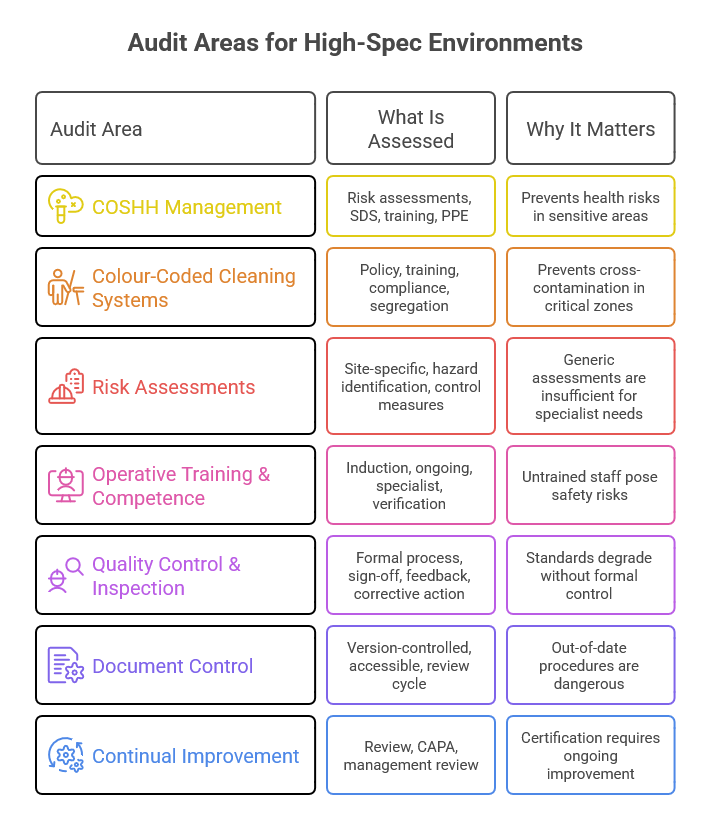
Here is what a CQMS audit examines for a professional cleaning company:
COSHH in Practice: What Compliant Chemical Use Actually Looks Like
The Control of Substances Hazardous to Health(COSHH) Regulations 2002 — is the legal framework governing how hazardous chemicals are managed in UK workplaces. For cleaning companies, it is one of the most frequently misunderstood and most frequently breached compliance requirements in the sector.
Most cleaning companies will tell you they are COSHH compliant. Very few can demonstrate it. CQMS certification requires documented evidence of COSHH compliance across every dimension, not a verbal assurance.
What COSHH Compliance Actually Requires of a Cleaning Company
• Written COSHH risk assessment for every product: not a generic template, but a specific assessment for each chemical used, covering the hazards it presents, the exposure routes, and the control measures in place
• Current Safety Data Sheets (SDS): SDS documentation for every product must be current (reviewed within the last three years), accessible to operatives, and understood, not filed in a folder nobody reads
• Substitution principle applied: COSHH requires that the least hazardous product capable of achieving the required result is used. Using a highly caustic chemical where a milder alternative would suffice is a COSHH breach
• Correct dilution and application: using a cleaning product at the wrong dilution, typically too concentrated, is both a COSHH risk and a surface damage risk. Operative training must cover correct dilution ratios
• Secure storage: all chemicals must be stored in locked, labelled, and ventilated storage away from food, patient areas, and public access
• PPE provision and use: appropriate personal protective equipment must be provided and must actually be worn. CQMS audits check both the provision and the evidence of use
• Emergency procedures: operatives must know what to do in the event of a chemical spill, exposure, or accidental ingestion and those procedures must be documented and trained
COSHH in Medical Cleaning Environments: The Higher Standard
In medical and healthcare-adjacent settings, COSHH compliance demands an additional layer of consideration. Cleaning products used in clinical areas must be effective against the pathogens relevant to that environment, including MRSA, C. difficile, and norovirus, while being safe for use around patients, medical equipment, and clinical materials.
This requires product selection that goes beyond cost and convenience. Signature Cleans’ CQMS-certified approach to medical and healthcare-adjacent cleaning in Exeter includes:
• Environment-specific product selection: products are chosen for their efficacy against clinically relevant pathogens, not simply for general surface cleaning
• Compatibility assessment: cleaning products are assessed for compatibility with medical equipment surfaces, including disinfectants that may damage electronic equipment or degrade plastics over time
• Residue management: in clinical environments, chemical residue on surfaces can affect patient care, CQMS-compliant cleaning protocols include residue control as a specific documented step
• Product rotation protocols: in high-infection-risk environments, routine rotation of disinfectant products helps prevent pathogen resistance — a consideration absent from general commercial cleaning standards
Common COSHH Failure: The most frequent COSHH breach in cleaning operations is not the use of dangerous chemicals — it is the use of the right chemicals in the wrong way. Incorrect dilution, missing PPE, or out-of-date SDS documentation are all COSHH failures regardless of which products are used. CQMS certification audits all three.
Colour-Coded Cleaning: The System That Prevents Cross-Contamination
Of all the operational cleaning standards that separate professional, accredited cleaning from unverified alternatives, colour-coding is the one most often misunderstood, most often claimed, and most often incompletely implemented.
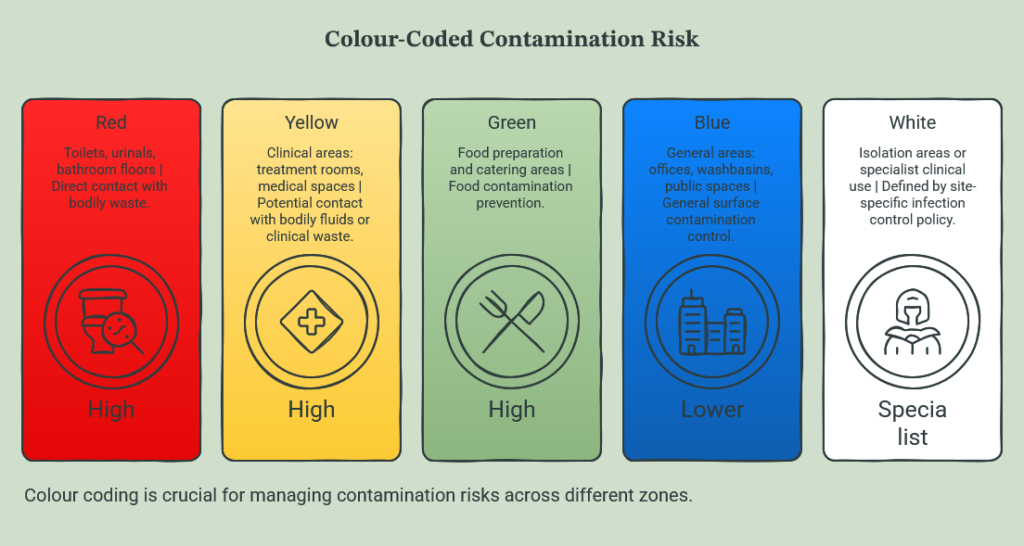
The colour-coded cleaning system is a UK industry standard, endorsed by the British Institute of Cleaning Science (BICSc) and required in all healthcare and food-handling environments by infection control and food safety legislation. Its purpose is simple: to ensure that cleaning equipment used in high-contamination areas, toilets, clinical spaces, food preparation areas, is never used in lower-contamination areas such as offices, reception areas, or communal spaces.
The standard colour allocation used across the UK is:
Why This Matters in Practice: A mop head used to clean a toilet that is then used on an office floor does not simply spread bacteria — it creates an infection pathway that is invisible to the building’s occupants. In a medical waiting room or GP surgery, that pathway connects clinical waste with patient seating areas. The colour-coding system exists precisely to prevent this. CQMS certification verifies that the system is not just described in a policy document but implemented, trained, and audited in practice.
What CQMS Certification Requires of a Colour-Coding System
Describing a colour-coding policy in a document is not the same as implementing one. CQMS certification audits the operational reality, including:
• Written colour-coding policy: a documented, version-controlled policy specifying which colour applies to which zone, for which equipment types, and how breaches are identified and managed
• Operative training records: evidence that every operative has been trained on the colour-coding system, not just told about it, but trained with documented assessment of understanding
• Equipment labelling and segregation: physical colour-coded equipment (mop heads, buckets, cloths, scrubbing pads) that are stored separately and cannot be confused
• Cross-contamination incident procedure: a documented process for what happens if colour-coding is breached, including reporting, quarantine of affected equipment, and retraining requirements
• Site-specific adaptation: standard colour-coding zones are adapted to the specific layout and risk profile of each client site, a dental surgery has different zoning requirements than a commercial office building
Colour-Coding in Exeter’s Medical and Office Environments
Exeter’s NHS and primary care facilities operate under NHS infection prevention and control (IPC) standards, which mandate colour-coded cleaning systems as a baseline requirement. Private medical practices, dental surgeries, and physiotherapy clinics in Exeter are subject to CQC (Care Quality Commission) inspection, and cleaning standards, including colour-coding compliance, are assessed as part of the safe environment domain.
For professional offices in Exeter, colour-coding is best practice rather than a regulatory requirement, but in any environment with kitchen facilities, washrooms, and communal areas, the contamination risk that colour-coding addresses is real regardless of whether a regulator is checking for it.
Risk Assessments for Cleaning: Generic vs Site-Specific
Every cleaning company operating in the UK is legally required under the Management of Health and Safety at Work Regulations 1999 to conduct risk assessments for all cleaning activities. The question is not whether a cleaning company has risk assessments, it is whether those assessments are meaningful.
Generic risk assessments, the kind downloaded from a template library and filed unchanged, satisfy the letter of the law but not its purpose. They describe hypothetical risks in hypothetical environments. They do not identify the specific hazards present in your building, the specific control measures required for your occupants, or the specific actions needed if something goes wrong in your specific location.
CQMS certification requires site-specific risk assessments. This means:
Generic Risk Assessment
CQMS-Standard Site-Specific Risk Assessment
Describes ‘slip and trip hazards’ in general terms
Identifies specific floor types in each area, their slip resistance when wet, and the cleaning methods and products that maintain that resistance
Lists ‘chemical hazards’ without product specifics
Documents every product used on-site by name, with cross-referenced COSHH assessments and SDS for each
Mentions ‘vulnerable persons’ as a generic category
Identifies the specific vulnerable occupants in this environment, immunocompromised patients, elderly residents, young children, and adapts control measures accordingly
Covers ‘manual handling’ in standard terms
Addresses the specific manual handling challenges of this site, heavy equipment on stairs, awkward access to plant rooms, specific furniture configurations
Updated ‘annually’ without evidence of review
Reviewed when the site, its occupants, or the cleaning scope changes, with dated version control and documented sign-off
Signed by a manager who has not visited the site
Produced by or with the operative responsible for the site, verified by a supervisor with site knowledge
Risk Assessments for Medical Cleaning in Exeter
In healthcare and medical cleaning environments, risk assessments must go beyond the standard cleaning risk framework to incorporate infection control considerations. A CQMS-certified cleaning company operating in Exeter’s medical sector will produce risk assessments that cover:
• Pathogen-specific risks: identification of the specific infection risks relevant to the clinical environment and the cleaning protocols required to mitigate them
• Waste handling procedures: clinical waste, sharps containers, and contaminated materials require specific handling protocols that must be documented in the cleaning risk assessment
• Patient and visitor protection: risk controls that account for the presence of vulnerable patients during cleaning activities, including noise, chemical fumes, slip hazards, and access disruption
• Equipment decontamination: cleaning equipment itself is a contamination risk if not decontaminated between uses and between zones, the risk assessment must document the decontamination procedure
Operative Training: The Human Element of Cleaning Standards
Cleaning standards are ultimately implemented by people. The most comprehensive COSHH documentation, the most detailed colour-coding policy, and the most thorough risk assessment are worthless if the operative cleaning your building does not understand them, has not been trained on them, or has been trained but not assessed for competence.
CQMS certification audits operative training as a specific and detailed criterion, because it is where the gap between policy and practice is most likely to exist.
What CQMS-Verified Training Looks Like
• Documented induction: every new operative receives a formal induction covering health and safety, COSHH, colour-coding, manual handling, and emergency procedures, with a signed record confirming completion
• Site-specific briefing: before starting at a new client site, operatives receive a briefing specific to that environment, its layout, its specific risks, its occupants, and any non-standard requirements
• Competence assessment: training is followed by documented assessment of competence, not just ‘did the training happen’ but ‘does the operative understand and can they apply it’
• Specialist environment training: operatives cleaning medical, food, or education environments receive additional training specific to those sectors, covering infection control, food safety, and safeguarding as relevant
• Refresher training programme: training is not a one-off event. CQMS-certified companies maintain a documented refresher training schedule, updated when regulations, products, or site conditions change
• Training records accessible to clients: in regulated environments, clients have the right to verify that the operatives cleaning their premises are trained to the required standard. CQMS-certified companies maintain records that can be produced on request
Training Transparency: Signature Cleans maintains full training records for every operative across all client sites. If you manage a medical practice, school, or regulated facility in Exeter and need to verify operative training for a CQC inspection, NHS audit, or Ofsted visit, we can provide that documentation immediately, because CQMS certification requires us to have it ready.
CQMS Certification vs ISO 9001: What Is the Difference?
Facilities managers and procurement leads in Exeter sometimes ask how CQMS certification compares to ISO 9001, the international quality management standard. The distinction is important and often misunderstood.
What it is
Sector-specific quality management certification for contractors in the UK construction and facilities management sector
Audit focus
Operational compliance in contractor-specific activities: COSHH, colour-coding, risk assessments, site-specific procedures, operative training
Sector relevance
Directly relevant to cleaning, facilities management, construction, and maintenance contractors — auditors understand the sector
UK procurement recognition
Widely recognised by UK public sector, local authorities, academy trusts, and NHS procurement as satisfying quality management pre-qualification
Cost and accessibility
Accessible to SME cleaning companies; designed for contractors of all sizes
Practical outcome for clients
Assurance that the specific operational activities of cleaning are managed to a documented, audited standard
For cleaning companies operating in Exeter’s healthcare, education, and commercial sectors, CQMS certification is the more operationally relevant standard. It speaks directly to the activities, COSHH management, colour-coding, risk assessments, operative training, that determine whether cleaning is genuinely safe, rather than whether a quality management system exists on paper.
What CQMS-Certified Cleaning Looks Like Across Different Exeter Environments
Medical Practices and GP Surgeries
Medical cleaning in Exeter’s primary care estate demands the highest application of CQMS-verified standards. Signature Cleans delivers:
• Full colour-coded zoning: clinical areas, waiting rooms, toilets, and staff areas each operate under separate colour-coded protocols
• CQC-aligned cleaning schedules: cleaning frequencies and methods are documented to align with CQC safe environment inspection criteria
• Pathogen-specific product selection: disinfectants selected for efficacy against MRSA, norovirus, and C. difficile as relevant to the clinical environment
• Clinical waste awareness: operatives trained in the identification and correct handling of clinical waste, reporting rather than handling in compliance with the Environmental Protection Act 1990
Dental Surgeries and Allied Health Practices
Dental surgeries in Exeter operate under both CQC and the HTM 01-05 decontamination guidance, a highly specific compliance framework. Cleaning standards in dental environments must account for:
• Decontamination zone segregation: strict separation of dirty and clean zones, maintained through colour-coded cleaning protocols and documented cleaning sequences
• Chemical compatibility with dental equipment: surface disinfectants must be compatible with composite surfaces, autoclaves, and electronic dental equipment
• Handwashing basin priority: handwashing facilities in clinical areas must be maintained to a higher standard than general washrooms, CQMS documentation distinguishes between these zones
Professional Offices and Business Premises
Office cleaning standards in Exeter are lower-risk than medical environments but still demand documented, consistent compliance, particularly in buildings with kitchen facilities, multiple tenants, or high footfall.
• Kitchen and communal area segregation: food preparation areas are cleaned under green-coded protocols, entirely separate from bathroom and office cleaning
• Touch-point sanitisation programmes: documented high-frequency touch-point cleaning covering door handles, lift buttons, light switches, and shared equipment
• Floor-type specific methods: CQMS risk assessments identify the correct cleaning method and product for each floor type, preventing damage to specialist flooring and maintaining slip resistance
• Out-of-hours cleaning protocols: many Exeter offices require early morning or evening cleaning. CQMS documentation covers lone working risk assessments and emergency procedures for out-of-hours operatives
Educational Facilities and Schools
Exeter schools and educational facilities served by Signature Cleans receive CQMS-verified cleaning standards that satisfy both Ofsted safe environment criteria and local authority procurement requirements:
• Safeguarding-integrated cleaning: operatives hold DBS certificates and are trained on safeguarding awareness, CQMS training documentation covers both cleaning competence and site-specific safeguarding requirements
• Child-safe product selection: all products are assessed for safety in environments where children are present, chemical residues, fume levels, and surface compatibility are all considered
• Holiday deep clean documentation: CQMS post-clean sign-off provides the paper trail that bursars and headteachers need for compliance records and Ofsted readiness
Frequently Asked Questions: CQMS, Cleaning Standards, and Compliance
What is CQMS certification and how is it different from other quality standards?
The Constructionline Quality Management Scheme(CQMS), is an independently verified quality management certification specifically for contractors in the UK construction and facilities management sector. Unlike generic quality standards such as ISO 9001, CQMS audits the specific operational activities of cleaning and facilities contractors, including COSHH management, colour-coded cleaning systems, site-specific risk assessments, and operative training. Signature Cleans holds full CQMS certification, independently audited and verified.
What does colour-coded cleaning prevent?
Colour-coded cleaning prevents cross-contamination, the transfer of bacteria, pathogens, and chemical residues between high-risk and lower-risk areas. By assigning specific equipment colours to specific zones (red for toilets, yellow for clinical areas, green for food preparation, blue for general use), the system creates a physical barrier to contamination pathways. In medical and healthcare environments, cross-contamination can cause Healthcare Associated Infections (HCAIs). In food environments, it can cause food poisoning. CQMS certification verifies that the colour-coding system is implemented, trained, and audited, not just described in a policy.
Is COSHH compliance a legal requirement for cleaning companies?
Yes. The Control of Substances Hazardous to Health Regulations 2002 (COSHH) are a legal requirement under UK health and safety law. Every cleaning company using hazardous chemicals, which includes almost all professional cleaning products, must conduct and document COSHH risk assessments, maintain current Safety Data Sheets, provide appropriate PPE, and ensure operatives are trained in safe chemical handling. CQMS certification audits COSHH compliance as a core criterion. Signature Cleans maintains full COSHH documentation for every product used at every client site.
How do I verify a cleaning company’s CQMS certification?
Ask the cleaning company to provide their current CQMS certification certificate, which will include the issuing body, the scope of certification, and the expiry date. You can also verify certification status directly with Constructionline. Signature Cleans provides CQMS certification documentation as standard during any procurement or onboarding process, no chasing required.
Does CQMS certification cover medical cleaning standards?
CQMS certification covers the quality management systems relevant to medical and healthcare-adjacent cleaning, including COSHH compliance, colour-coded protocols, operative training, and site-specific risk assessments. It does not replace sector-specific standards such as NHS Infection Prevention and Control guidance or CQC safe environment criteria, but a CQMS-certified cleaning company will operate in a way that supports compliance with those standards. Signature Cleans has experience cleaning in healthcare-adjacent environments in Exeter and applies CQMS-verified standards to every medical cleaning contract.
What happens if a CQMS-certified cleaning company breaches a standard?
CQMS certification requires documented corrective action processes. If a cleaning standard is breached — whether identified through internal inspection, client feedback, or an incident, a CQMS-certified company has a formal procedure for reporting, investigating, and correcting the issue. This includes root cause analysis, corrective action, and preventive measures to ensure the breach does not recur. This accountability framework is what distinguishes CQMS-certified cleaning from informal arrangements where service failures are handled (or not) at the operative’s discretion.
Why Signature Cleans Delivers Exeter’s Highest Standard of Cleaning Compliance
Signature Cleans is a CQMS-certified cleaning company serving medical practices, dental surgeries, professional offices, schools, and commercial premises across Exeter and Devon. Our CQMS certification is not a marketing credential, it is the documented, independently audited evidence that our cleaning standards hold up when the auditor is not in the room.
Every Signature Cleans contract in Exeter is delivered to the CQMS-verified standard:
Standard
What It Means for Your Premises
CQMS Certified
Independently audited quality management systems covering COSHH, colour-coding, risk assessments, training, and quality control. The most operationally rigorous quality standard for cleaning contractors in the UK.
SSIP Accredited
Health and safety independently verified. Satisfies your contractor H&S pre-qualification requirement. Employer’s liability and public liability insurance confirmed.
PQS Certified
Full pre-qualification credentials, financial standing, insurance, environmental policy, equality compliance, independently assessed. Streamlines procurement for public sector and regulated environments.
DBS Checked (all operatives)
Every Signature Cleans team member holds a current enhanced DBS certificate. Essential for schools, medical practices, and any environment with vulnerable occupants.
COSHH Compliant
Full Safety Data Sheets and COSHH risk assessments for every product used on your premises. Correct dilution, PPE, storage, and disposal, documented and audited.
Colour-Coded Protocols
Site-specific colour-coded cleaning system implemented, trained, and audited. Contamination pathways eliminated, not just policy-described, but operationally enforced.
Site-Specific Risk Assessments
Risk assessments that reflect your specific environment, occupants, and hazards, not generic templates. Reviewed when your site changes. Signed off by supervisors with site knowledge.
Our Promise: When Signature Cleans cleans your Exeter premises, you are not simply buying a cleaning visit. You are buying a CQMS-verified compliance framework, COSHH-managed, colour-coded, risk-assessed, and documented, that protects your occupants, satisfies your regulators, and gives you the paper trail you need if you are ever asked to demonstrate your contractor’s cleaning standards.
Whether you manage a GP surgery in St Leonard’s, a dental practice in Heavitree, a professional office in the city centre, or a school in Pinhoe, Signature Cleans delivers the cleaning standard that your environment demands and your compliance obligations require.
Medical Cleaning Services: Flexibility, Process & Results
What Effective Medical Cleaning Actually Requires
When most people think about medical cleaning services, they think about what they can see: floors that shine, bins that have been emptied, waiting rooms that look presentable. Visible cleanliness matters — but in a clinical environment, it is only the surface of what an effective cleaning service actually delivers.
Dental practices and healthcare facilities operate under pressures that most commercial environments do not face. Appointments run continuously throughout the day. Clinical staff are focused entirely on patient care. Infection prevention standards are non-negotiable. Compliance obligations must be evidenced, not merely assumed.
In these environments, a professional cleaning provider is not assessed by how quickly they complete a task. They are assessed by how reliably they work around clinical operations, how clearly they communicate, and how consistently they follow the correct process — every visit, without exception.
Q: What are medical cleaning services and what makes them different? Medical cleaning services are specialist cleaning programmes designed for healthcare environments — dental practices, GP surgeries, clinics, and hospitals. They differ from standard commercial cleaning in three fundamental ways: they must work around continuous clinical operations without disrupting patient care; they require documented accountability systems to evidence compliance; and they depend on consistent, repeatable processes rather than speed to maintain infection prevention standards.
The Three Principles That Define Professional Medical Cleaning Services
The most effective medical cleaning services are not built on the fastest teams or the lowest prices. They are built on three operational principles that directly support the clinical environments they serve.
1. Flexibility
2. Accountability
3. Process
Working around your clinical schedule — not the other way around. Morning, evening, out-of-hours, and deep clean scheduling that adapts to your operations.
Clear documentation of what was cleaned, when, by whom, and to what standard. Evidence your compliance team can rely on without having to chase.
Repeatable, documented cleaning procedures followed consistently across every visit — so standards are predictable, not dependent on individual habits.
These three principles are not aspirational. They are the operational baseline that any professional medical cleaning provider should be able to demonstrate before a contract begins — not promise to develop after one.
Q: What should medical cleaning services include? Professional medical cleaning services should include: flexible scheduling that works around clinical operating hours; documented accountability for every visit including what was cleaned, when, and by whom; consistent cleaning processes aligned to infection prevention requirements; trained staff following colour-coded equipment protocols and COSHH-compliant chemical use; and a named account manager responsible for quality and communication. These are operational requirements, not optional enhancements.
1. Flexibility: Working Around Clinical Operations, Not Against Them
The principle: A dental practice cannot accommodate a cleaning team that turns up mid-morning during peak appointments. Professional medical cleaning services adapt to the facility — the facility does not adapt to them.
Healthcare facilities rarely operate on a standard schedule — and the best medical cleaning services are built to reflect that reality. Dental practices often begin seeing patients early in the morning and continue throughout the day, sometimes into evenings or weekends. GP surgeries manage high footfall across extended hours. Private clinics vary their schedules by specialty and season.
For a cleaning provider, this creates a scheduling challenge. For the healthcare facility, it should never create a problem. A professional medical cleaning service adapts its schedule to the operational requirements of the practice — not the other way around.
What flexible scheduling looks like in a clinical context:
• Early morning cleans completed before the first patient appointment — typically between 6am and 8am — so clinical staff arrive to a fully prepared environment.
• Evening or overnight cleaning following the last appointment of the day, ensuring treatment rooms and patient areas are fully reset for the following morning.
• Flexible scheduling around specialist clinic days, extended hours, and weekend working — without requiring the facility manager to renegotiate the contract every time the schedule changes.
• Planned deep cleans and periodic intensive treatments scheduled during closure periods — bank holidays, annual leave blocks, or designated maintenance windows.
• Rapid-response availability for unplanned cleaning needs — post-incident cleans, unexpected spills, or additional capacity before an inspection or patient event.
The goal of genuine flexibility is straightforward: cleaning supports clinical operations rather than competing with them. When this works correctly, staff focus on patient care without interruption, and the cleaning team is simply part of the background infrastructure of a well-run facility.
Q: When should medical cleaning take place in a dental practice? Medical cleaning in a dental practice should be scheduled to avoid disruption to patient appointments — typically early morning before the first patient (6am–8am) or in the evening after the practice closes. Deep cleans and periodic intensive treatments should be planned during closure periods. A professional medical cleaning provider will develop a schedule around the practice’s specific operating hours, including flexibility for extended clinics, weekend working, and unplanned cleaning requirements.
2. Accountability: The Evidence That Compliance Depends On
The principle: In a clinical environment, assumptions are not enough. A practice manager needs to know what was cleaned, when it was cleaned, and by whom — without having to ask.
Accountability in medical cleaning is not simply about good communication. It is about creating a documented record that demonstrates compliance — one that can withstand scrutiny from a CQC inspector, a practice owner, or a patient safety review.
For practice managers and facilities managers carrying multiple responsibilities, clear accountability from a cleaning provider removes a significant source of administrative uncertainty. The question should never be ‘was this area cleaned?’ — it should be immediately answerable from the records the provider maintains and shares.
What was completed
Every cleaning task should be clearly defined in a written specification, and completion of each task documented per visit. This creates transparency and removes ambiguity about what is included in the service — and what is not.
When it was completed
Time-stamped visit records provide confidence that cleaning activities were carried out according to the agreed schedule. This is particularly important for high-touch areas and treatment environments where the timing of a clean relative to patient contact matters.
Who completed the work
Named operatives with confirmed training records create a direct accountability chain. Consistency of personnel — the same trained cleaner attending regularly rather than a rotating roster of unfamiliar faces — further strengthens this accountability and improves the quality of the clean itself.
How issues are reported and resolved
A clear escalation pathway for issues identified during a clean — a damaged surface, a consumable that needs restocking, a concern about a specific area — ensures that problems are communicated to the facility manager promptly and resolved in a documented, traceable way.
Q: How do medical cleaning companies provide accountability to healthcare facilities? Professional medical cleaning companies provide accountability through: written cleaning specifications that define every task included in the service; time-stamped digital visit logs confirming completion of each task per visit; named operatives with documented training records; and a formal issue-reporting process with documented resolution. This audit trail supports CQC compliance, evidences due diligence in the event of a patient safety concern, and removes uncertainty for practice managers overseeing multiple responsibilities.
3. Process: Why Consistency Protects Standards More Than Speed
The principle: In clinical cleaning, speed without process creates risk. The most effective medical cleaning services complete tasks correctly — every time — rather than completing them quickly.
In many industries, efficiency and speed are legitimate competitive advantages. In medical cleaning services, speed without the correct process is a liability. A treatment room cleaned quickly but incorrectly — with the wrong product, an insufficient contact time, or a missed high-touch surface — is not a clean treatment room. It is a risk that has been documented as complete.
The most effective clinical cleaning operations are built on documented procedures followed consistently across every visit. These procedures are not improvised by individual operatives — they are defined, trained, supervised, and audited. When the process is correct and consistent, the outcome is predictable. And predictable outcomes are precisely what healthcare facilities require.
What a documented clinical cleaning process covers:
• Zone-based task sequencing: Cleaning proceeds in a defined order — from cleanest to dirtiest zones — to prevent cross-contamination between clinical and non-clinical areas.
• Colour-coded equipment discipline: NHS-aligned colour coding for cloths, mops, and buckets ensures equipment used in washrooms never crosses into treatment or waiting areas.
• Contact time compliance: Disinfectant products applied with the correct dwell time — not wiped off immediately — to achieve the efficacy claimed on the product label.
• High-touch point protocols: Door handles, light switches, chair controls, bracket tables, and reception surfaces sanitised with defined frequency — not on an ad-hoc basis.
• Product selection and COSHH compliance: Cleaning chemicals selected for clinical efficacy (EN 14476 and EN 13727 standards), with COSHH risk assessments documented and accessible to all cleaning staff.
Q: Why is process more important than speed in medical cleaning? In medical cleaning, speed without the correct process creates infection risk rather than reducing it. A surface disinfected with insufficient contact time, the wrong product, or using cross-contaminated equipment has not been effectively cleaned — regardless of how quickly the task was completed. Documented cleaning procedures that define product selection, contact times, colour-coded equipment use, and task sequencing ensure outcomes are consistent and repeatable — which is what infection prevention requires.
4. Consistency Over Occasional Excellence: The Standard That Actually Matters
There is a common misconception about what makes a cleaning service excellent: that it is measured by its best performance. In reality, healthcare facilities benefit far more from consistency than from occasional excellence.
A dental practice that receives an outstanding clean once a month and an adequate clean the rest of the time has not received a professional medical cleaning service. It has received an unreliable one with occasional peaks. The patients and staff who experience the adequate cleans are not reassured by knowing that last Tuesday was exceptional.
Who notices consistency in a clinical environment:
• Patients: Research consistently shows that patients use environmental cleanliness as a proxy for clinical quality. A consistently clean waiting room and treatment area builds confidence before a clinician has said a word.
• Clinical staff: Staff working in a consistently well-maintained environment report higher confidence in their facility’s infection control standards — and lower tolerance for lapses when they do occur.
• Practice managers: Consistency means no complaints to manage, no conversations to have with the contractor, and no explanation required to a patient or inspector. It is the outcome that makes every other aspect of managing a practice easier.
• Compliance assessors: CQC inspectors and infection prevention auditors look for evidence of sustained standards over time — not a facility that performs well on inspection days. Consistent process and documentation are what create that evidence.
This is why robust processes, clear communication, and structured accountability are not just operational preferences — they are the mechanisms that make consistency achievable at scale, visit after visit, without depending on individual motivation or managerial supervision.
Q: Why is consistency more important than occasional excellence in healthcare cleaning? Healthcare environments require consistent cleaning standards because the risks of lapses — infection transmission, compliance failures, patient confidence erosion — are not mitigated by previous excellent performance. Patients, clinical staff, and compliance assessors all assess cleanliness based on what they encounter consistently, not on what the facility was like on its best day. Consistent outcomes require consistent processes — documented procedures, trained staff, and regular quality audits — not individual effort or goodwill.
5. Questions to Ask Before Choosing a Medical Cleaning Provider
The difference between a provider who delivers genuine medical cleaning services and one who delivers standard commercial cleaning with a clinical label applied becomes clear quickly when you ask the right questions. These five questions will reveal more about a provider’s long-term reliability than any discussion about price.
1. Can you work around our clinical schedule — including early mornings, evenings, and unplanned requests? The answer should describe specific operational capability, not a general willingness.
2. How do you document completed work, and how does that documentation reach us? The answer should describe a digital, time-stamped system — not a manual sign-in sheet or verbal confirmation.
3. What cleaning procedures do your teams follow in clinical areas — specifically regarding contact times, colour coding, and product selection? A provider who cannot answer this specifically is not operating a clinical cleaning programme.
4. How do you handle issues identified during a clean, and what is your response time for urgent requests? The answer should describe a documented escalation pathway with defined response timeframes.
5. How do you ensure the same standard is delivered on every visit, not just the first? The answer should describe quality audits, named operatives, and process-based delivery — not assurances about motivation or experience.
Q: What questions should I ask a medical cleaning company before hiring them? Before hiring a medical cleaning company, ask: Can you work around our clinical schedule including early mornings and evenings? How do you document completed work and how does that reach us? What specific cleaning procedures do your teams follow regarding contact times, colour coding, and product selection? How do you handle issues and what is your response time? How do you ensure the same standard on every visit — not just the first? Providers who cannot answer each question specifically are not operating a genuine clinical cleaning programme.
6. What the Future of Medical Cleaning Services Requires
Healthcare facilities are operating in an environment of increasing scrutiny — from CQC inspections and infection prevention audits to patient feedback platforms and the NHS Commitment to Cleanliness framework. In this context, the expectations placed on medical cleaning services are not static. They are rising.
The facilities that manage this well are not the ones with the largest cleaning budgets. They are the ones with the right provider — one who understands that a clinical cleaning contract is not a commodity service, but a compliance-critical operational partnership.
What that partnership requires in practice:
• A provider who understands the regulatory framework — NHS National Standards of Healthcare Cleanliness 2025, CQC Regulation 15, COSHH — and can demonstrate alignment to it without being prompted.
• A cleaning programme that is reviewed and updated as the facility’s needs change — not set at contract start and left unchanged.
• An account manager with genuine healthcare cleaning knowledge who can contribute to infection prevention discussions, not just scheduling ones.
• A reporting framework that provides the evidence a practice manager needs for compliance documentation — automatically, not on request.
• Accreditations that confirm independent assessment of the provider’s standards: SSIP, CQMS, PQS, ISO 9001, and BICSc affiliation are the markers of a provider operating at a genuinely professional level.
Q: What accreditations should a medical cleaning company hold? A professional medical cleaning company should hold: SSIP accreditation (independent health and safety assessment); CQMS verification (quality management systems); PQS certification (pre-qualification standard covering insurance, financials, and H&S); ISO 9001 quality management certification; and public liability insurance of at least £5 million. BICSc affiliation confirms ongoing investment in staff training. Providers holding all of these have been independently assessed against professional standards — not simply self-declared compliant.
Frequently Asked Questions
Q: How is medical cleaning different from standard commercial cleaning? Medical cleaning differs from standard commercial cleaning in its regulatory requirements, process discipline, and accountability infrastructure. Medical cleaning requires EN-certified disinfectants applied with correct contact times, NHS colour-coded equipment to prevent cross-contamination, documented visit logs for compliance evidence, and staff trained in infection prevention and control. Standard commercial cleaning does not include these requirements and is not appropriate for registered healthcare facilities.
Q: How often should a dental practice be professionally cleaned? Dental practices typically require a professional clean every operational day — either early morning before the first appointment or in the evening after the last. High-touch clinical areas (treatment rooms, bracket tables, door handles, and reception surfaces) should be sanitised between every patient contact as part of standard infection control. Periodic deep cleans — typically monthly or quarterly — supplement daily cleaning and address areas not covered by the routine programme.
Q: What is the NHS colour-coded cleaning system and why does it matter? The NHS colour-coded cleaning system assigns specific colours to cleaning equipment (cloths, mops, and buckets) for use in defined areas: red for washrooms and toilets, yellow for clinical and isolation areas, blue for general areas, and green for catering and food preparation. The system prevents cross-contamination between zones by ensuring equipment used in high-risk clinical areas is never used elsewhere. Any medical cleaning provider operating in a healthcare facility must implement and enforce this system rigorously.
The Foundation of a Reliable Clinical Cleaning Partnership
The best medical cleaning services are not defined by how quickly tasks are completed. They are defined by how reliably they support the clinical environment they serve — visit after visit, across the full duration of the contract.
Flexibility that genuinely works around clinical operations. Accountability that provides evidence without requiring the practice manager to chase it. Processes that deliver consistent outcomes because they are documented and followed, not because individual operatives happen to be having a good day.
For dental practices and healthcare facilities, these are not ambitious expectations. They are the operational baseline that a professional cleaning partner should deliver as standard. The questions in this guide will help you identify whether a provider you are considering can actually meet them — before you sign a contract rather than after.
Looking for a medical cleaning provider built around clinical operations?We deliver professional medical cleaning services to dental practices and healthcare facilities — with flexible scheduling, digital accountability, documented processes, and SSIP, CQMS, and PQS accreditations. Get in touch for a free, no-obligation site assessment and compliance review.
Medical Cleaning Services: What Healthcare Practices in Exeter Need to Know
What are medical cleaning services?
Medical cleaning services are specialist cleaning programmes designed specifically for healthcare and patient-facing environments, including GP surgeries, dental practices, private clinics, physiotherapy centres, and veterinary practices. Unlike general commercial cleaning, they are built around infection prevention and control, the safe handling of clinical waste, and documented compliance with regulatory standards including those set by the Care Quality Commission.
The distinction matters more than many practice managers initially realise. A general cleaning contractor may do an adequate job in an office setting, but in a clinical environment the stakes are fundamentally different. Inadequate decontamination of treatment surfaces, cross-contamination between clinical and non-clinical zones, or incorrect waste handling can pose a genuine risk to patients, staff, and your practice’s standing with regulators.
Quick answer: Medical cleaning services are specialist cleaning programmes tailored to healthcare environments. They differ from standard commercial cleaning in their use of clinical-grade products, infection control protocols, colour-coded equipment, and documented procedures designed to meet CQC compliance requirements.
Why Clinical Environments Require a Specialist Approach
Cleaning in a healthcare setting is not a routine maintenance task, it is an active component of patient safety. The Department of Health’s National Standards of Cleanliness and the CQC’s Key Lines of Enquiry both make clear that practice managers are responsible for evidencing that their environment is consistently clean and that appropriate systems are in place to maintain it.
Infection control is non-negotiable
Clinical cleaning requires a clear separation between procedures and products used in clinical areas versus non-clinical ones. Treatment rooms, consulting areas, and clinical surfaces must be decontaminated using healthcare-appropriate disinfectants, not the general-purpose products used in offices or schools. Cross-contamination between zones, or the transfer of pathogens via shared equipment or incorrect working methods, can have serious consequences for vulnerable patients.
CQC inspections require documented evidence
When a CQC inspector visits your practice, they will expect to see more than a clean environment, they will want documented evidence that your cleaning standards are consistently maintained. This means written cleaning specifications, visit records, and quality audit reports. A professional medical cleaning service provider will supply all of this as standard, giving you the paperwork trail you need when inspectors arrive.
Patient confidence begins with appearance
Patients form an impression of your practice before they have spoken to a single member of staff. A visibly clean, fresh-smelling environment communicates professionalism, care, and attention to detail; qualities that directly influence patient retention and word-of-mouth recommendation. Conversely, a poorly maintained waiting room or visibly unclean treatment area can quietly undermine confidence in your clinical standards.
The Risks of Using a Non-specialist Cleaning Contractor
Appointing a general commercial cleaning company to service a healthcare environment is a decision that carries meaningful risk, both to patient safety and to your practice’s regulatory position. The following are the most common failure points when non-specialist contractors are used in clinical settings:
Cross-contamination
Shared mops, cloths, and equipment used across clinical and non-clinical zones without colour-coded segregation.
Wrong products
General-purpose cleaning products lacking the antimicrobial efficacy required for clinical surface decontamination.
No documentation
No written cleaning specification or visit records, leaving practice managers exposed during CQC inspections.
Waste mishandling
Incorrect segregation or disposal of clinical waste and sharps. A regulatory breach that can carry serious consequences.
For practice managers in Exeter and across Devon, the answer is not simply to find a cheaper option, it is to find a contractor who has been independently assessed to operate to the standards your environment demands.
What’s Included in a Clinical Cleaning Programme
A professional medical cleaning service is built around your specific practice, its layout, clinical zones, session schedule, and regulatory requirements. Whilst every programme is tailored, a comprehensive clinical cleaning contract typically covers the following:
Waiting room and reception cleaning – surfaces, seating, hard flooring, and touch-points
Treatment room sanitisation after each clinical session using healthcare-appropriate disinfectants
Clinical surface decontamination across all patient-facing areas
Bathroom and washroom deep cleaning and disinfection to clinical standards
Touch-point sanitisation – door handles, light switches, handrails, and reception counters
Colour-coded equipment to prevent cross-contamination between clinical and non-clinical zones
Correct segregation, handling, and disposal of clinical waste in line with regulatory requirements
All clinical-grade cleaning products supplied as standard, no additional product costs
Documented cleaning records and quality audit reports available for compliance purposes
Scheduling built around your clinical hours – before opening, between sessions, or after close
Deep cleaning and periodic services
Healthcare deep cleaning sits alongside routine visits as a necessary part of maintaining a clinical environment to the required standard. Periodic deep cleans, typically quarterly or biannually, cover areas that routine visits cannot address fully: upholstery, air vents, hard-to-reach surfaces, and thorough washroom decontamination. These are particularly important ahead of CQC inspections or following periods of elevated infection risk.
Why Accreditation and Certification Matter
In a healthcare setting, the accreditation and certification of your medical cleaning service provider is not a formality, it is a genuine indicator of competence, safety, and reliability. Appointing an unaccredited contractor may reduce costs on paper, but it introduces risk that a regulated healthcare environment simply cannot afford to carry.
Quick answer: Accredited cleaning contractors have been independently assessed against nationally recognised standards for health and safety, quality management, and professional practice. In a healthcare setting, this provides practice managers with assurance that their contractor is compliant, properly insured, and capable of operating to the standard that CQC and patient safety require.
Key accreditations to look for in a medical cleaning contractor
Safety
SSIP accreditation
Safety Schemes in Procurement – the UK’s principal health and safety prequalification framework. SSIP accreditation confirms that a contractor has been independently assessed for health and safety competence. For healthcare practice managers, it provides the assurance that the cleaning teams on your premises operate to a verified standard of safe working practice.
Quality
CQMS verification
Contractor Quality Management Scheme – confirms that a contractor operates to documented quality management standards. In a clinical environment, consistency is everything. CQMS verification means that the cleaning specification followed on Monday is identical to the one followed on Friday, regardless of which team member is on site.
Procurement
PQS certification
Pre-Qualification Scheme – a recognised procurement standard that demonstrates a contractor has met baseline requirements around financial standing, competence, and compliance. NHS and private healthcare providers increasingly require PQS certification before approving a cleaning contractor for their supply chain.
Compliance
CQC-ready documentation
Beyond accreditation, a specialist contractor should supply written cleaning specifications, dated visit records, and quality audit reports as standard, the documented evidence that CQC inspectors expect to see when assessing the safety and effectiveness of your practice’s environment.
“SSIP accreditation and CQMS verification – the standard that healthcare providers and practice managers require when appointing a cleaning contractor.” Signature Cleans operates to exactly this standard across all healthcare and clinical environments it services in Exeter, Devon, Cornwall, and Somerset.
Why accreditation protects your practice
Should an incident occur on your premises, a member of the cleaning team injured on site, a clinical waste handling breach, or a complaint arising from inadequate decontamination, the accreditation status of your contractor will be scrutinised. An accredited provider has the insurance, documented procedures, and independently verified competence to demonstrate they were operating correctly. An unaccredited one may not.
For healthcare practice managers, due diligence in contractor selection is not optional, it is part of your governance obligation.
How Signature Cleans Works with Healthcare Practices
Signature Cleans provides dedicated medical cleaning services to GP surgeries, dental practices, private clinics, physiotherapy centres, and veterinary practices across Exeter and the wider South West. Their approach is built around three principles that matter most in a clinical setting: documented specification, consistent delivery, and transparent quality auditing.
The Signature Cleans clinical approach
Every engagement begins with a free site visit – walking through the practice with the manager, understanding clinical and non-clinical zones, session schedules, and any specific compliance or patient-facing requirements. From there, a bespoke cleaning specification is written for that practice: a documented plan covering what is cleaned, when, how, and with which products. Teams follow that specification on every visit. Regular quality audits are conducted and shared with the practice manager, providing both confidence that standards are maintained and the documented evidence required for CQC inspections or internal governance reviews.
Clients who require verifiable standards
Signature Cleans’ client roster includes organisations such as Porsche and Bouygues UK, businesses that require independently verified standards from their supply chain partners before awarding contracts. The same rigour applied to those environments is brought to every healthcare practice they service. SSIP accreditation and CQMS verification are not marketing claims, they are certifications that have been independently assessed and can be evidenced on request.
Who They Work with Across Exeter and the South West
Signature Cleans provides dental practice cleaning and clinical services across a range of healthcare environments throughout Exeter, Devon, Cornwall, and Somerset:
Dental practices – general, cosmetic, and specialist dentistry across NHS and private settings
GP surgeries – single and multi-partner practices, covering clinical and administrative areas
Private clinics – dermatology, aesthetics, minor surgery, and specialist environments
Physiotherapy and rehabilitation clinics – treatment rooms, exercise areas, and patient-facing spaces
Veterinary practices – clinical and consulting areas where infection control cleaning is equally critical
Frequently Asked Questions
What makes medical cleaning services different from regular commercial cleaning?
Medical cleaning services use clinical-grade disinfectants, colour-coded equipment to prevent cross-contamination, and documented procedures tailored to healthcare environments. They are designed to meet CQC compliance requirements and infection prevention standards, none of which are part of a standard commercial cleaning contract.
Do I need a specialist cleaning contractor for my GP surgery or dental practice?
Yes. CQC inspectors expect practice managers to demonstrate that cleaning is carried out to a documented standard appropriate to a clinical environment. A general commercial cleaning contractor is unlikely to provide the written specifications, visit records, or quality audits that inspectors require, nor are they typically trained in infection prevention protocols for healthcare settings.
What is SSIP accreditation and why does it matter for healthcare cleaning?
SSIP (Safety Schemes in Procurement) is a UK health and safety prequalification framework. An SSIP-accredited cleaning contractor has been independently assessed to confirm they operate to recognised health and safety standards. For healthcare practice managers, it provides verified assurance that the contractor’s teams working on your premises do so safely, lawfully, and to a consistent standard.
How often should a medical or dental practice be professionally cleaned?
Most GP surgeries and dental practices require daily cleaning, with treatment rooms sanitised between each clinical session. The frequency will depend on the volume of patients seen, the number of clinical areas, and the specific requirements of the practice. A specialist contractor will carry out a site assessment and recommend a schedule accordingly.
Can cleaning take place outside clinical hours?
Yes, and for most healthcare practices, it should. Reputable clinical cleaning contractors will schedule visits before surgeries open, between sessions, or after close, to avoid any disruption to clinical operations or patient-facing time. This should be established and agreed as part of the cleaning specification before the contract begins.
What documentation should a medical cleaning contractor provide?
As a minimum, a specialist contractor should provide a written cleaning specification tailored to your practice, dated visit records for every clean carried out, and regular quality audit reports. These are the documents CQC inspectors will expect to review, and their absence, even where the cleaning itself is adequate, can create difficulties during an inspection.
Does Signature Cleans cover areas outside Exeter?
Yes. Signature Cleans provides clinical and medical cleaning services across Exeter, Devon, Cornwall, and Somerset. For practices based further afield within the South West, it is worth contacting them directly to confirm coverage for your specific location.
Why Medical Cleaning Services Can’t Afford to Cut Corners: A Guide for Healthcare Facility Managers
When the Stakes Are Higher Than a Dusty Desk
In most workplaces, a missed cleaning detail is an inconvenience. In a clinical setting, it can be something far more serious.
Healthcare-associated infections (HAIs) remain one of the most significant patient safety risks in UK healthcare facilities. According to NHS England, approximately 300,000 patients a year in England acquire a healthcare-associated infection during their care. Many of these are preventable — and the physical cleanliness of the care environment plays a direct role in whether infection spreads or is contained.
For healthcare facility managers, this reality reframes what medical cleaning services actually means. It is not a support function. It is a patient safety function — one that operates at the intersection of clinical governance, regulatory compliance, and the everyday experience of the people in your care.
This guide covers what professional medical cleaning services should look like in practice, how cleaning standards slip and why that is unacceptable in a clinical setting, what the regulatory framework requires of your facility, and how to choose a provider equipped to deliver to that standard consistently.
What are medical cleaning services and why do they matter?
Medical cleaning services are specialist cleaning programmes designed for clinical and healthcare environments — GP surgeries, dental practices, hospitals, and private clinics. They differ from standard commercial cleaning in their infection control protocols, use of clinical-grade disinfectants, colour-coded equipment systems, and alignment with the NHS National Standards of Healthcare Cleanliness 2025. In a clinical setting, cleaning is a patient safety function, not just a facilities task.
Small Misses, Big Consequences: Why Clinical Cleaning Requires Structure
In most workplaces, a missed detail is frustrating. In a clinical setting, it can be far more serious. That’s why cleaning in medical environments can’t rely on guesswork or rushed jobs. It needs structure, consistency, and attention to detail every single time.
The consequences of inadequate cleaning in a clinical environment are not abstract. They are documented, measurable, and in many cases preventable. Consider what a single missed clean can mean in practice:
• A treatment room surface not properly disinfected between patients becomes a transmission vector for pathogens including MRSA, Clostridioides difficile (C. diff), and norovirus — all of which can survive on hard surfaces for hours to weeks.
• A waiting area that is not cleaned to the required frequency accumulates pathogen load throughout the day, increasing exposure risk for immunocompromised patients who may have no ability to resist opportunistic infection.
• A dental surgery where suction unit traps, bracket tables, and light handles are not cleaned to the correct protocol following each patient creates a cross-contamination risk that no amount of PPE fully mitigates.
• A GP consultation room where high-touch points, door handles, examination couch coverings, blood pressure equipment, are not sanitised between appointments creates the conditions for direct patient-to-patient transmission.
None of these outcomes requires negligence. They require only inconsistency, a rushed visit, a skipped area, a product applied incorrectly or not left for the required contact time. In a standard office environment, the consequence is a complaint. In a clinical environment, the consequence can be a patient safety incident, a CQC regulatory finding, or worse.
This is why professional medical cleaning services cannot operate on goodwill and general competence alone. They require documented systems, trained staff, clinical-grade products, and an audit framework that can demonstrate compliance to an inspector at any point.
What are the risks of inadequate cleaning in a medical facility?
Inadequate cleaning in a medical facility increases the risk of healthcare-associated infections (HAIs), cross-contamination between patients, and regulatory non-compliance. Pathogens including MRSA, C. diff, and norovirus can survive on clinical surfaces for extended periods. A single missed clean or incorrectly applied disinfectant can create conditions for patient-to-patient transmission, CQC inspection findings, and potential breach of the Health and Social Care Act 2008.
The Regulatory Framework: What UK Healthcare Facilities Are Required to Meet
Healthcare facility managers in the UK operate within a clear and demanding regulatory framework for cleanliness. Understanding this framework is essential both for ensuring compliance and for evaluating whether a cleaning provider is genuinely equipped to deliver to the required standard.
National Standards of Healthcare Cleanliness 2025
Published by NHS England, the National Standards of Healthcare Cleanliness 2025 apply to all NHS trust settings and provide the benchmark framework for all healthcare cleaning in the UK. They replace the 2021 version and introduce a Functional Risk (FR) category system that classifies every area of a healthcare facility by its infection risk level:
Risk Category
Healthcare Setting
Cleaning Requirement
FR1 / FR2
Operating theatres, treatment rooms, A&E, ICUs
Intensive, frequent cleaning with documented efficacy audits
FR3 / FR4
Consultation rooms, GP surgeries, dental surgeries
Daily cleaning with high-touch point protocols and signed logs
FR5 / FR6
Waiting areas, reception, office spaces
Regular cleaning with documented schedules and audit trails
From 2026, most healthcare settings are also required to display a public-facing ‘Commitment to Cleanliness’ charter – a visible star rating (1-5) showing patients who is responsible for cleaning and how often it takes place. A poor rating does not just affect patient confidence. It can trigger a formal CQC inspection.
Health and Social Care Act 2008 – Regulation 15
Regulation 15 of the Health and Social Care Act 2008 (Regulated Activities) Regulations 2014 requires healthcare facilities to be clean, secure, and suitable, with standards of hygiene appropriate to their purpose. This is a legal requirement — not a guideline. CQC inspectors assess compliance with Regulation 15 as a fundamental standard, and findings of non-compliance can result in requirement notices, warning notices, or registration conditions.
COSHH – Control of Substances Hazardous to Health
COSHH regulations govern how cleaning chemicals are assessed, stored, used, and documented in healthcare environments. In a clinical setting, COSHH compliance means: documented risk assessments for every cleaning product used; Safety Data Sheets (SDS) accessible to all cleaning staff; correct selection of disinfectants tested to EN 14476 or equivalent standards; appropriate PPE specified and used; and ventilation controls documented and followed. A cleaning provider who cannot demonstrate COSHH compliance is not operating legally in a healthcare environment.
CQC inspections and the cleanliness standard
The Care Quality Commission (CQC) inspects all registered healthcare providers in England against the fundamental standards of the Health and Social Care Act. Cleanliness and infection control are assessed under the ‘Safe’ domain. Inspectors look not only at the physical condition of the facility at the time of inspection, they look for evidence of documented cleaning schedules, signed completion records, and audit trails that demonstrate standards are maintained over time, not just on inspection days.
What cleaning standards must UK healthcare facilities comply with?
UK healthcare facilities must comply with the NHS National Standards of Healthcare Cleanliness 2025 (which introduced Functional Risk categories and mandatory public star ratings), Regulation 15 of the Health and Social Care Act 2008 (requiring legally compliant hygiene standards), and COSHH regulations governing cleaning chemical selection, documentation, and staff training. CQC inspectors assess compliance with these standards under the ‘Safe’ domain during registered provider inspections.
When Standards Slip: How Cleaning Decline Happens in Clinical Settings
Like most services, cleaning standards don’t usually drop overnight. It happens gradually. Corners get cut. Processes get rushed. Communication drops. In a clinical setting, that slow decline isn’t acceptable. We build systems to make sure standards stay where they should be.
Service drift in medical cleaning is particularly dangerous precisely because it is gradual. Each individual slip is small enough to go unnoticed. The cumulative effect, over weeks or months, is a facility that is no longer being cleaned to the standard required by its regulatory obligations, even if it looks broadly acceptable to a non-specialist eye.
How the decline typically unfolds:
1. A cleaning operative takes a shortcut, a high-touch surface is wiped rather than disinfected with the correct contact time, or a treatment room is cleaned without the required zone-to-zone colour coding discipline.
2. The shortcut is not flagged because there is no audit mechanism to detect it. Signed logs show the visit took place; they do not capture the quality of what was done.
3. The shortcut becomes a habit, then a norm. Other operatives observe it and adopt it. The standard that was once delivered consistently is now delivered inconsistently, but the paperwork looks the same.
4. A CQC inspection, an infection incident, or a patient complaint surfaces the problem. By this point, the decline has been in progress for weeks or months and the audit trail, if one exists, shows no record of it being identified or addressed.
The solution is not stricter supervision in isolation. It is a quality management system that makes decline visible before it becomes entrenched, one that combines trained staff, documented protocols, regular efficacy audits, and a named account manager who is accountable for the standard being maintained, not just the schedule being followed.
The warning signs that cleaning standards have drifted in a clinical setting:
• Cleaning visits are being completed faster than the specification allows, a sign that tasks are being abbreviated rather than completed.
• High-touch point logs show consistent completion but audit checks reveal surfaces that are not meeting the required microbial standard on ATP testing.
• Staff report informally that certain areas ‘don’t seem to get properly cleaned’, a reliable early indicator that the operative is working around rather than through the full specification.
• The same areas are flagged repeatedly in patient feedback or staff concern forms.
• Your cleaning provider cannot produce documented audit results when asked, or produces them only when prompted, rather than as part of a regular reporting cycle.
How do cleaning standards slip in medical facilities?
Cleaning standards in medical facilities typically slip gradually rather than suddenly. Shortcuts, incorrect contact times, missed high-touch points, colour coding errors, go undetected when there is no robust audit mechanism. Over time, these become embedded norms. The key risk is that signed visit logs can appear compliant while actual cleaning quality has deteriorated. Preventing standard drift requires regular efficacy audits, ATP testing, documented quality checks, and an accountable account manager, not just a completed schedule.
What Patients Notice and What That Means for Your Practice
You might be focused on delivering great care. But patients are also noticing the waiting area, the treatment room, the overall cleanliness. It all contributes to how they feel about your practice.
Healthcare facility managers are rightly focused on clinical outcomes. But patients are forming judgements about their care environment from the moment they arrive and those judgements directly influence their confidence in the quality of care they are about to receive.
Research consistently shows that patients use the cleanliness of a healthcare facility as a proxy for its clinical quality. A visibly clean, well-maintained waiting room, consultation space, and treatment area communicates competence and care before a clinician has said a word. The inverse is equally true: a waiting area with marked surfaces, a consultation room with a dusty sill, or a surgery that carries the faint smell of inadequate cleaning creates doubt and doubt, once planted, affects the entire patient experience.
The areas patients most notice in a clinical setting:
• Waiting areas: The first indoor environment a patient encounters. Chairs, flooring, reception surfaces, and leaflet displays are all assessed, consciously or otherwise, within seconds of arrival.
• Consultation and treatment rooms: Patients notice the cleanliness of examination couches, work surfaces, equipment, and high-touch points. These areas carry particular weight because they are where intimate clinical contact occurs.
• Washrooms: Consistently the single strongest environmental indicator of a facility’s broader standards. In a healthcare setting, a poorly maintained washroom does not just suggest lack of care, it actively undermines confidence in infection control across the entire facility.
• Transitions and corridors: Marked walls, dusty skirting boards, and unclean floor edges are noticed in clinical settings in a way they would not be in a standard office because the expectation of cleanliness in healthcare is higher.
From 2026, the NHS requirement for facilities to display a public ‘Commitment to Cleanliness’ star rating makes this dynamic explicit. Patients will be able to see, at the point of entry, how their facility has been assessed for cleanliness. A low rating is not merely a reputational risk — it is a visible, documented signal of a facility that is not meeting its obligations.
How does facility cleanliness affect patient experience in healthcare?
Patients consistently use the cleanliness of a healthcare facility as a proxy for its clinical quality and safety. Research shows that visible dirt, poor maintenance, or odour in clinical environments reduces patient confidence even when the quality of clinical care is high. In GP surgeries and dental practices, waiting areas, treatment rooms, and washrooms are the primary environmental signals patients use to assess whether a facility is safe, professional, and well-managed.
What Professional Medical Cleaning Services Should Include
The gap between a general commercial cleaning company and a genuinely qualified provider of medical cleaning services is significant. Healthcare facility managers should understand exactly what a compliant, professional medical cleaning specification should look like, and use that understanding to evaluate any provider they are considering.
Clinical-grade disinfection protocols
All disinfectants used in a clinical setting should be tested and proven effective against relevant pathogens, typically to EN 14476 (viricidal efficacy) and EN 13727 (bactericidal efficacy) standards. Contact times must be followed precisely: a product applied and wiped off immediately does not deliver the disinfection it claims. Your provider should be able to specify the products they use, their efficacy certifications, and how correct contact time is ensured and verified.
Colour-coded equipment systems
NHS guidance mandates colour-coded cleaning equipment (cloths, mops, buckets) to prevent cross-contamination between clinical zones and non-clinical areas. The standard colour coding system designates red for washrooms and toilets, yellow for clinical and isolation areas, blue for general areas, and green for catering and food preparation areas. Any provider operating in a clinical environment must use and enforce this system rigorously and must be able to demonstrate that their staff are trained in its correct application.
Zone-based task specifications
A professional medical cleaning specification should detail every area of the facility by its Functional Risk (FR) category, with specific tasks, frequencies, products, and verification methods listed for each zone. This is not a generic checklist, it is a site-specific document developed after a thorough survey of your facility, reviewed regularly, and updated when the facility or its usage changes.
COSHH-compliant chemical management
All cleaning chemicals used in your facility should be covered by documented COSHH risk assessments, with Safety Data Sheets accessible to staff, correct PPE specified and provided, and storage and disposal procedures documented and followed. Your provider should be able to produce this documentation on request — not assemble it in response to an inspection.
Digital visit logs and audit trails
Every cleaning visit should be recorded digitally, with time-stamped completion records accessible to the facility manager. Regular efficacy audits, including ATP (adenosine triphosphate) testing to verify surface cleanliness at a microbial level, should be conducted and documented. This creates the audit trail that CQC inspectors look for and that protects your facility in the event of a patient safety incident or complaint.
Healthcare-trained and consistently assigned staff
Cleaning staff working in clinical environments should receive specific training in infection prevention and control, not just general cleaning skills. BICSc (British Institute of Cleaning Science) qualifications aligned to healthcare tasks are the recognised standard. Consistency matters too — a named operative or small regular team assigned to your facility reduces the risk of missed areas, ensures familiarity with your specific protocols, and creates accountability that rotating agency staff cannot provide.
What should professional medical cleaning services include?
Professional medical cleaning services should include: clinical-grade disinfection using EN 14476 and EN 13727 certified products applied with correct contact times; NHS colour-coded equipment systems; a zone-based specification aligned to Functional Risk (FR) categories; COSHH-compliant chemical management with documented risk assessments; digital visit logs and regular ATP efficacy audits; and healthcare-trained, consistently assigned staff with BICSc or equivalent qualifications. These are not optional enhancements, they are the baseline requirements for a compliant clinical cleaning operation.
Choosing the Right Provider: The Questions That Matter
Not every commercial cleaning company is qualified or equipped to deliver compliant medical cleaning services. The following questions will quickly separate providers with genuine healthcare cleaning capability from those offering general commercial cleaning with a clinical label applied.
• Can you provide evidence of staff training specifically in infection prevention and control, not just general cleaning? What qualifications do your healthcare cleaning operatives hold?
• What disinfectant products do you use in clinical areas, and what are their EN efficacy certifications? How do you ensure correct contact times are followed?
• How do you implement the NHS colour-coded cleaning equipment system, and how do you verify staff compliance with zone separation?
• Can you produce a sample COSHH risk assessment and Safety Data Sheet for a product used in a clinical environment?
• What does your audit process look like? Do you conduct ATP testing, and how frequently? Who receives the results, and what is the escalation pathway when a result falls below the required standard?
• What accreditations does your company hold? SSIP, CQMS, and PQS are the procurement accreditation baseline. ISO 9001 and BICSc affiliation are strong additional markers of professional operation.
• Will cleaning staff be DBS-checked as standard? Who is our named account manager, and how often will they visit the site?
A provider genuinely experienced in medical cleaning services will answer every one of these questions with specificity and without hesitation. Vague answers, deferred responses, or unfamiliarity with the regulatory framework are reliable indicators that a company is not operating at the level a healthcare facility requires.
How do I choose a medical cleaning company for a healthcare facility?
When choosing a medical cleaning company, ask specifically about IPC training and BICSc qualifications, EN-certified disinfectant products and contact time protocols, NHS colour-coded equipment compliance, COSHH documentation, ATP testing and audit processes, and relevant accreditations (SSIP, CQMS, PQS, ISO 9001). A DBS-checked, consistently assigned team and a named account manager conducting regular site audits are essential for sustaining compliance over the duration of the contract.
Frequently Asked Questions
What is the difference between medical cleaning and standard commercial cleaning?
Medical cleaning differs from standard commercial cleaning in its infection control protocols, product selection, and regulatory requirements. Medical cleaning uses EN-certified clinical-grade disinfectants with specified contact times, NHS colour-coded equipment to prevent cross-contamination, zone-based cleaning specifications aligned to Functional Risk categories, and documented audit trails for CQC compliance. Standard commercial cleaning does not typically include any of these requirements and is not appropriate for use in registered healthcare facilities.
How often should a GP surgery or dental practice be professionally cleaned?
GP surgeries and dental practices typically fall within Functional Risk categories FR3 to FR4 under the NHS National Standards of Healthcare Cleanliness 2025. This generally requires daily cleaning of all clinical and patient-facing areas, including treatment rooms, waiting areas, and washrooms. High-touch points — door handles, examination equipment, light handles, and bracket tables — should be sanitised between every patient contact in active clinical areas. Periodic deep cleans and annual efficacy audits supplement the daily routine.
What is ATP testing and why is it used in healthcare cleaning?
ATP (adenosine triphosphate) testing is a rapid surface hygiene verification method used to measure biological residue on cleaned surfaces. A swab is taken from a surface and tested using a luminometer device; the result — measured in relative light units (RLUs) — indicates whether the surface meets the required microbial cleanliness standard. ATP testing provides objective, real-time evidence of cleaning efficacy that signed completion logs alone cannot deliver, and is increasingly expected as part of a compliant healthcare cleaning audit programme.
Structure, Consistency, and Attention to Detail — Every Single Time
The standard required of medical cleaning services in a UK healthcare facility is not aspirational. It is defined, regulated, and inspected. For healthcare facility managers, the decision about who delivers that standard — and how — is one of the most operationally significant decisions in your building’s management.
A provider who relies on goodwill, general experience, and informal processes cannot sustain the level of consistency a clinical environment demands. The drift will come. The question is only when, and what it will cost when it arrives — in patient safety terms, in regulatory terms, or in both.
The right provider brings not just trained staff and compliant products, but a system: documented protocols, regular audits, transparent reporting, and an account manager who is as invested in maintaining your facility’s compliance as you are. That is the standard worth holding out for — and the standard your patients, your staff, and your regulatory obligations require.
Looking for a medical cleaning provider who understands what compliance actually means?
We work with GP surgeries, dental practices, and healthcare facilities across Exeter and Devon to deliver structured, accredited medical cleaning services — with COSHH-compliant protocols, digital audit trails, and a named account manager for every contract. Get in touch to arrange a free site assessment and tailored compliance review.