Most people think cleaning compliance means having a certificate on the wall. It does not. It means a cleaner using the wrong colour mop head in a treatment room. It means a COSHH data sheet that was last reviewed three years ago. It means an office kitchen sponge used on a bathroom surface because nobody checked.
These are not hypothetical failures. They are the kinds of real-world compliance gaps that CQMS, the Constructionline Quality Management Scheme is specifically designed to identify, document, and eliminate. And in high-specification environments like medical facilities, dental practices, and professional offices in Exeter, the consequences of getting them wrong range from infection outbreaks to regulatory enforcement and reputational damage that cannot be undone.
This article demystifies what professional cleaning standards actually mean in practice. It explains what CQMS certification requires of a cleaning company, not in abstract terms, but in the specific, operational behaviours that separate compliant cleaning from the appearance of compliant cleaning. And it explains why Signature Cleans, as a CQMS-certified cleaning company in Exeter, delivers a standard that genuinely protects the organisations we serve.
| Quick Answer: CQMS certification verifies that a cleaning company has documented, audited quality management systems covering COSHH compliance, colour-coded cleaning protocols, risk assessments, operative training, and formal quality control processes. It is the difference between a cleaning company that claims professional standards and one that has had those standards independently verified. |
Why Cleaning Standards Matter More Than You Think – Especially in Exeter
Exeter’s commercial and healthcare landscape creates specific and demanding cleaning compliance requirements. The city is home to the Royal Devon and Exeter NHS Foundation Trust, a significant primary care estate, dozens of dental and physiotherapy practices, GP surgeries, and a large professional office sector across the city centre, Sowton Business Park, and Marsh Barton.
Each of these environments has occupants who are vulnerable to infection risk in ways that the average office environment does not. A medical waiting room sees immunocompromised patients. A dental surgery handles clinical waste and biological material. A GP surgery is a high-turnover environment where cross-contamination risks are real and consequential.
Yet many of these facilities are cleaned by contractors whose compliance credentials are unverified, companies that can describe their cleaning standards confidently but cannot demonstrate them through independent audit. CQMS certification is the mechanism that closes that gap.
| The Compliance Gap: A cleaning company saying it meets professional cleaning standards and a cleaning company having those standards independently verified are two very different things. In regulated environments, medical facilities, schools, and care settings only the latter is sufficient. |
What Is CQMS Certification and What Does It Actually Audit?
The Constructionline Quality Management Scheme(CQMS) — is an independently verified quality management certification for contractors operating in construction, facilities management, and specialist service sectors. It assesses whether a company has the documented systems, processes, and controls in place to deliver consistent, compliant, and accountable service.
For cleaning companies, CQMS certification is not a box-ticking exercise. The audit is specifically designed to assess real-world operational compliance, the kind of detail that tells you whether a cleaning company’s standards hold up when the auditor is not in the room.
Here is what a CQMS audit examines for a professional cleaning company:
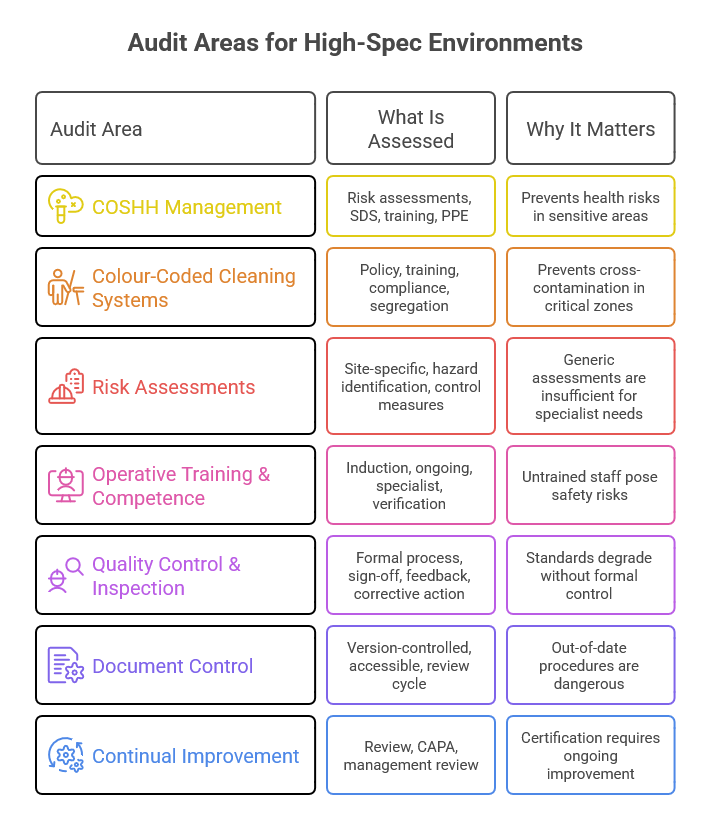
COSHH in Practice: What Compliant Chemical Use Actually Looks Like
The Control of Substances Hazardous to Health(COSHH) Regulations 2002 — is the legal framework governing how hazardous chemicals are managed in UK workplaces. For cleaning companies, it is one of the most frequently misunderstood and most frequently breached compliance requirements in the sector.
Most cleaning companies will tell you they are COSHH compliant. Very few can demonstrate it. CQMS certification requires documented evidence of COSHH compliance across every dimension, not a verbal assurance.
What COSHH Compliance Actually Requires of a Cleaning Company
• Written COSHH risk assessment for every product: not a generic template, but a specific assessment for each chemical used, covering the hazards it presents, the exposure routes, and the control measures in place
• Current Safety Data Sheets (SDS): SDS documentation for every product must be current (reviewed within the last three years), accessible to operatives, and understood, not filed in a folder nobody reads
• Substitution principle applied: COSHH requires that the least hazardous product capable of achieving the required result is used. Using a highly caustic chemical where a milder alternative would suffice is a COSHH breach
• Correct dilution and application: using a cleaning product at the wrong dilution, typically too concentrated, is both a COSHH risk and a surface damage risk. Operative training must cover correct dilution ratios
• Secure storage: all chemicals must be stored in locked, labelled, and ventilated storage away from food, patient areas, and public access
• PPE provision and use: appropriate personal protective equipment must be provided and must actually be worn. CQMS audits check both the provision and the evidence of use
• Emergency procedures: operatives must know what to do in the event of a chemical spill, exposure, or accidental ingestion and those procedures must be documented and trained
COSHH in Medical Cleaning Environments: The Higher Standard
In medical and healthcare-adjacent settings, COSHH compliance demands an additional layer of consideration. Cleaning products used in clinical areas must be effective against the pathogens relevant to that environment, including MRSA, C. difficile, and norovirus, while being safe for use around patients, medical equipment, and clinical materials.
This requires product selection that goes beyond cost and convenience. Signature Cleans’ CQMS-certified approach to medical and healthcare-adjacent cleaning in Exeter includes:
• Environment-specific product selection: products are chosen for their efficacy against clinically relevant pathogens, not simply for general surface cleaning
• Compatibility assessment: cleaning products are assessed for compatibility with medical equipment surfaces, including disinfectants that may damage electronic equipment or degrade plastics over time
• Residue management: in clinical environments, chemical residue on surfaces can affect patient care, CQMS-compliant cleaning protocols include residue control as a specific documented step
• Product rotation protocols: in high-infection-risk environments, routine rotation of disinfectant products helps prevent pathogen resistance — a consideration absent from general commercial cleaning standards
| Common COSHH Failure: The most frequent COSHH breach in cleaning operations is not the use of dangerous chemicals — it is the use of the right chemicals in the wrong way. Incorrect dilution, missing PPE, or out-of-date SDS documentation are all COSHH failures regardless of which products are used. CQMS certification audits all three. |
Colour-Coded Cleaning: The System That Prevents Cross-Contamination
Of all the operational cleaning standards that separate professional, accredited cleaning from unverified alternatives, colour-coding is the one most often misunderstood, most often claimed, and most often incompletely implemented.
The colour-coded cleaning system is a UK industry standard, endorsed by the British Institute of Cleaning Science (BICSc) and required in all healthcare and food-handling environments by infection control and food safety legislation. Its purpose is simple: to ensure that cleaning equipment used in high-contamination areas, toilets, clinical spaces, food preparation areas, is never used in lower-contamination areas such as offices, reception areas, or communal spaces.
The standard colour allocation used across the UK is:
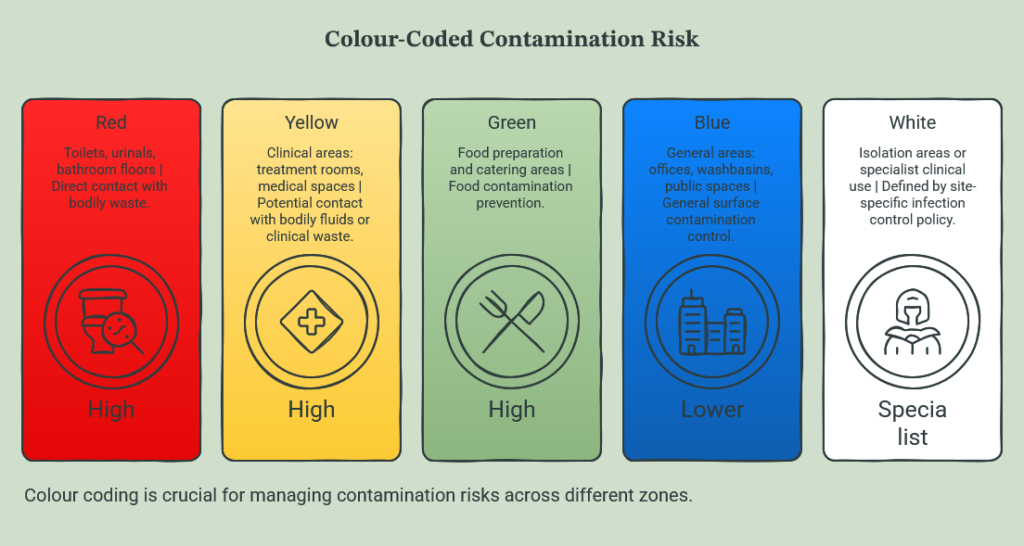
| Why This Matters in Practice: A mop head used to clean a toilet that is then used on an office floor does not simply spread bacteria — it creates an infection pathway that is invisible to the building’s occupants. In a medical waiting room or GP surgery, that pathway connects clinical waste with patient seating areas. The colour-coding system exists precisely to prevent this. CQMS certification verifies that the system is not just described in a policy document but implemented, trained, and audited in practice. |
What CQMS Certification Requires of a Colour-Coding System
Describing a colour-coding policy in a document is not the same as implementing one. CQMS certification audits the operational reality, including:
• Written colour-coding policy: a documented, version-controlled policy specifying which colour applies to which zone, for which equipment types, and how breaches are identified and managed
• Operative training records: evidence that every operative has been trained on the colour-coding system, not just told about it, but trained with documented assessment of understanding
• Equipment labelling and segregation: physical colour-coded equipment (mop heads, buckets, cloths, scrubbing pads) that are stored separately and cannot be confused
• Cross-contamination incident procedure: a documented process for what happens if colour-coding is breached, including reporting, quarantine of affected equipment, and retraining requirements
• Site-specific adaptation: standard colour-coding zones are adapted to the specific layout and risk profile of each client site, a dental surgery has different zoning requirements than a commercial office building
Colour-Coding in Exeter’s Medical and Office Environments
Exeter’s NHS and primary care facilities operate under NHS infection prevention and control (IPC) standards, which mandate colour-coded cleaning systems as a baseline requirement. Private medical practices, dental surgeries, and physiotherapy clinics in Exeter are subject to CQC (Care Quality Commission) inspection, and cleaning standards, including colour-coding compliance, are assessed as part of the safe environment domain.
For professional offices in Exeter, colour-coding is best practice rather than a regulatory requirement, but in any environment with kitchen facilities, washrooms, and communal areas, the contamination risk that colour-coding addresses is real regardless of whether a regulator is checking for it.
Risk Assessments for Cleaning: Generic vs Site-Specific
Every cleaning company operating in the UK is legally required under the Management of Health and Safety at Work Regulations 1999 to conduct risk assessments for all cleaning activities. The question is not whether a cleaning company has risk assessments, it is whether those assessments are meaningful.
Generic risk assessments, the kind downloaded from a template library and filed unchanged, satisfy the letter of the law but not its purpose. They describe hypothetical risks in hypothetical environments. They do not identify the specific hazards present in your building, the specific control measures required for your occupants, or the specific actions needed if something goes wrong in your specific location.
CQMS certification requires site-specific risk assessments. This means:
| Generic Risk Assessment | CQMS-Standard Site-Specific Risk Assessment |
| Describes ‘slip and trip hazards’ in general terms | Identifies specific floor types in each area, their slip resistance when wet, and the cleaning methods and products that maintain that resistance |
| Lists ‘chemical hazards’ without product specifics | Documents every product used on-site by name, with cross-referenced COSHH assessments and SDS for each |
| Mentions ‘vulnerable persons’ as a generic category | Identifies the specific vulnerable occupants in this environment, immunocompromised patients, elderly residents, young children, and adapts control measures accordingly |
| Covers ‘manual handling’ in standard terms | Addresses the specific manual handling challenges of this site, heavy equipment on stairs, awkward access to plant rooms, specific furniture configurations |
| Updated ‘annually’ without evidence of review | Reviewed when the site, its occupants, or the cleaning scope changes, with dated version control and documented sign-off |
| Signed by a manager who has not visited the site | Produced by or with the operative responsible for the site, verified by a supervisor with site knowledge |
Risk Assessments for Medical Cleaning in Exeter
In healthcare and medical cleaning environments, risk assessments must go beyond the standard cleaning risk framework to incorporate infection control considerations. A CQMS-certified cleaning company operating in Exeter’s medical sector will produce risk assessments that cover:
• Pathogen-specific risks: identification of the specific infection risks relevant to the clinical environment and the cleaning protocols required to mitigate them
• Waste handling procedures: clinical waste, sharps containers, and contaminated materials require specific handling protocols that must be documented in the cleaning risk assessment
• Patient and visitor protection: risk controls that account for the presence of vulnerable patients during cleaning activities, including noise, chemical fumes, slip hazards, and access disruption
• Equipment decontamination: cleaning equipment itself is a contamination risk if not decontaminated between uses and between zones, the risk assessment must document the decontamination procedure
Operative Training: The Human Element of Cleaning Standards
Cleaning standards are ultimately implemented by people. The most comprehensive COSHH documentation, the most detailed colour-coding policy, and the most thorough risk assessment are worthless if the operative cleaning your building does not understand them, has not been trained on them, or has been trained but not assessed for competence.
CQMS certification audits operative training as a specific and detailed criterion, because it is where the gap between policy and practice is most likely to exist.
What CQMS-Verified Training Looks Like
• Documented induction: every new operative receives a formal induction covering health and safety, COSHH, colour-coding, manual handling, and emergency procedures, with a signed record confirming completion
• Site-specific briefing: before starting at a new client site, operatives receive a briefing specific to that environment, its layout, its specific risks, its occupants, and any non-standard requirements
• Competence assessment: training is followed by documented assessment of competence, not just ‘did the training happen’ but ‘does the operative understand and can they apply it’
• Specialist environment training: operatives cleaning medical, food, or education environments receive additional training specific to those sectors, covering infection control, food safety, and safeguarding as relevant
• Refresher training programme: training is not a one-off event. CQMS-certified companies maintain a documented refresher training schedule, updated when regulations, products, or site conditions change
• Training records accessible to clients: in regulated environments, clients have the right to verify that the operatives cleaning their premises are trained to the required standard. CQMS-certified companies maintain records that can be produced on request
| Training Transparency: Signature Cleans maintains full training records for every operative across all client sites. If you manage a medical practice, school, or regulated facility in Exeter and need to verify operative training for a CQC inspection, NHS audit, or Ofsted visit, we can provide that documentation immediately, because CQMS certification requires us to have it ready. |
CQMS Certification vs ISO 9001: What Is the Difference?
Facilities managers and procurement leads in Exeter sometimes ask how CQMS certification compares to ISO 9001, the international quality management standard. The distinction is important and often misunderstood.
| What it is | Sector-specific quality management certification for contractors in the UK construction and facilities management sector |
| Audit focus | Operational compliance in contractor-specific activities: COSHH, colour-coding, risk assessments, site-specific procedures, operative training |
| Sector relevance | Directly relevant to cleaning, facilities management, construction, and maintenance contractors — auditors understand the sector |
| UK procurement recognition | Widely recognised by UK public sector, local authorities, academy trusts, and NHS procurement as satisfying quality management pre-qualification |
| Cost and accessibility | Accessible to SME cleaning companies; designed for contractors of all sizes |
| Practical outcome for clients | Assurance that the specific operational activities of cleaning are managed to a documented, audited standard |
For cleaning companies operating in Exeter’s healthcare, education, and commercial sectors, CQMS certification is the more operationally relevant standard. It speaks directly to the activities, COSHH management, colour-coding, risk assessments, operative training, that determine whether cleaning is genuinely safe, rather than whether a quality management system exists on paper.
What CQMS-Certified Cleaning Looks Like Across Different Exeter Environments
Medical Practices and GP Surgeries
Medical cleaning in Exeter’s primary care estate demands the highest application of CQMS-verified standards. Signature Cleans delivers:
• Full colour-coded zoning: clinical areas, waiting rooms, toilets, and staff areas each operate under separate colour-coded protocols
• CQC-aligned cleaning schedules: cleaning frequencies and methods are documented to align with CQC safe environment inspection criteria
• Pathogen-specific product selection: disinfectants selected for efficacy against MRSA, norovirus, and C. difficile as relevant to the clinical environment
• Clinical waste awareness: operatives trained in the identification and correct handling of clinical waste, reporting rather than handling in compliance with the Environmental Protection Act 1990
Dental Surgeries and Allied Health Practices
Dental surgeries in Exeter operate under both CQC and the HTM 01-05 decontamination guidance, a highly specific compliance framework. Cleaning standards in dental environments must account for:
• Decontamination zone segregation: strict separation of dirty and clean zones, maintained through colour-coded cleaning protocols and documented cleaning sequences
• Chemical compatibility with dental equipment: surface disinfectants must be compatible with composite surfaces, autoclaves, and electronic dental equipment
• Handwashing basin priority: handwashing facilities in clinical areas must be maintained to a higher standard than general washrooms, CQMS documentation distinguishes between these zones
Professional Offices and Business Premises
Office cleaning standards in Exeter are lower-risk than medical environments but still demand documented, consistent compliance, particularly in buildings with kitchen facilities, multiple tenants, or high footfall.
• Kitchen and communal area segregation: food preparation areas are cleaned under green-coded protocols, entirely separate from bathroom and office cleaning
• Touch-point sanitisation programmes: documented high-frequency touch-point cleaning covering door handles, lift buttons, light switches, and shared equipment
• Floor-type specific methods: CQMS risk assessments identify the correct cleaning method and product for each floor type, preventing damage to specialist flooring and maintaining slip resistance
• Out-of-hours cleaning protocols: many Exeter offices require early morning or evening cleaning. CQMS documentation covers lone working risk assessments and emergency procedures for out-of-hours operatives
Educational Facilities and Schools
Exeter schools and educational facilities served by Signature Cleans receive CQMS-verified cleaning standards that satisfy both Ofsted safe environment criteria and local authority procurement requirements:
• Safeguarding-integrated cleaning: operatives hold DBS certificates and are trained on safeguarding awareness, CQMS training documentation covers both cleaning competence and site-specific safeguarding requirements
• Child-safe product selection: all products are assessed for safety in environments where children are present, chemical residues, fume levels, and surface compatibility are all considered
• Holiday deep clean documentation: CQMS post-clean sign-off provides the paper trail that bursars and headteachers need for compliance records and Ofsted readiness
Frequently Asked Questions: CQMS, Cleaning Standards, and Compliance
What is CQMS certification and how is it different from other quality standards?
The Constructionline Quality Management Scheme(CQMS), is an independently verified quality management certification specifically for contractors in the UK construction and facilities management sector. Unlike generic quality standards such as ISO 9001, CQMS audits the specific operational activities of cleaning and facilities contractors, including COSHH management, colour-coded cleaning systems, site-specific risk assessments, and operative training. Signature Cleans holds full CQMS certification, independently audited and verified.
What does colour-coded cleaning prevent?
Colour-coded cleaning prevents cross-contamination, the transfer of bacteria, pathogens, and chemical residues between high-risk and lower-risk areas. By assigning specific equipment colours to specific zones (red for toilets, yellow for clinical areas, green for food preparation, blue for general use), the system creates a physical barrier to contamination pathways. In medical and healthcare environments, cross-contamination can cause Healthcare Associated Infections (HCAIs). In food environments, it can cause food poisoning. CQMS certification verifies that the colour-coding system is implemented, trained, and audited, not just described in a policy.
Is COSHH compliance a legal requirement for cleaning companies?
Yes. The Control of Substances Hazardous to Health Regulations 2002 (COSHH) are a legal requirement under UK health and safety law. Every cleaning company using hazardous chemicals, which includes almost all professional cleaning products, must conduct and document COSHH risk assessments, maintain current Safety Data Sheets, provide appropriate PPE, and ensure operatives are trained in safe chemical handling. CQMS certification audits COSHH compliance as a core criterion. Signature Cleans maintains full COSHH documentation for every product used at every client site.
How do I verify a cleaning company’s CQMS certification?
Ask the cleaning company to provide their current CQMS certification certificate, which will include the issuing body, the scope of certification, and the expiry date. You can also verify certification status directly with Constructionline. Signature Cleans provides CQMS certification documentation as standard during any procurement or onboarding process, no chasing required.
Does CQMS certification cover medical cleaning standards?
CQMS certification covers the quality management systems relevant to medical and healthcare-adjacent cleaning, including COSHH compliance, colour-coded protocols, operative training, and site-specific risk assessments. It does not replace sector-specific standards such as NHS Infection Prevention and Control guidance or CQC safe environment criteria, but a CQMS-certified cleaning company will operate in a way that supports compliance with those standards. Signature Cleans has experience cleaning in healthcare-adjacent environments in Exeter and applies CQMS-verified standards to every medical cleaning contract.
What happens if a CQMS-certified cleaning company breaches a standard?
CQMS certification requires documented corrective action processes. If a cleaning standard is breached — whether identified through internal inspection, client feedback, or an incident, a CQMS-certified company has a formal procedure for reporting, investigating, and correcting the issue. This includes root cause analysis, corrective action, and preventive measures to ensure the breach does not recur. This accountability framework is what distinguishes CQMS-certified cleaning from informal arrangements where service failures are handled (or not) at the operative’s discretion.
Why Signature Cleans Delivers Exeter’s Highest Standard of Cleaning Compliance
Signature Cleans is a CQMS-certified cleaning company serving medical practices, dental surgeries, professional offices, schools, and commercial premises across Exeter and Devon. Our CQMS certification is not a marketing credential, it is the documented, independently audited evidence that our cleaning standards hold up when the auditor is not in the room.
Every Signature Cleans contract in Exeter is delivered to the CQMS-verified standard:
| Standard | What It Means for Your Premises |
| CQMS Certified | Independently audited quality management systems covering COSHH, colour-coding, risk assessments, training, and quality control. The most operationally rigorous quality standard for cleaning contractors in the UK. |
| SSIP Accredited | Health and safety independently verified. Satisfies your contractor H&S pre-qualification requirement. Employer’s liability and public liability insurance confirmed. |
| PQS Certified | Full pre-qualification credentials, financial standing, insurance, environmental policy, equality compliance, independently assessed. Streamlines procurement for public sector and regulated environments. |
| DBS Checked (all operatives) | Every Signature Cleans team member holds a current enhanced DBS certificate. Essential for schools, medical practices, and any environment with vulnerable occupants. |
| COSHH Compliant | Full Safety Data Sheets and COSHH risk assessments for every product used on your premises. Correct dilution, PPE, storage, and disposal, documented and audited. |
| Colour-Coded Protocols | Site-specific colour-coded cleaning system implemented, trained, and audited. Contamination pathways eliminated, not just policy-described, but operationally enforced. |
| Site-Specific Risk Assessments | Risk assessments that reflect your specific environment, occupants, and hazards, not generic templates. Reviewed when your site changes. Signed off by supervisors with site knowledge. |
| Our Promise: When Signature Cleans cleans your Exeter premises, you are not simply buying a cleaning visit. You are buying a CQMS-verified compliance framework, COSHH-managed, colour-coded, risk-assessed, and documented, that protects your occupants, satisfies your regulators, and gives you the paper trail you need if you are ever asked to demonstrate your contractor’s cleaning standards. |
Whether you manage a GP surgery in St Leonard’s, a dental practice in Heavitree, a professional office in the city centre, or a school in Pinhoe, Signature Cleans delivers the cleaning standard that your environment demands and your compliance obligations require.