
Professional office cleaning can be a worthwhile investment for UK businesses when it saves employee time, improves workplace hygiene and reduces the burden of managing cleaning internally. Its value depends on office size, occupancy, cleaning frequency and the cost of alternative arrangements.
For busy workplaces with shared kitchens, washrooms and regular visitors, a professional cleaning contract can offer greater consistency than relying on employees to clean communal areas. Smaller offices with limited occupancy may only need occasional visits.
The real question isn’t simply how much office cleaning costs. It’s whether the service delivers enough operational and financial value to justify the investment.
What Are Professional Office Cleaning Services?
Professional office cleaning involves scheduled cleaning designed to maintain commercial workplaces to agreed standards.
Unlike domestic cleaning, it must account for employee occupancy, shared facilities, security requirements and business operating hours.
A typical service may include:
- Cleaning desks, workstations and shared surfaces
- Maintaining reception areas and meeting rooms
- Cleaning kitchens, washrooms and communal facilities
- Vacuuming carpets and cleaning hard floors
- Emptying bins and managing routine waste
- Cleaning frequently touched surfaces
- Periodic specialist cleaning
Cleaning schedules can range from occasional visits to daily services.
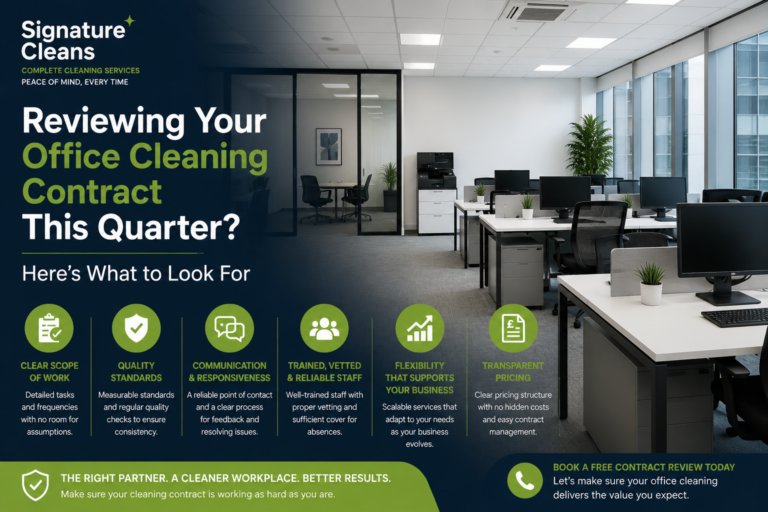
For businesses in Exeter and surrounding areas, Signature Cleans’ professional office cleaning services provide tailored schedules based on workplace requirements.
What Are the Benefits of Professional Office Cleaning for UK Businesses?
Professional cleaning offers more than tidy desks. A well-managed service can improve workplace presentation, support hygiene and reduce cleaning-related administration.
1. A Cleaner Environment for Employees
Shared kitchens, washrooms, meeting rooms and workstations accumulate dirt throughout the working week.
Regular cleaning helps maintain these spaces by removing waste, addressing frequently used surfaces and following an agreed cleaning specification.
This is particularly valuable in busy offices where employees share desks and facilities.
The main benefit is consistency: staff can arrive at a maintained workplace without being responsible for routine commercial cleaning alongside their normal duties.
2. How Office Cleanliness Affects Productivity
A clean office doesn’t automatically increase productivity, but poorly maintained facilities can create unnecessary distractions.
Overflowing bins, dirty kitchens and neglected communal areas may require employees or managers to interrupt their work to resolve cleaning problems.
Professional cleaning establishes clear responsibilities and scheduled tasks, reducing these interruptions.
The most measurable benefit is often the time recovered when employees and managers no longer need to organise or carry out routine cleaning.
Rather than assuming a percentage increase in productivity, businesses should calculate how much working time their current arrangements consume.
3. Workplace Hygiene and Employee Absenteeism
Regular cleaning supports workplace hygiene by maintaining shared surfaces, washrooms and communal facilities.
However, professional cleaning alone cannot guarantee fewer employee sick days.
Absenteeism depends on several factors, including seasonal illness, ventilation, personal hygiene and workplace policies.
Cleaning should therefore form part of a wider hygiene strategy rather than being presented as a guaranteed solution to sickness absence.
4. Better First Impressions for Clients
Your office provides clients, suppliers and prospective employees with an impression of how your organisation operates.
Clean reception areas, meeting rooms and washrooms can reinforce professionalism, while neglected facilities may undermine confidence.
This matters particularly in shared workplaces, where multiple businesses use the same communal spaces. In these environments, serviced office cleaning can help maintain consistent standards while accommodating changing occupancy patterns.
5. Less Administration for Business Owners
When cleaning is managed internally, someone must organise schedules, purchase supplies, monitor standards and resolve problems.
Depending on the contract, a professional provider can manage cleaning staff, arrange cover, supply equipment and conduct quality checks.
This reduces the time office managers spend dealing with routine cleaning issues and allows them to focus on their primary responsibilities.
What’s Included in a Professional Office Cleaning Contract?
A commercial cleaning contract should define the areas covered, cleaning frequency, responsibilities and expected standards.
Routine Office Cleaning
Typical tasks include vacuuming, mopping, dusting, waste collection, workstation cleaning and maintaining kitchens, washrooms and reception areas.
The agreement should also clarify exclusions, access arrangements and who supplies cleaning products and consumables.
Deep Cleaning and Specialist Services
Some tasks require less frequent but more intensive attention.
These may include carpet cleaning, upholstery treatment, detailed floor care and intensive cleaning of heavily used facilities.
A suitable provider should distinguish routine tasks from those requiring periodic deep cleaning, ensuring the workplace receives appropriate attention without unnecessary expenditure.
Contract Cleaning vs Janitorial Services
In the UK, contract cleaning and janitorial services can overlap.
Commercial cleaning contracts generally establish ongoing cleaning tasks, agreed frequencies and defined service responsibilities.
Janitorial services often focus on daily upkeep, such as waste management, replenishing washroom supplies and maintaining communal areas during working hours.
Because providers use these terms differently, businesses should compare the written service specification rather than relying on the service name.
How to Calculate the ROI of Professional Office Cleaning
The return on investment of office cleaning is usually measured through avoided costs, recovered working time and improved service consistency rather than direct revenue.
A useful starting point is:
Net financial value = Measurable costs avoided – Professional cleaning cost
Less measurable benefits, such as workplace presentation and employee comfort, should be considered separately.
Step 1: Calculate Your Current Cleaning Costs
Identify the resources currently required to maintain your office.
Include:
- Employee hours spent cleaning
- Management time spent organising cleaning
- Cleaning products and consumables
- Equipment purchases and maintenance
- Recruitment and employment costs, where relevant
- Holiday and sickness cover
Where employees undertake cleaning, consider the full cost of their working time rather than salary alone.
Step 2: Compare Professional Cleaning Quotations
Request quotations based on your premises, occupancy and required tasks.
Check what’s included, how often cleaning will take place, whether products and equipment are supplied, and how quality will be monitored.
A cheaper quotation isn’t necessarily better value if essential tasks are excluded.
Step 3: Calculate Potential Value
Consider a hypothetical office where employees collectively spend five hours per week cleaning communal areas.
If that time is valued at £18 per hour:
5 hours × £18 = £90 per week
Across 52 weeks, this represents £4,680 of employee time.
This is an illustrative calculation, not a typical cleaning price or guaranteed saving. The hourly figure is hypothetical and may not reflect full employment costs.
Time recovered only becomes a financial saving when it reduces actual costs or creates productive capacity.
Businesses should compare these measurable costs with the proposed contract price while also considering service reliability and reduced administration.
Step 4: Monitor Cleaning Performance
After appointing a provider, review:
- Completion of agreed tasks
- Missed visits or recurring issues
- Quality inspection results
- Employee and manager feedback
- Time spent resolving complaints
- Unexpected additional costs
These measures provide a more credible assessment of value than an unsupported ROI percentage.
In-House vs Outsourced Office Cleaning: Which Is Better?
Businesses can employ cleaners directly, outsource to a specialist provider or combine both approaches.
|
Factor |
In-House Cleaning |
Outsourced Cleaning |
| Recruitment | Business responsibility | Usually contractor-managed |
| Payroll | Managed internally | Contractor manages its employees |
| Absence cover | Business arranges | Depends on contract |
| Equipment | Usually supplied internally | Depends on agreement |
| Quality checks | Managed internally | May include contractor inspections |
| Management time | Direct supervision required | Usually reduced |
| Total cost | Staffing and operating costs | Scope and frequency dependent |
When Is Outsourcing Worth It?
Outsourcing may be particularly valuable when:
- Cleaning is needed several times per week.
- Employees currently handle routine cleaning.
- Evening or weekend cleaning is required.
- Managing staff and absence cover takes significant time.
- Documented standards and inspections are important.
- The business needs clearer accountability.
A managed service can provide predictable cleaning arrangements while reducing operational responsibilities.
When Might In-House Cleaning Be Better?
Outsourcing isn’t automatically cheaper.
Large workplaces requiring cleaners throughout the day may benefit from directly employed staff, particularly where management systems and equipment already exist.
Small offices with limited occupancy may only need occasional professional visits.
Some businesses benefit from a hybrid arrangement, with basic upkeep managed internally and scheduled specialist cleaning outsourced.
The right choice depends on total cost, required standards and available management capacity.
What Commercial Cleaning Compliance Requirements Apply in the UK?
UK employers have responsibilities to provide safe and healthy workplaces.
The Health and Safety at Work etc. Act 1974 and the Workplace (Health, Safety and Welfare) Regulations 1992 are relevant to workplace safety, cleanliness and welfare facilities.
Professional cleaning can support these obligations, but appointing a contractor does not automatically remove an employer’s responsibilities.
Cleaning Chemicals and COSHH
The Control of Substances Hazardous to Health Regulations (COSHH) may apply where cleaning products create relevant exposure risks.
Contractors should assess applicable risks, use products correctly and ensure staff receive suitable training.
Businesses should ask how providers manage chemical storage, safe working procedures and site-specific hazards.
Risk Assessments and Safe Working Practices
Cleaning contractors should understand risks associated with wet floors, manual handling, equipment and cleaning chemicals.
Appropriate risk assessments and method statements may be needed depending on the work involved.
For authoritative guidance, consult the Health and Safety Executive’s workplace facilities guidance.
What Accreditations Should a UK Cleaning Company Have?
Accreditations and independent assessments can help businesses evaluate potential contractors.
However, no single certification guarantees cleaning quality, and not every office cleaning company is legally required to hold the same accreditations.
What Does SSIP Accreditation Mean?
Safety Schemes in Procurement (SSIP) supports the assessment and mutual recognition of occupational health and safety standards.
Assessment through an SSIP member scheme provides evidence that a contractor’s health and safety management arrangements have been evaluated against relevant criteria.
It does not guarantee that accidents cannot occur or that every cleaning task will meet the required standard.
Businesses should verify current assessment status and continue checking site-specific safety arrangements.
Learn more from Safety Schemes in Procurement.
Other Credentials Worth Checking
Depending on the premises, buyers may request evidence of:
- Appropriate public liability and employers’ liability insurance
- Staff training and supervision
- Quality inspection procedures
- Risk assessments and safe working practices
- Relevant commercial cleaning experience
- Contractor prequalification or quality assessments
Some providers hold PQS or CQMS-related certifications. Buyers should verify the issuing organisation, validity and scope of any claimed assessment.
Credentials matter, but consistent attendance, clear communication and reliable service delivery are equally important.
How to Choose the Right Office Cleaning Company in the UK
Choosing a provider should involve more than comparing headline prices.
Check Relevant Experience
Look for experience with similar workplaces.
A professional services office, shared workspace and busy customer-facing premises may require different cleaning schedules.
Request a Clear Cleaning Specification
Ask for a written breakdown of areas, tasks and frequencies.
Avoid vague quotations describing the service only as “general office cleaning”.
A clear specification establishes expectations and makes performance easier to assess.
Verify Insurance, Training and Security
Request appropriate insurance documentation and ask how cleaners are trained and supervised.
Discuss access controls, key management and any site-specific security requirements.
DBS checks may be relevant in certain environments, but they are not universally required for office cleaners.
Ask About Quality Control
Find out whether the provider conducts inspections, records problems and follows up on corrective actions.
A named contact and clear complaints procedure can reduce management time and improve accountability.
Consider Green Cleaning Practices
Businesses seeking environmentally responsible cleaning should ask about:
- Appropriate product selection and dilution
- Reusable materials where suitable
- Reduced packaging waste
- Efficient cleaning schedules
- Responsible waste segregation
Avoid assuming that products marketed as “green” are automatically harmless or suitable for every surface.
A responsible contractor should explain how its methods balance effectiveness, safety and environmental considerations.
Questions to Ask Before Hiring a Commercial Cleaner
Before signing a contract, ask:
- Which areas and tasks are included?
- How often will each area be cleaned?
- Who supplies equipment and consumables?
- What happens if a cleaner is absent?
- How are cleaning standards inspected?
- What insurance and accreditations can be verified?
- How is site access managed?
- What are the notice periods and contract terms?
Clear answers help businesses compare providers on actual service value.
How Often Should an Office Be Professionally Cleaned?
Cleaning frequency depends on occupancy, visitor traffic, shared facilities and working patterns.
|
Office Type |
Possible Approach |
| Small, lightly used office | One or two visits per week |
| Medium office with regular occupancy | Several visits per week |
| Busy office with shared facilities | Daily cleaning may be appropriate |
| Customer-facing workplace | Regular cleaning with extra attention to reception and washrooms |
| Hybrid office | Schedule aligned with occupancy |
These are illustrative starting points, not universal requirements.
High-use washrooms, kitchens and waste facilities may need more frequent attention than other areas.
A site assessment can help establish a practical schedule without paying for unnecessary visits.
Frequently Asked Questions
Is Professional Office Cleaning Worth It for a Small Business?
It can be, especially when employees spend valuable time cleaning or shared facilities need regular attention. However, a lightly used office may only require occasional professional visits.
Is Outsourcing Cheaper Than Employing an In-House Cleaner?
Not always. Outsourcing may reduce recruitment, supervision and equipment responsibilities, but total costs depend on cleaning hours, service requirements and contract terms.
How Can a Business Calculate Office Cleaning ROI?
Compare professional cleaning costs with measurable expenses avoided, including employee time, management administration, equipment and staffing costs. Assess less measurable benefits separately.
Does Professional Cleaning Reduce Employee Sick Days?
Appropriate cleaning supports workplace hygiene, but reduced absenteeism cannot be guaranteed. Illness rates are influenced by ventilation, personal hygiene and other factors.
Can Office Cleaning Take Place Outside Business Hours?
Yes. Many providers offer early morning, evening and weekend cleaning. Availability and additional costs should be confirmed before signing a contract.
What Does SSIP Accreditation Mean for a Cleaning Contractor?
SSIP provides a framework for health and safety prequalification. It offers evidence of assessed management arrangements but does not guarantee cleaning quality or replace site-specific checks.
Is Professional Office Cleaning Worth the Investment for Your Business?
For many UK businesses, professional office cleaning is worthwhile because it delivers more than a tidy workplace.
A well-managed service can maintain hygiene standards, support professional presentation, reduce cleaning-related administration and provide clearer accountability.
However, the best investment isn’t necessarily the most frequent or expensive cleaning contract.
The right service matches your premises, working patterns, budget and required standards.
Before making a decision, calculate your current cleaning costs, identify operational problems and compare the value of different arrangements.
Find Out What Professional Office Cleaning Could Cost Your Business
Signature Cleans provides tailored commercial and office cleaning services for businesses in Exeter and across its service areas in Devon, Cornwall and Somerset.
Our office cleaning service includes:
- Cleaning specifications tailored to your premises
- Flexible daily, weekly and out-of-hours schedules
- Trained cleaning teams
- Regular quality inspections
- Dedicated account support
- Quotations based on your requirements
Whether you’re reviewing an existing contract, outsourcing for the first time or looking for a more dependable provider, we can help assess your cleaning needs.
Request a Free Office Cleaning Assessment
Alternatively, call 01392 535094 to discuss your requirements with our Exeter team.
Signature Cleans – professional office cleaning built around your business.