
CQMS certification shows that a contractor has completed an assessment against specific health-and-safety or prequalification criteria. For facilities managers, it provides useful evidence when choosing a commercial cleaning company. However, it does not guarantee that assessors have inspected every cleaning operative, procedure or client site.
This distinction matters when selecting cleaners for offices, medical practices, dental surgeries, schools and other commercial premises in Exeter.
A certificate helps buyers evaluate a contractor’s management arrangements. Nevertheless, businesses must also check site-specific risk assessments, chemical handling, staff training and cleaning quality.
This guide explains what CQMS certification means, what it covers and how to verify a certificate. It also outlines the additional evidence you should request before appointing a cleaning contractor.
What Is CQMS Certification?
CQMS Ltd operates the CQMS Safety-Scheme, a UK contractor health-and-safety assessment scheme. The organisation also holds Registered Member status with Safety Schemes in Procurement (SSIP).
Through this scheme, CQMS reviews contractors’ submitted documentation against the relevant SSIP core criteria. Contractors who meet those criteria can obtain certification within the appropriate assessment category.
According to the official SSIP register, CQMS Ltd has held Registered Member status since April 2012.
Additionally, CQMS offers broader contractor prequalification assessments. Therefore, the meaning of a CQMS certificate depends on the specific scheme, assessment level and modules completed.
Importantly, a standard CQMS Safety-Scheme assessment differs from ISO 9001 certification or a comprehensive inspection of cleaning operations.
For procurement teams, the key question is not simply whether a contractor displays a CQMS logo.
Instead, ask which assessment the contractor completed and what that assessment verifies.
What Does CQMS Certification Cover?
A CQMS Safety-Scheme assessment reviews documented health-and-safety management arrangements against the applicable SSIP criteria.
Depending on the assessment category, contractors may need to provide policies, risk assessments, competence records, training information and other relevant evidence.
However, a standard desktop assessment does not involve watching cleaners work at every client site.
| Evidence | What It Can Demonstrate | What Buyers Must Still Check |
| Current CQMS Safety-Scheme certificate | Assessment against relevant SSIP criteria | Certificate validity and scope |
| Health-and-safety documentation | Documented management arrangements | Whether staff follow procedures |
| Risk assessment evidence | A method for identifying and controlling hazards | Risks specific to your premises |
| Training arrangements | Evidence of competence management | Individual competence and site induction |
| Additional assessment modules | Further prequalification evidence | Which modules the contractor completed |
| Site-based assessment, if applicable | Additional on-site examination | Locations and activities covered |
This distinction becomes particularly important in commercial cleaning.
For example, a contractor may have a suitable company-wide safety policy. However, it must still explain how staff will manage slippery floors, chemical exposure and access restrictions at your building.
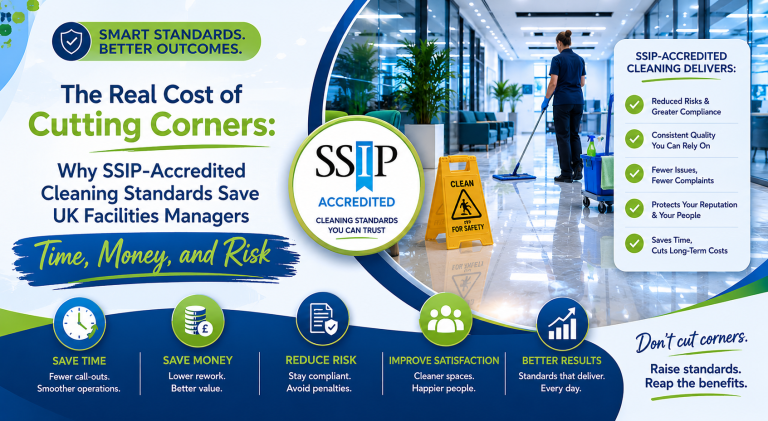
For further guidance, read why SSIP-accredited cleaning standards matter to facilities managers.
Why Does CQMS Certification Matter When Choosing a Cleaning Contractor?
CQMS certification helps buyers assess whether a contractor has demonstrated suitable health-and-safety management arrangements against defined criteria.
As a result, procurement teams can use it as one element of their supplier assessment process.
However, certification should never replace a wider evaluation.
Facilities managers should also consider insurance, cleaning specifications, operational experience, staff competence, quality checks and communication.
A certified contractor will not automatically suit every building. Equally, a company without a particular certificate may still have the competence to deliver safe cleaning.
Ultimately, certification provides independent assessment against defined criteria rather than a guarantee of perfect performance.
Businesses considering commercial contract cleaning in Exeter should therefore examine both contractor credentials and the proposed cleaning arrangements.
Risk Assessments: Generic Documents vs Site-Specific Controls
Risk assessments help cleaning companies identify hazards, evaluate potential harm and introduce suitable control measures.
Although a generic assessment provides a useful starting point, it may overlook risks at an individual property.
For this reason, contractors should adapt their assessments to the workplace.
| Generic Risk Assessment | Site-Specific Risk Assessment |
| Lists slippery floors as a general hazard | Identifies entrances, floor finishes and cleaning times |
| Mentions hazardous chemicals | Considers products and methods used on site |
| Refers broadly to vulnerable occupants | Accounts for relevant occupants and activities |
| Covers manual handling generally | Considers stairs, storage and equipment movement |
| Uses an unchanged template | Reflects the building’s layout and working conditions |
| Follows only a fixed review date | Responds to changing risks and circumstances |
These examples demonstrate good risk-management practice. They do not mean CQMS independently inspects every client’s cleaning arrangements.
For instance, medical practices may require additional controls for infection prevention, patient movement and clinical equipment.
Meanwhile, offices often need procedures for shared kitchens, washrooms, floor finishes and out-of-hours access.
In both cases, contractors should match their cleaning procedures to the premises rather than rely on generic paperwork.
COSHH Compliance: What Should Cleaning Companies Demonstrate?
The Control of Substances Hazardous to Health Regulations 2002, commonly known as COSHH, require employers to assess and control risks from hazardous substances.
Cleaning companies frequently use detergents, disinfectants, descalers and other products that require appropriate precautions.
Consequently, a competent contractor should explain how it manages those risks.
COSHH Risk Assessments and Safety Data Sheets
Safety Data Sheets (SDS) provide information about chemical hazards, handling, storage and emergency measures.
However, an SDS does not replace a COSHH risk assessment.
Employers must consider how staff use each substance, the potential exposure and the controls needed to prevent harm.
The Health and Safety Executive’s COSHH guidance explains these responsibilities in more detail.
Safe Chemical Handling
Appropriate controls may include suitable product selection, correct dilution, protective equipment, secure storage and staff instruction.
Additionally, employers should review risk assessments when circumstances change or existing controls become ineffective.
Importantly, HSE does not impose a universal three-year SDS review cycle.
Instead, contractors should maintain relevant information and ensure their controls remain appropriate.
Although CQMS may assess health-and-safety management evidence, buyers should still check the chemical-handling arrangements proposed for their building.
Colour-Coded Cleaning: Reducing Cross-Contamination
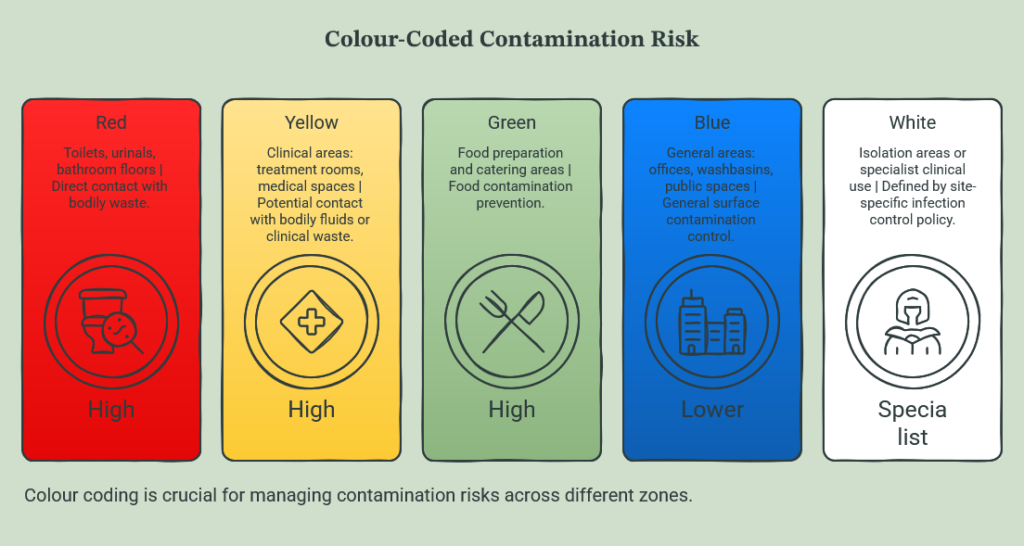
Colour-coded cleaning helps teams separate equipment between different areas.
For example, cleaners should not use cloths or mop heads from toilets in kitchens or reception areas.
By keeping equipment separate, cleaning companies can reduce the risk of transferring contamination.
Many organisations use colour-coding systems. However, the exact colours and procedures should reflect the site’s requirements.
A cleaning contractor should demonstrate that staff understand:
- Which equipment belongs in each area.
- How to store and maintain cleaning equipment.
- What to do if equipment enters the wrong zone.
- Whether specialist areas need additional precautions.
Nevertheless, colour-coding cannot eliminate every contamination risk.
Likewise, CQMS Safety-Scheme certification does not automatically prove that assessors have inspected a particular colour-coding system.
The important requirement is a suitable procedure that staff understand and follow consistently.
Operative Training: Turning Cleaning Standards Into Practice
Written policies only work when employees understand how to apply them.
Therefore, cleaning operatives need training that reflects their duties, equipment, chemicals and working environment.
Relevant training may include site induction, COSHH awareness, manual handling, safe equipment use and emergency procedures.
Specialist environments may also require additional instruction.
For example, cleaners working in medical practices must understand the difference between general environmental cleaning and tasks that appropriately trained clinical staff should perform.
Furthermore, contractors need arrangements for supervising employees, responding to problems and updating training when procedures change.
When assessing a cleaning company, ask for evidence of relevant training arrangements. You should also establish how supervisors check staff competence.
Crucially, company-level certification does not mean the certification provider has individually assessed every employee.
CQMS Certification vs ISO 9001: What’s the Difference?
CQMS Safety-Scheme certification and ISO 9001 certification serve different purposes.
| Comparison | CQMS Safety-Scheme | ISO 9001 |
| Main focus | Contractor health-and-safety assessment | Quality management systems |
| Assessment basis | Relevant SSIP core criteria | ISO 9001 requirements |
| Typical use | Contractor prequalification | Demonstrating quality-management arrangements |
| What it does not guarantee | Perfect safety performance | Perfect service quality |
| Buyer consideration | Check assessment category and scope | Check certification body, scope and validity |
Additionally, CQMS offers broader prequalification services. Therefore, buyers should not assume every CQMS assessment covers identical requirements.
Neither certification replaces the need to review a contractor’s cleaning specification or operational capabilities.
Instead, procurement teams should understand what each credential demonstrates and assess it alongside practical evidence.
What Additional Cleaning Evidence Should Different Premises Request?
Different workplaces present different cleaning risks.
Consequently, facilities managers should request evidence that reflects their building and its activities.
| Environment | Additional Evidence to Request |
| Medical practices | Risk-based schedules, IPC procedures, task responsibilities and product information |
| Dental surgeries | Environmental cleaning arrangements, equipment boundaries and infection-control procedures |
| Professional offices | Cleaning specifications, COSHH controls, staff cover and quality checks |
| Schools | Safeguarding procedures, appropriate vetting where required and cleaning risk assessments |
| Shared commercial buildings | Access arrangements, communal-area schedules and reporting procedures |
Healthcare cleaning requires particular attention.
For instance, a CQMS Safety-Scheme certificate does not automatically establish compliance with Care Quality Commission requirements or NHS infection prevention guidance.
Healthcare providers must therefore maintain appropriate cleaning and infection-control arrangements.
For additional information, explore Signature Cleans’ medical and dental cleaning services and office cleaning services in Exeter.
How Do You Verify a Cleaning Company’s CQMS Certification?
Before accepting a CQMS certification claim, request the contractor’s current certificate and check its details.
Use the following verification checklist:
- Legal company name: Confirm that it matches the business you intend to appoint.
- Issuing scheme: Identify whether the certificate comes from CQMS Safety-Scheme or another assessment provider.
- Certificate number: Request an identifiable reference.
- Assessment scope: Check which activities and categories the certificate covers.
- Validity: Confirm that the certification remains current.
- Additional modules: Establish whether broader quality or site-based assessments form part of the certification.
Next, verify the details with the issuing organisation or through the relevant SSIP verification arrangements.
Remember that SSIP includes multiple registered assessment schemes. Therefore, an SSIP-accredited contractor does not necessarily hold a CQMS-issued certificate.
Finally, request the cleaning specification, relevant safety information and quality-control arrangements for your premises.
By combining certification checks with operational due diligence, buyers can make a better-informed decision.
Frequently Asked Questions About CQMS Certification
Is CQMS Certification the Same as SSIP Accreditation?
CQMS Safety-Scheme operates as an SSIP Registered Member scheme. Therefore, a qualifying CQMS assessment can provide SSIP recognition within the relevant category. However, contractors can also obtain SSIP recognition through other registered schemes.
Does CQMS Certification Guarantee Safe Cleaning?
No. Certification provides assurance about the assessed criteria. However, it cannot guarantee that accidents, contamination or service failures will never occur.
Does CQMS Certification Cover Medical Cleaning Standards?
Not automatically. Healthcare cleaning requires additional infection-prevention controls, appropriate procedures and clear responsibilities. Therefore, buyers should assess healthcare-specific requirements separately.
Can Buyers Request Additional Cleaning Safety Evidence?
Yes. Buyers can request relevant risk assessments, COSHH information, training arrangements, insurance details and cleaning specifications as part of contractor due diligence.
Choosing a Cleaning Contractor in Exeter: Look Beyond the Certificate
CQMS certification provides useful evidence when evaluating a cleaning contractor. However, buyers must understand the assessment scope before relying on it.
Facilities managers should also check whether the contractor has suitable procedures for their building, competent staff and reliable quality-control arrangements.
Signature Cleans provides commercial cleaning services for offices, healthcare premises and other workplaces across Exeter and Devon.
If you’re reviewing your current contractor or preparing a new cleaning specification, discuss your building’s requirements and request relevant credentials and operational documentation.