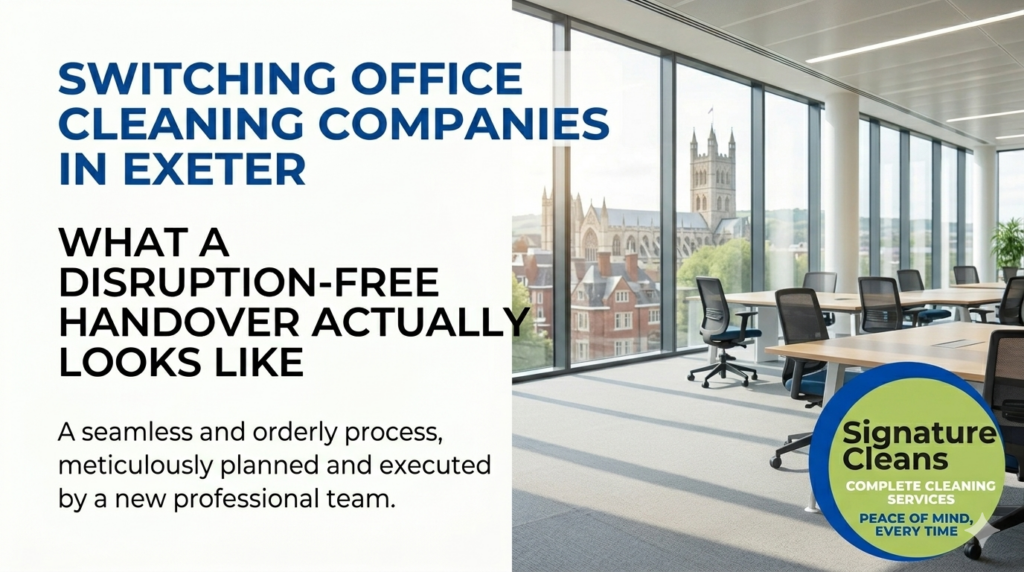
Quick Answer: Switching office cleaning companies in Exeter does not have to disrupt day-to-day operations. A structured handover — a documented onboarding plan, a clear point of contact, and a defined start date, allows a new provider to take over with no gap in service and no impact on staff or visitors. The risk most businesses associate with switching usually comes from a previous provider’s poor communication, not from the act of switching itself.
“We’d switch, but it feels like a hassle”
It’s one of the most common reasons businesses stay with an underperforming office cleaning company in Exeter for far longer than they should. The cleaning isn’t good enough. The communication has gone quiet. Standards have slipped. But switching feels riskier than putting up with it.
That hesitation is understandable, and it’s also based on a false assumption. Switching providers is only disruptive when the new provider doesn’t have a structured process for taking over. With the right onboarding approach, a change in cleaning company should feel like a step forward, not a risk.
What a structured cleaning handover should include
A disruption-free switch isn’t about luck — it’s about process. Before agreeing to a new contract, a facilities manager or business owner should expect a new provider to set out exactly how the transition will work, in writing, before the first clean takes place.
| What to expect | Why it matters |
| Site walkthrough | A director or manager visits the site before the contract starts, to understand layout, access, existing schedules and any sensitivities (e.g. occupied desks, client-facing areas). |
| Defined start date | A fixed handover date agreed in advance – not an open-ended transition that drags on for weeks. |
| Named point of contact | One person responsible for the account from day one, so questions and adjustments don’t get lost between people. |
| Documented scope | A written specification of tasks, frequency and standards, removing ambiguity about what’s included. |
| Overlap or notice period | Enough notice with the outgoing provider that there’s no gap in coverage between contracts. |
| First-week check-in | A scheduled follow-up in the first week to catch and resolve any teething issues immediately. |
If a prospective cleaning company can’t describe this process clearly before you’ve signed anything, that’s a signal worth paying attention to, the same lack of structure is likely to show up in the cleaning itself.
Why most cleaning problems start with communication, not cleaning
It’s a pattern that shows up across the commercial cleaning industry: the issue a client complains about is rarely the root cause. A missed bin, a smudged window, an unstocked washroom, these happen with almost every provider occasionally. What turns a minor lapse into a reason to switch is what happens next.
The communication gap that causes most complaints
Without a clear feedback loop, small issues go unreported until they accumulate into a bigger frustration. No updates after a clean. No way to flag a problem quickly. No accountability for how an issue was resolved, or whether it was resolved at all. None of this is about the standard of cleaning, it’s about the absence of a system around it.
What good communication looks like in practice
• A single named contact who knows your site, not a call centre
• A clear channel to report an issue the same day it happens
• Visibility on what was done – not just an assumption that it was
• A response and resolution, not just an acknowledgement
This is also why monthly audits and documented reporting matter more than they might seem to on paper. They turn cleaning quality into something you can see and measure, rather than something you only notice when it’s gone wrong.
Reliability is the Baseline – Not a Selling Point
Turning up on time. Doing the job properly. These shouldn’t be features a cleaning company highlights as a differentiator, they’re the minimum expectation of any commercial contract. Yet in commercial cleaning, this is consistently where providers fall short.
The businesses that switch providers most often aren’t chasing a cheaper price or a longer list of extras. They’re looking for a company that simply does what it says it will do, every time, without needing to be chased. That consistency is what allows a facilities manager to stop thinking about cleaning altogether — which is the actual goal of outsourcing it in the first place.
What causes most office cleaning complaints? Most commercial cleaning complaints originate from poor communication rather than the cleaning itself. Common causes include a lack of regular updates, no clear channel to report issues, and no accountability for how problems are resolved. Reliable providers address this with a named point of contact, documented audits, and a consistent team assigned to each site.
Signs it’s time to switch your office cleaning provider
1. You’ve stopped reporting issues because nothing changes when you do
2. Different cleaners turn up each week with no consistency
3. There’s no documented schedule — just a vague sense of what’s covered
4. You have no way to verify the cleaning standard beyond a visual check
5. Your current provider can’t produce accreditation (SSIP, PQS, or equivalent) on request
If two or more of these sound familiar, the cost of staying is usually higher than the perceived cost of switching
Frequently Asked Questions: Switching Office Cleaning Providers
Will switching office cleaning companies disrupt my office?
It shouldn’t. A properly structured handover — including a site walkthrough, a fixed start date and an overlap or notice period with your outgoing provider — means a new cleaning company can take over with no gap in service and no impact on your day-to-day operations.
How much notice do I need to give my current cleaning company?
This depends on your existing contract terms, which typically range from 30 to 90 days. Check your current agreement for a specific notice period, and plan your new provider’s onboarding to begin once that notice period is confirmed.
What should I ask a new cleaning company before switching?
Ask how they handle onboarding and handover, who your single point of contact will be, how issues get reported and resolved, and whether they provide documented audits or reporting. Their answers to these questions tend to predict the day-to-day experience more reliably than the price they quote.
Why do most office cleaning complaints happen?
Most complaints trace back to poor communication rather than the cleaning itself — no updates, no clear way to report a problem, and no accountability when something is missed. A provider with a clear communication process tends to resolve small issues before they become recurring ones.
How long does it take to switch to a new office cleaning provider in Exeter?
With Signature Cleans, the process from first enquiry to first clean is typically under two weeks. This includes a free site assessment, a documented proposal, and onboarding of a dedicated team trained to your site before their first visit.
Related Reading
If you’re weighing up a switch, these pages cover the standards and accreditation worth checking before you sign a new contract:
| Page | Why it’s relevant |
| Office Cleaning Exeter | Our core office cleaning service — SSIP-accredited, dedicated teams, documented audits. |
| Contract Cleaning | Daily, weekly and out-of-hours commercial cleaning delivered to a documented playbook. |
| The Real Cost of Cutting Corners | Why accreditation and documented standards reduce risk and hidden cost. |
| Why Professional Office Cleaning Is a Sound Investment | The business case for accredited office cleaning over ad-hoc or in-house cleaning. |
Switching shouldn’t feel like a risk
If your current office cleaning in Exeter isn’t being communicated clearly, or basic reliability has become the exception rather than the rule, a structured switch can solve both — without disrupting your week.
| 📋 Book a free site assessmentsignature-cleans.co.uk/contact | 📞 Call us direct01392 535094 |
Peace of mind, every time.