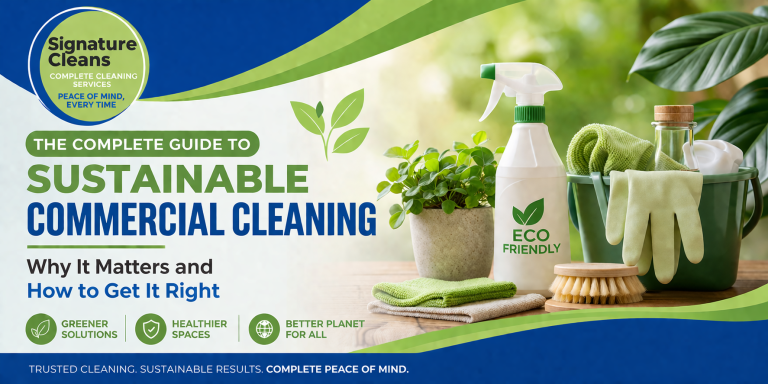
Sustainability is no longer a nice-to-have — it’s an expectation. More and more businesses across Exeter and the South West are asking their cleaning providers about environmental practices. But there’s a tension that deserves an honest answer: can you clean to a genuinely professional standard whilst reducing your environmental impact?
The answer is yes — but it requires considerably more than simply swapping one product for another. It takes a considered approach to chemicals, equipment, training, and waste management. Here’s how responsible commercial cleaning Exeter actually works in practice.
The Chemical Question: What Green Cleaning Actually Means
Cleaning chemicals are the most visible environmental issue for any commercial cleaning service. Traditional products often contain volatile organic compounds (VOCs), phosphates, and synthetic fragrances that are harmful to both the environment and indoor air quality.
The good news is that the market for effective, environmentally responsible alternatives has matured considerably. When selecting green cleaning chemicals, reputable commercial cleaners in Exeter should be looking for:
- EU Ecolabel or equivalent certification — Independent verification that a product meets environmental performance standards across its entire lifecycle
- Biodegradable formulations — Products that break down safely after entering the water system, rather than accumulating in waterways
- Low or zero VOC content — Reducing airborne pollutants improves indoor air quality for building occupants, which is particularly important in enclosed office environments
- Concentrated formats — Concentrated products reduce plastic packaging and transport emissions significantly; a single litre of concentrate can replace dozens of ready-to-use spray bottles
However, honesty matters here. In certain environments — healthcare settings, food production facilities, or premises dealing with specific biohazards — there are situations where a stronger chemical is genuinely necessary. Being environmentally responsible doesn’t mean using an eco-label product where it cannot do the job. It means choosing the right product for each situation and selecting the greener option wherever it is genuinely effective.
Dilution Systems: One of the Biggest Environmental Wins in Office Cleaning
One of the most impactful environmental improvements in professional cleaning in Exeter comes not from which chemical you use, but how you use it.
Dilution control systems — where concentrated chemicals are automatically mixed with water at the correct ratio — deliver several meaningful benefits:
- Reduced chemical waste — Manual mixing often leads to over or under-dilution; automated systems eliminate this inconsistency entirely
- Less plastic waste — A single 5-litre concentrate container replaces approximately 50 trigger spray bottles; over the course of a year, the plastic savings are substantial
- Lower transport footprint — Shipping concentrated products means fewer deliveries, less fuel, and reduced carbon emissions
- Consistent cleaning results — Correct dilution means the product performs as intended every time, which actually improves outcomes rather than compromising them
For any office cleaning service in Exeter that takes sustainability seriously, dilution control systems should be standard practice — not an optional extra.
Microfibre Technology: Cleaner Results, Fewer Chemicals
Microfibre cloths and mops represent one of the most significant advances in environmentally responsible cleaning. A quality microfibre cloth can remove up to 99% of bacteria from a surface using water alone — no chemicals required for routine dusting and surface wiping.
The environmental advantages are tangible:
- Dramatically reduced chemical usage — For many routine tasks, water and microfibre are entirely sufficient
- Reduced water consumption — Microfibre mops use a fraction of the water compared to traditional cotton alternatives
- Longer lifespan — A quality microfibre cloth can withstand hundreds of machine washes before needing replacement, unlike disposable alternatives
The important caveat is that microfibre must be laundered correctly — washed at the right temperature, without fabric softener — to maintain its effectiveness. Poorly maintained microfibre performs no better than a standard cloth. This is a training and quality control issue, not a product issue, and it’s one that any serious cleaning company in Exeter should have a clear process for managing.
Addressing Common Misconceptions About Green Commercial Cleaning
One of the challenges Exeter businesses encounter is the gap between what they expect from eco-friendly cleaning and what it actually involves. A few common misconceptions worth addressing directly:
“Green cleaning means it won’t smell clean” — Many people associate the smell of strong chemicals with cleanliness. In reality, that chemical smell often indicates poor ventilation or over-application. A properly cleaned space should smell neutral and fresh, not heavily fragranced.
“Eco products don’t work as well” — This may have been true a decade ago. Modern eco-certified products now perform comparably to traditional alternatives for the vast majority of commercial cleaning tasks.
“It costs more” — Concentrated products and microfibre systems frequently reduce overall costs through lower consumption and longer equipment life. The initial investment in better equipment typically pays for itself within a reasonable timeframe.
Signature Cleans: A Practical Approach to Sustainable Commercial Cleaning in Exeter
At Signature Cleans, our approach to sustainability is practical rather than ideological. We don’t claim to be a “100% green” cleaning company — because that claim usually involves compromises we’re not willing to make on quality or results.
Instead, we take a straightforward approach to delivering responsible commercial cleaning services in Exeter:
- Use environmentally responsible products wherever they deliver the required standard of cleanliness
- Use stronger products only where genuinely necessary, minimising their use through targeted, careful application
- Invest in equipment and systems that reduce waste, chemical usage, and water consumption as standard practice
- Train our teams thoroughly to use products correctly — because even the most responsible product is wasteful when over-applied
- Continuously review our product range as better, more effective alternatives become available
Sustainability in commercial cleaning isn’t about perfection. It’s about making consistently better choices, being honest about trade-offs, and delivering results that satisfy both your cleanliness standards and your environmental values.
Ready to Work with a Cleaning Company in Exeter That Takes Both Quality and Sustainability Seriously?
If you’d like to find out how Signature Cleans can maintain the highest cleaning standards for your Exeter premises whilst supporting your sustainability commitments, we’d welcome the conversation.
Request your free consultation today and find out what responsible, professional cleaning looks like for your business.