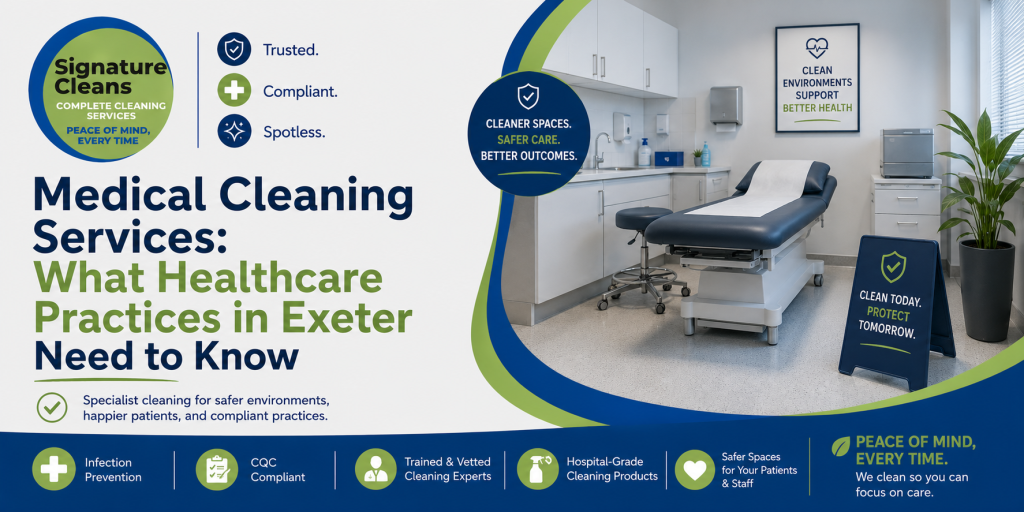
Healthcare practices in Exeter, including GP surgeries, dental practices, private clinics and physiotherapy centres, need cleaning arrangements that reflect their clinical activities, infection prevention procedures and patient-facing environments.
Unlike standard office cleaning, medical cleaning requires clear responsibilities, suitable products, appropriate cleaning frequencies and documented quality checks.
Signature Cleans provides medical and dental cleaning services in Exeter, with tailored cleaning specifications and flexible schedules designed around individual healthcare premises.
However, choosing a cleaning contractor involves more than finding someone to maintain a tidy waiting room.
Practice managers must understand which tasks belong to their cleaning provider, which remain with clinical staff and how environmental cleanliness supports wider infection prevention arrangements.
This guide explains what professional medical cleaning should include, the relevant regulatory considerations and how Exeter healthcare practices can evaluate potential contractors.
Why Healthcare Practices Require a Specialist Cleaning Approach
Healthcare environments present different cleaning challenges from conventional commercial premises.
Patients, clinical staff and visitors regularly move between waiting rooms, consultation areas and treatment spaces. Consequently, cleaning arrangements must account for different activities and levels of risk.
A dental surgery, for example, may require environmental cleaning alongside separate procedures for decontaminating clinical equipment.
Similarly, a GP practice needs suitable arrangements for consultation rooms, shared facilities, washrooms and frequently touched surfaces.
The objective is not simply to make the premises look clean.
Instead, environmental cleaning should support the healthcare provider’s infection prevention procedures while maintaining a welcoming environment for patients.
Cleaning, Disinfection and Decontamination
These terms describe different activities.
Cleaning removes dirt, organic matter and contamination from surfaces.
Disinfection uses appropriate products or methods to reduce or inactivate microorganisms.
Decontamination is a broader process that may involve cleaning, disinfection or sterilisation, depending on the item and risk.
Not every surface requires the same treatment.
Therefore, practices should establish suitable procedures for each area and follow relevant clinical guidance and product instructions.
Infection Prevention and Cleaning Responsibilities
One of the biggest risks in healthcare cleaning is unclear responsibility.
For example, a contractor may assume clinical staff clean treatment surfaces between appointments, while the practice manager expects those tasks to form part of the external cleaning contract.
Without written arrangements, important tasks may be missed.
Preventing Cross-Contamination
Cleaning equipment should be separated appropriately between areas with different hygiene requirements.
Colour-coded cloths, mops and other equipment can help staff maintain this separation.
However, the colour-coding arrangement should follow the practice’s documented procedures rather than rely on an assumed universal system.
Likewise, cleaning products should suit the surface, task and relevant infection prevention requirements.
Where disinfection is necessary, staff must follow the manufacturer’s instructions, including the required concentration and contact time.
Clinical Waste and Sharps
Clinical waste management requires separate consideration.
Healthcare providers should establish appropriate arrangements for waste segregation, storage, collection and disposal.
Routine environmental cleaning contracts should not automatically include handling clinical waste or sharps.
Instead, the contract must identify any authorised waste-related tasks and the necessary training, equipment and procedures.
Clear boundaries help protect staff and ensure responsibilities remain understood.
What Should a Healthcare Cleaning Specification Include?
A written cleaning specification defines what the contractor will clean, how often tasks should occur and which responsibilities remain with the practice.
The following table provides a practical starting point.
| Area or Task | Cleaning Requirements | Responsibility |
| Reception and waiting areas | Floors, seating, counters and touchpoints | Cleaning contractor |
| Consultation rooms | Agreed environmental cleaning tasks | Practice and contractor |
| Treatment surfaces | Between-patient cleaning and disinfection procedures | Usually clinical team; confirm locally |
| Toilets and washrooms | Fixtures, floors, touchpoints and appropriate products | Cleaning contractor |
| Clinical equipment | Manufacturer-approved cleaning and decontamination | Clinical staff or authorised personnel |
| Clinical waste and sharps | Segregation, storage and disposal arrangements | Healthcare provider and authorised waste contractors |
| Periodic deep cleaning | Additional tasks, frequencies and exclusions | Agreed contract responsibilities |
| Quality assurance | Inspections, records and corrective action | Both parties |
This table is illustrative.
The final specification should reflect the practice’s activities, risk assessments, layout and infection prevention procedures.
Importantly, it should distinguish routine cleaning from additional or specialist services.
For example, upholstery cleaning or intensive floor maintenance may require separate scheduling.
Where appropriate, professional deep cleaning services can complement the regular cleaning programme.
CQC Requirements and Medical Cleaning Standards
Healthcare practice managers often ask whether their cleaning contractor can make their premises CQC compliant.
However, no cleaning contractor can guarantee compliance simply by completing scheduled visits.
The healthcare provider remains responsible for meeting the regulatory requirements applicable to its service.
What Does CQC Regulation 15 Require?
The Care Quality Commission’s Regulation 15 addresses premises and equipment.
It requires relevant providers to maintain suitable, clean and properly maintained environments and equipment.
Appropriate cleaning arrangements, monitoring and maintenance can help providers demonstrate how they manage these responsibilities.
However, cleaning logs alone do not establish compliance.
Practice managers should consider their cleaning specification, risk assessments, infection prevention procedures and the effectiveness of their monitoring arrangements.
Read the CQC’s Regulation 15 guidance for further information.
NHS Healthcare Cleanliness Standards
The NHS National Standards of Healthcare Cleanliness 2025 provide guidance on cleaning responsibilities, risk categories, frequencies and quality assurance.
These standards are particularly relevant to NHS healthcare environments.
However, private practices and other healthcare organisations should determine which requirements apply to their circumstances rather than assume every NHS trust procedure automatically governs their premises.
For a more detailed discussion, read our guide to medical practice cleaning standards.
Why Cleaning Records and Quality Checks Matter
A cleaning programme needs more than a written schedule.
Practice managers also need a practical way to establish whether the agreed work is taking place.
Depending on the contract, useful records may include:
- Written cleaning specifications.
- Scheduled task checklists.
- Visit and attendance records.
- Quality inspection reports.
- Reports of missed tasks or problems.
- Records of corrective action.
These documents support accountability and help managers identify recurring issues.
Nevertheless, a completed checklist does not automatically prove that every surface meets the expected standard.
Inspections and communication remain important.
For example, if a washroom repeatedly falls below the agreed standard, the contractor should investigate the cause and agree corrective action with the practice.
This approach supports continuous improvement rather than relying solely on paperwork.
Flexible Medical Cleaning Around Clinical Hours
Healthcare practices often operate to demanding appointment schedules.
Therefore, cleaning arrangements should minimise unnecessary interference with consultations, treatments and patient access.
Depending on the premises, suitable options may include early morning, evening or weekend visits.
Some agreed tasks may also take place during opening hours.
An Example for an Exeter Dental Practice
Consider a busy dental practice that schedules routine cleaning after its final appointment.
The contractor cleans agreed floors, reception areas, washrooms and other environmental surfaces.
Meanwhile, clinical staff remain responsible for specified treatment-area cleaning between patients.
The practice also schedules periodic cleaning when rooms are available.
This is an illustrative arrangement rather than a description of a particular client contract.
The important point is that everyone understands the cleaning schedule and responsibility boundaries.
For more guidance on scheduling and accountability, see medical cleaning services: flexibility, process and results.
Why Patient-Facing Cleanliness Matters
Patients notice the condition of a healthcare environment.
A clean reception area, maintained washrooms and tidy waiting room contribute to a professional first impression.
Conversely, visibly dirty surfaces or neglected facilities may raise concerns about how the premises are managed.
However, appearance alone does not establish effective infection prevention.
A room may look clean while still requiring appropriate environmental cleaning procedures.
For this reason, healthcare practices should consider both visible presentation and the underlying cleaning arrangements.
The strongest approach combines suitable methods, documented responsibilities and consistent attention to patient-facing areas.
How to Verify a Healthcare Cleaning Contractor
Choosing a contractor involves evaluating practical competence rather than relying solely on marketing claims.
A suitable provider should understand the premises, explain its cleaning methods and agree clear responsibilities.
What Do Accreditations Tell You?
Safety Schemes in Procurement, or SSIP, provides a framework for recognised contractor health-and-safety assessments.
SSIP accreditation can help buyers assess relevant health-and-safety arrangements.
However, it does not guarantee clinical cleaning performance or establish CQC compliance.
Similarly, procurement certifications should be evaluated according to their actual scope.
Signature Cleans publicly identifies SSIP accreditation and PQS certification.
Healthcare buyers should verify current credentials, insurance, relevant training and site-specific procedures during procurement.
Questions Every Practice Manager Should Ask
Before appointing a contractor, ask:
- Which tasks will your team perform? Confirm responsibilities for clinical and non-clinical areas.
- How do you prevent cross-contamination? Ask about equipment separation, products and documented methods.
- Can you work around our clinical schedule? Establish access arrangements and suitable cleaning times.
- What training and safety evidence can you provide? Review relevant competence, insurance and risk assessments.
- How will you monitor cleaning quality? Agree inspection methods, reporting and corrective action.
Also ask how the contractor manages staff absence and communicates operational changes.
The answers should form part of the agreed cleaning specification.
How Signature Cleans Supports Healthcare Practices in Exeter
Signature Cleans provides tailored cleaning services for healthcare facilities across Exeter and the wider South West.
Its medical and dental cleaning service is designed for premises such as dental practices, private clinics, treatment centres and consulting rooms.
The company’s published approach includes:
Site assessment: Reviewing the premises, operational requirements and cleaning expectations.
Tailored specification: Agreeing cleaning tasks, frequencies, schedules and responsibilities.
Trained cleaning teams: Providing staff with relevant site instructions and cleaning procedures.
Flexible scheduling: Arranging cleaning around the practice’s operating hours where possible.
Quality inspections: Monitoring agreed standards and addressing issues through established reporting arrangements.
These measures provide a practical foundation for a managed healthcare cleaning contract.
However, each practice should confirm the precise scope of work before appointing a provider.
Frequently Asked Questions
How Often Should Healthcare Practices in Exeter Be Cleaned?
Cleaning frequency depends on the premises, patient activity, infection prevention requirements and the tasks involved. Some environmental areas may need daily cleaning, while specified clinical surfaces require attention between patients.
Can a General Commercial Cleaning Company Clean a GP Surgery?
Yes, provided the contractor has suitable competence, procedures and resources for the agreed tasks. The important issue is whether it can meet the healthcare environment’s actual requirements.
Does Medical Cleaning Include Clinical Waste Disposal?
Not automatically. Clinical waste and sharps require appropriate management arrangements. Any contractor involvement should be expressly agreed and supported by suitable procedures.
Can Cleaning Take Place Outside Patient Hours?
Yes. Early morning, evening and weekend cleaning may be suitable, depending on the practice and agreed contract.
What Records Should a Cleaning Contractor Provide?
The practice should agree appropriate documentation, which may include cleaning specifications, visit records, inspection reports and corrective-action records.
Medical Cleaning Services for Exeter Healthcare Practices
Healthcare cleaning requires more than a tidy reception area or a completed checklist.
Practice managers need suitable cleaning procedures, clear responsibilities, flexible scheduling and dependable quality checks.
The right contractor should understand the healthcare environment and work alongside the practice’s existing infection prevention arrangements.
Signature Cleans offers medical and dental cleaning services across Exeter and Devon, with tailored cleaning programmes and site assessments.
Whether you manage a GP surgery, dental practice, private clinic or treatment centre, a site assessment can help establish the cleaning requirements appropriate to your premises.
Request a Free Medical Cleaning Site Assessment
Alternatively, call 01392 535094 to discuss your healthcare cleaning requirements.