
What cleaning standards apply in the UK? There is no single mandatory cleaning standard covering every UK workplace. Commercial cleaning companies must meet applicable health and safety duties, including risk assessment and COSHH requirements. Cleaning quality is usually defined through site-specific specifications, suitable methods, staff training and inspections. Additional standards apply in particular sectors, including healthcare.
For facilities managers seeking professional contract cleaning services in Exeter, understanding these requirements helps distinguish genuine contractor capability from marketing claims.
However, cleaning standards are not simply a compliance exercise. They influence operational reliability, procurement efficiency and the total cost of maintaining a building.
A cheap quotation may become expensive when it excludes essential tasks, creates repeated complaints or requires additional management time.
This guide explains the UK cleaning standards landscape, what SSIP accreditation actually verifies and how to specify cleaning requirements in a commercial contract.
What Do Cleaning Standards Mean in the UK?
Cleaning standards operate across three distinct layers.
1. Legal Requirements
UK legislation establishes duties relating to workplace safety, hazardous substances, risk assessment and employee protection.
Cleaning contractors must identify relevant risks and implement suitable controls.
However, responsibilities depend on the work, premises and organisations involved.
2. Procurement and Accreditation Standards
Facilities managers may use recognised assessment schemes to evaluate contractor health and safety arrangements.
For example, Safety Schemes in Procurement (SSIP) supports mutual recognition between participating contractor assessment schemes.
Nevertheless, accreditation does not replace every buyer verification requirement.
3. Operational Cleaning Standards
Operational standards define the cleaning work itself.
These include cleaning frequencies, methods, surface requirements, staff competence, inspections and corrective action.
A contractor may hold recognised credentials while still needing a detailed, site-specific cleaning specification.
Therefore, buyers should evaluate all three layers rather than relying on certificates alone.
Which Cleaning Standards and Regulations Apply in the UK?
The following table distinguishes legal duties from voluntary frameworks.
| Standard or Framework | What It Covers | Status |
| Health and Safety at Work etc. Act 1974 | General workplace health and safety duties | Applicable legal requirements |
| COSHH Regulations 2002 | Risks from exposure to hazardous substances | Applicable legal requirements |
| Management of Health and Safety at Work Regulations 1999 | Risk assessment and preventive arrangements | Applicable legal requirements |
| SSIP | Contractor health and safety prequalification | Voluntary unless contractually required |
| BICSc | Professional cleaning training and methods | Voluntary unless specified |
| ISO 9001 | Organisational quality management systems | Voluntary unless specified |
| NHS National Standards of Healthcare Cleanliness 2025 | Healthcare cleaning requirements and assurance | Sector-specific requirements |
Not every framework applies to every building.
For example, a commercial office and an NHS hospital have different operational requirements.
Likewise, ISO 9001 certification does not establish that every cleaning visit meets a particular cleanliness standard.
The relevant question is whether the contractor can demonstrate suitable arrangements for the premises and work involved.
What Are the Legal Requirements for Commercial Cleaning?
UK commercial cleaning companies must manage workplace risks under applicable legislation.
The Health and Safety Executive provides guidance on employers’ responsibilities and safe working arrangements.
Risk Assessments and Safe Working Methods
Contractors should assess foreseeable risks associated with their cleaning activities.
These may include wet floors, manual handling, electrical equipment, working at height and interactions with building occupants.
Appropriate controls should reflect the actual site.
A generic risk assessment may provide a starting point, but it cannot account for every building’s access arrangements or hazards.
COSHH and Cleaning Chemicals
The Control of Substances Hazardous to Health Regulations require employers to assess and control relevant exposure risks.
For cleaning contractors, this may involve chemical selection, dilution, storage, ventilation and protective equipment.
Importantly, a Safety Data Sheet is not the same as a COSHH risk assessment.
The assessment considers how workers use a substance and the exposure risks arising from that activity.
See the HSE’s COSHH guidance for further information.
Insurance and Contractor Responsibilities
Employers generally require employers’ liability insurance unless an exemption applies.
Public liability insurance is commonly requested by commercial clients, although appropriate cover depends on the contract and risks.
Facilities managers should verify relevant insurance and agree how the contractor will manage activities on their premises.
Legal responsibilities cannot simply be transferred by appointing an accredited supplier.
What Does SSIP Accreditation Actually Verify?
SSIP stands for Safety Schemes in Procurement.
It brings together participating assessment schemes that apply recognised core criteria for contractor health and safety capability.
The objective is to reduce unnecessary duplication when contractors undergo prequalification assessments.
For example, a contractor assessed through one participating scheme may benefit from mutual recognition when another participating scheme’s assessment would otherwise be required.
However, mutual recognition operates within the relevant scheme rules and assessment scope.
What Buyers Should Check
An SSIP assessment may consider evidence relating to:
- Health and safety policies and responsibilities.
- Risk assessment arrangements.
- Relevant training and competence.
- Accident reporting procedures.
- Insurance and other applicable documentation.
- Management of relevant contractor activities.
The exact assessment and evidence requirements depend on the scheme and contractor circumstances.
SSIP accreditation is evidence of assessed health and safety capability, not certification that every site is clean or every task has been completed correctly.
Facilities managers should still verify certificate validity, relevant competence and site-specific arrangements.
The SSIP website explains mutual recognition and participating schemes.
SSIP, CQMS, PQS and ISO 9001: What’s the Difference?
These terms are often grouped together, but they do not mean the same thing.
SSIP is the mutual recognition framework for contractor health and safety assessments.
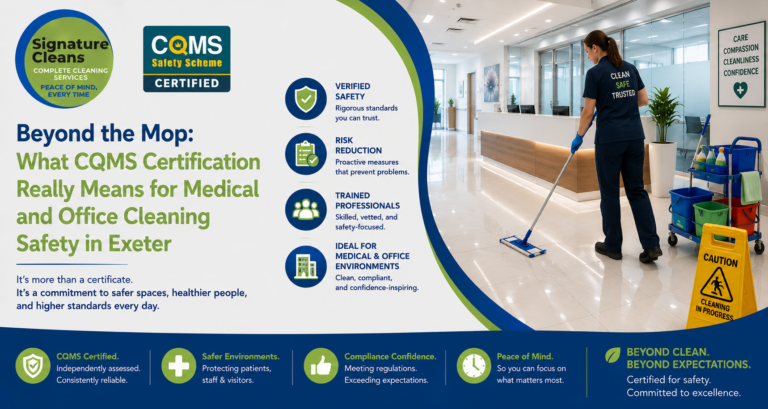
CQMS Ltd operates contractor assessment services, including the CQMS Safety-Scheme, an SSIP-recognised assessment route. Additional CQMS services may assess other procurement requirements.
A standard CQMS Safety-Scheme certificate should not be described as independent certification of cleaning performance.
For more detail, read what CQMS certification means for cleaning safety.
PQS certification relates to the particular prequalification scheme and assessment scope. Buyers should verify the issuer and requirements rather than assume it covers every procurement consideration.
ISO 9001 addresses quality management systems. Certification can demonstrate assessment against that standard, but it does not guarantee the quality of an individual cleaning visit.
Ultimately, no single credential replaces a well-managed cleaning contract.
Why Cutting Corners on Cleaning Standards Can Cost More
Facilities managers often compare cleaning quotations using the monthly price.
However, the invoice represents only one part of the contract’s overall cost.
Additional costs may arise from repeated complaints, missed tasks, remedial visits, damaged surfaces or management time spent resolving problems.
Consider two hypothetical situations.
Scenario one: an unclear cleaning specification.
A contractor quotes a lower monthly price but excludes periodic floor maintenance.
The facilities manager later discovers that additional visits are necessary to maintain the required appearance.
The original quotation was cheaper, but it did not cover the full requirement.
Scenario two: inadequate chemical controls.
A contractor uses an unsuitable product on a sensitive floor finish.
The surface requires specialist attention, creating additional cost and disruption.
Neither example proves that accreditation would automatically prevent the problem.
Instead, they demonstrate why suitable methods, clear responsibilities and contractor competence matter.
Where SSIP Can Reduce Procurement Work
Recognised health and safety assessments may reduce duplicated prequalification requests.
Nevertheless, buyers still need to check relevant insurance, contractual requirements and site-specific risks.
The commercial benefit is potentially more efficient assessment, not the elimination of due diligence.
What Should a UK Commercial Cleaning Specification Include?
A cleaning specification translates broad standards into measurable requirements.
Without one, buyers and contractors may have different expectations about what the service includes.
| Requirement | What the Contract Should Define |
| Areas covered | Rooms, surfaces, facilities and exclusions |
| Cleaning frequency | Routine and periodic tasks |
| Expected result | Observable cleanliness and agreed quality criteria |
| Methods and products | Suitable equipment, chemical controls and surface compatibility |
| Responsibilities | Tasks assigned to cleaning staff and site personnel |
| Quality assurance | Inspections, reporting and corrective action |
| Changes and incidents | Escalation and additional-work procedures |
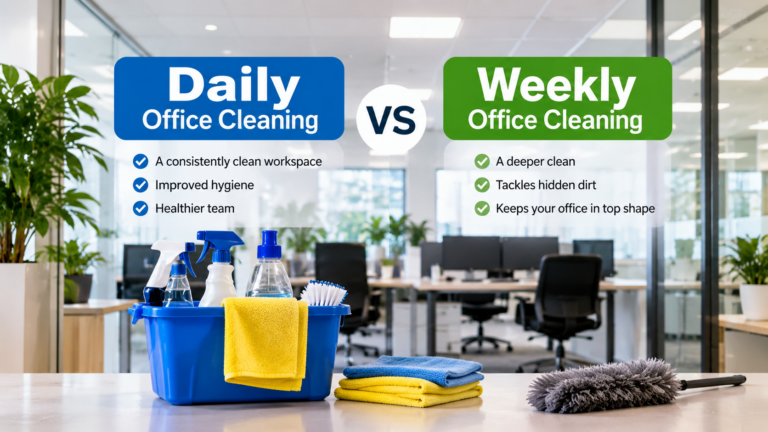
For example, an office contract might distinguish daily washroom cleaning from periodic carpet extraction.
Similarly, a warehouse may require separate arrangements for pedestrian areas, machinery interfaces and specialist spill response.
The contractor should assess the premises before finalising the specification.
Where routine cleaning does not cover intensive tasks, professional deep cleaning services may provide an appropriate additional option.
Cleaning Standards in Practice: Before, During and After
Good cleaning standards depend on what happens throughout the contract, not merely during supplier selection.
Before Cleaning Begins
The contractor should confirm the cleaning specification, relevant risks, access arrangements and agreed methods.
Staff should receive appropriate instructions for the premises.
Where necessary, the client should also confirm responsibilities for restricted areas and specialist equipment.
During the Cleaning Visit
Operatives should follow the agreed tasks, use suitable products and implement relevant safety controls.
For example, wet-floor precautions should reflect the area and building occupancy.
Supervisors should also have a practical method for identifying problems.
After the Visit
The contractor should record completed work using the agreed reporting system.
Depending on the contract, this may involve checklists, visit logs or inspection reports.
However, a completed checklist does not automatically prove cleaning quality.
Periodic inspections and corrective action help establish whether the expected standard has been achieved.
Do Different UK Sectors Have Different Cleaning Standards?
Yes. Cleaning requirements vary according to the environment and associated risks.
Offices and Commercial Premises
Office cleaning specifications typically address desks, shared facilities, washrooms, floors and frequently touched surfaces.
Frequency depends on occupancy, usage and agreed expectations.
Healthcare Facilities
Healthcare environments require additional consideration of infection prevention, cleaning responsibilities and clinical activities.
The NHS National Standards of Healthcare Cleanliness 2025 provide a detailed framework for relevant healthcare settings.
However, buyers should establish which requirements apply to their organisation.
Our article on medical practice cleaning standards explores these considerations further.
Schools and Education Settings
Schools require appropriate cleaning schedules, safeguarding arrangements and procedures for shared facilities.
DBS checks should reflect the role, eligibility and applicable safeguarding requirements.
Enhanced DBS clearance is not automatically mandatory for every cleaning operative.
How to Verify Cleaning Standards Before Appointing a Contractor
Facilities managers can make procurement more effective by requesting evidence rather than accepting broad assurances.
Use this practical checklist:
- Check relevant credentials. Confirm the issuing organisation, validity and assessment scope.
- Review insurance. Verify that the contractor holds suitable cover for the proposed work.
- Request risk information. Examine relevant assessments and safe working arrangements.
- Agree the specification. Document cleaning tasks, frequencies and exclusions.
- Confirm staff competence. Ask about training, supervision and site induction.
- Establish reporting. Agree how completed visits and service problems will be recorded.
- Set quality expectations. Define inspections, corrective action and review arrangements.
For larger contracts, include these requirements in the tender documents.
However, avoid imposing unnecessary accreditations that do not relate to the actual work or procurement policy.
The aim is to select a capable contractor and establish a manageable service.
Frequently Asked Questions About UK Cleaning Standards
Is There One Mandatory Cleaning Standard in the UK?
No. Applicable legal duties, sector-specific requirements and contractual specifications determine the standards relevant to each workplace.
Is SSIP Accreditation a Legal Requirement?
No. SSIP accreditation is not a universal statutory requirement for cleaning companies. However, individual buyers may require recognised health and safety assessment as part of their procurement process.
Does SSIP Accreditation Guarantee Cleaning Quality?
No. SSIP focuses on contractor health and safety assessment. Cleaning quality should be managed through specifications, appropriate methods, supervision and inspections.
How Often Should Commercial Premises Be Cleaned?
Cleaning frequency depends on the premises, occupancy, activities and associated risks. The contract should define routine and periodic tasks rather than assume one schedule suits every building.
Choosing a Cleaning Contractor in Exeter
UK cleaning standards provide a foundation for safer working and more reliable service delivery.
However, facilities managers achieve the best results when they combine suitable contractor checks with clear cleaning specifications and ongoing quality management.
Signature Cleans provides commercial cleaning services across Exeter and Devon, with site-specific cleaning arrangements and documented service expectations.
The company publicly identifies SSIP accreditation and PQS certification. Buyers should verify current credentials and their scope during procurement.
If you manage offices, healthcare premises or other commercial facilities, discuss your cleaning requirements before comparing quotations.
Request a Tailored Commercial Cleaning Quotation
Alternatively, call 01392 535094 to discuss your premises and cleaning requirements.