Quick answer
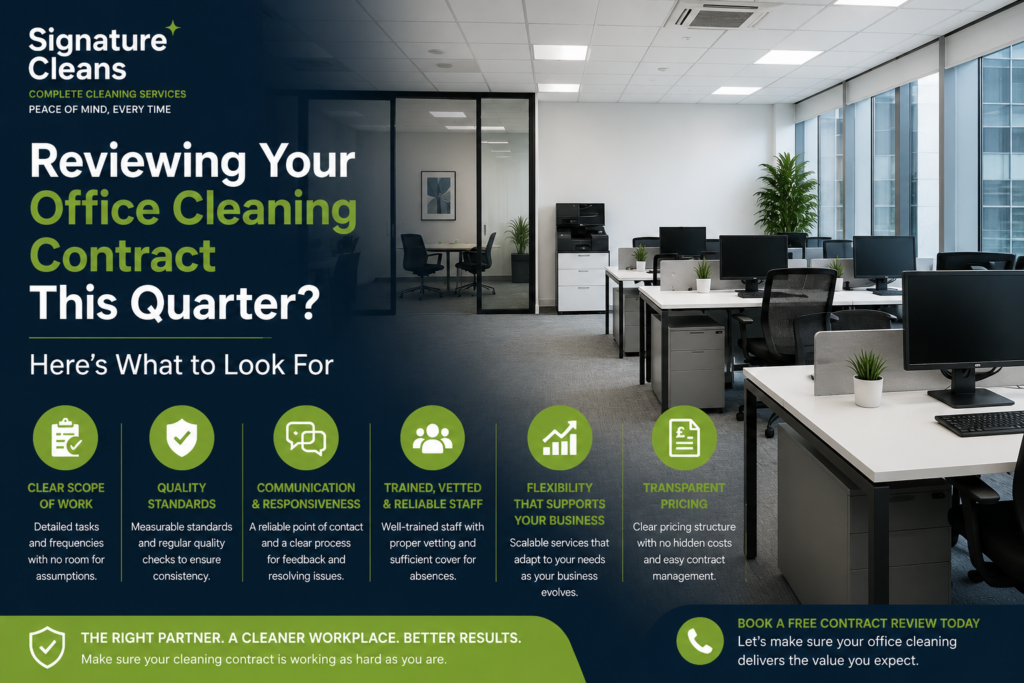
When reviewing an office cleaning contract, the three most reliable performance indicators are consistency of standards across visits, whether communication from the provider is proactive or reactive, and whether the contract runs without requiring active management input. Price is rarely the most useful review criterion, the true cost of a cheap cleaning contract includes the time spent managing it, correcting it, and compensating for it. A value-led contract from an accountable provider typically costs less in total than a cheaper contract that generates ongoing overhead.
3 Questions Worth Asking Honestly at Every Contract Review
Most office cleaning contracts get renewed by default; the cleaning is happening, nobody has complained recently, the price looks familiar. That’s not a review; it’s inertia. A genuine quarterly review starts with three questions that go beyond whether the invoice looks right.
1. Are standards consistent?
Not on the best day, on the average day, the day before a bank holiday, the week the regular cleaner is on leave. Consistency is the hardest thing for a cleaning provider to maintain and the first thing that degrades when the contract is under-resourced. If your office looks noticeably different depending on who cleaned it last or when, that inconsistency is structural, not incidental.
2. Is communication proactive?
A reactive cleaning provider responds when you contact them. A proactive one contacts you first, when a scheduled visit needs adjusting, when a recurring issue has been identified, when something on site has changed. The difference shows up in how much of your attention cleaning takes up. A provider who only communicates in response to complaints is putting the monitoring burden back on you.
3. Do you trust the provider to just get on with it?
This one is harder to quantify but easy to feel. If the answer involves any hesitation, a mental list of things to check, a habit of asking colleagues whether the cleaning was done, a vague awareness that you’d better look at the washrooms before a client visit, the contract isn’t delivering what outsourced cleaning is supposed to deliver: removal of the problem from your desk.
Why the cheapest office cleaning contract is rarely the most cost-effective one?
Price is the most visible number in a cleaning contract review and usually the least informative one. The invoice tells you what you’re paying. It doesn’t tell you what that contract is actually costing.
| Hidden cost | What it looks like in practice |
| Chasing missed tasks | Time spent by office or facilities managers emailing or calling to follow up on recurring misses — time that has a real cost even when it’s not itemised anywhere |
| Covering service gaps | When a cleaner doesn’t attend, someone on your team restocks the washroom, empties the bin, or wipes the kitchen down. That labour cost sits invisibly inside your headcount |
| Re-briefing rotating staff | Explaining the site layout, access arrangements, and specific requirements to a different person each week, repeatedly, because a cheaper contract can’t sustain a consistent team |
| Preparing for visits | Arranging additional or emergency cleaning before a client visit or inspection because daily standards aren’t sufficient. This is the most visible symptom of an underperforming contract |
| Managing complaints | Fielding and resolving internal staff complaints about hygiene, cleanliness, or inconsistency, diverting attention that should be on other things |
None of these appear on the cleaning invoice. Together, they can easily add up to more than the saving a cheaper provider represents, particularly when the time of the person managing them has a real hourly rate attached to it.
True Cost of Cheap Office Cleaning
The true cost of a cheap office cleaning contract includes not just the invoiced price but the management time required to maintain standards, chasing missed tasks, re-briefing rotating staff, arranging additional cleans before client visits, and handling internal complaints. For businesses where the facilities manager’s time has a real cost, a cheaper cleaning contract that requires regular intervention often costs more in total than a value-led contract that runs without management input.
What Value Actually Means in an Office Cleaning Contract
Value in a cleaning contract is not the most expensive option. It’s a contract structured so that the standard is maintained without you having to maintain it, consistent staffing, documented processes, proactive communication, and an audit trail that confirms the work is being done without anyone having to go and check.
At Signature Cleans, we are not the cheapest office cleaning provider in Exeter. We don’t aim to be. What we deliver instead is a contract that runs itself: the same named team, the same specification, monthly scored audits shared with your team, and a single point of contact who knows your account and contacts you, not the other way around. That’s what value means in practice, and it’s the reason our client retention rate is 100%.
A supplier does the job. A partner takes responsibility for the outcome.
This distinction matters more than it might seem at first. Every cleaning company attends. The difference is what they do with that attendance, whether they fulfil a task list or take ownership of the result.
| Area | A supplier | A partner |
| Mindset | Fulfils the task list and leaves | Takes responsibility for the outcome — the office being clean, not just cleaned |
| Communication | Responds when you contact them about an issue | Contacts you first when something needs attention — you don’t have to chase |
| Standards | Consistent at the start, tends to drift over time | Same standard on visit one and visit fifty, maintained by audits and accountability |
| Problem-solving | Addresses the specific problem reported | Investigates root cause — missed area, access issue, scheduling gap — and fixes it structurally |
| Reporting | No formal reporting — quality is assumed | Monthly scored audits shared with your team; you can see the standard, not just assume it |
| Relationship | Transactional — renewed on price at contract end | Long-term — built on trust, performance and shared investment in the result |
| Your workload | Regular management input needed to keep standards on track | Cleaning runs itself — no chasing, no rescheduling, no coverage gaps to resolve |
The supplier model is not wrong for every context. For a straightforward, low-frequency contract in a low-stakes environment, a transactional arrangement might be exactly what’s needed. But for an office environment where the cleaning standard affects how your business presents to clients, how your staff experience their working day, and how your facilities function without regular intervention, the supplier model creates overhead that a partner model eliminates.
A quick self-audit before you renew
Before signing the next twelve months, run through these:
1. Can you name the person who cleans your office each week, or is it a different face each visit?
2. In the last quarter, have you or a colleague chased the cleaning company about a missed task or a complaint?
3. Does your provider send you any form of quality report, audit, or confirmation of what was done?
4. Has your cleaning standard stayed consistent since the first month of the contract?
5. If a client arrived unexpectedly today, would you be confident in how the office looks?
Frequently Asked Questions
What should I look for when reviewing my office cleaning contract?
The three most reliable indicators are consistency of standards across every visit (not just the best ones), whether communication from the provider is proactive rather than reactive, and whether the contract runs without requiring active management input from your team. Price should be assessed alongside these factors, not instead of them.
Why is the cheapest office cleaning not always the best value?
Cheap cleaning contracts typically protect their margin by reducing staffing hours, rotating teams, and limiting account management. The result is a contract that requires regular intervention — chasing missed tasks, covering gaps, re-briefing staff, arranging extra cleans before visits. When the management time this requires is valued at its real cost, a cheaper contract often costs more in total than a consistent, value-led one.
What is the difference between an office cleaning supplier and a cleaning partner?
A cleaning supplier fulfils a task list and leaves, quality is assumed, communication is reactive, and the relationship is renewed on price. A cleaning partner takes responsibility for the outcome — the office being clean to a consistent standard, issues identified before complaints are raised, standards maintained and verified through regular audits, and a single named contact who knows the account.
How do I know if my current office cleaning provider is underperforming?
Signs include different cleaning staff attending each visit with no site familiarity, recurring complaints from colleagues about the same areas, no audit or reporting from the provider, a cleaning standard that has declined since onboarding, and any habit of arranging additional cleaning before client visits because daily standards aren’t reliable.
What accreditations should an office cleaning company in Exeter hold?
An accredited office cleaning provider in Exeter should hold SSIP accreditation (independently assessed health and safety standards) and PQS certification (quality management and pre-qualification), and carry at least £5 million public liability insurance, with £10 million being standard for commercial contracts. These credentials are required by most approved-supplier registers and indicate a provider that has invested in verifiable professional standards.
Related reading
If your review has raised concerns about your current provider, these pages cover the next steps from understanding what the overhead looks like to how a structured switch actually works:
| Page | Why it’s relevant |
| Why Your Office Cleaning in Exeter Shouldn’t Be Creating More Work | The hidden management overhead of a poor cleaning contract and what good looks like. |
| Switching Office Cleaning Companies in Exeter | How a structured handover works and why switching is less disruptive than staying. |
| Office Cleaning Exeter — Service Page | SSIP-accredited office cleaning in Exeter: documented specs, named teams, monthly audits. |
| The Real Cost of Cutting Corners | Why the cheapest cleaning contract rarely stays cheap: risk, time cost, and audit liability. |
| How to Choose the Right Commercial Cleaning Company in Exeter | The accreditation, insurance and management structure checklist before signing any contract. |
A Cleaning Contract That Runs Itself, Not One You Have to Run
If your quarterly review has surfaced more doubts than confidence, a free site assessment will show you exactly what a value-led, SSIP-accredited office cleaning contract looks like and what it costs to get cleaning off your list for good.