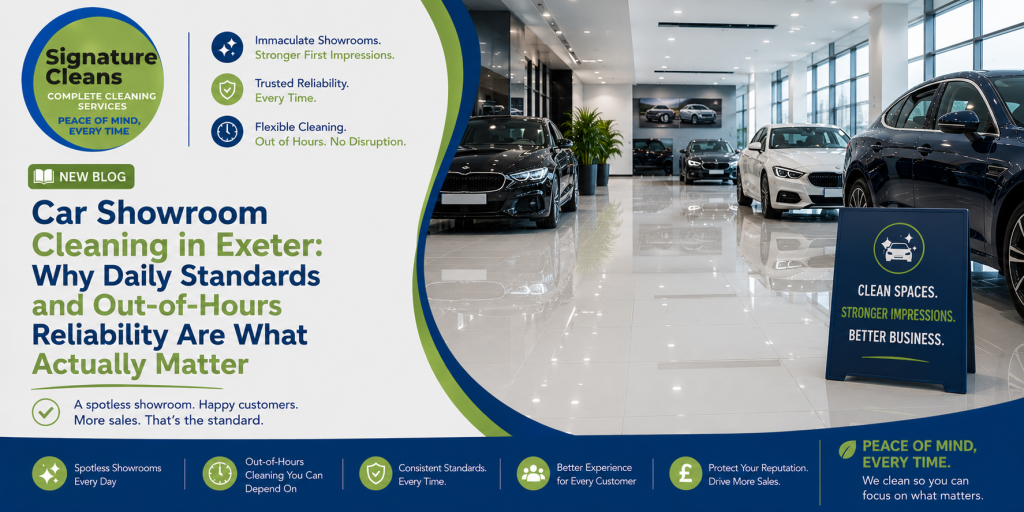
Showroom cleaning in Exeter involves the routine and periodic cleaning of car dealerships, vehicle display areas, customer lounges, reception spaces and other customer-facing facilities. Unlike standard office cleaning, automotive showrooms require particular attention to high-finish floors, large glass panels, valuable display vehicles and busy sales environments.
For dealership managers looking for a dependable provider, Signature Cleans offers professional contract cleaning services in Exeter, with schedules and cleaning specifications tailored to individual premises.
However, effective showroom cleaning involves more than creating a good first impression.
The real challenge is maintaining that standard every day without interfering with sales appointments, vehicle movements or customer handovers.
Whether you manage a premium automotive dealership or a busy multi-brand showroom, your cleaning contractor should understand the environment, protect its finishes and deliver consistent results.
This guide explains what professional showroom cleaning should include, how to evaluate providers and what affects the cost of a cleaning contract.
Why Car Showroom Cleaning Requires a Specialist Approach
Automotive showrooms present cleaning challenges that differ from those of conventional offices.
First, dealerships contain valuable display vehicles and carefully maintained surfaces. Cleaning equipment, chemicals and working methods must therefore suit the surroundings.
Second, showrooms often feature large areas of polished flooring and glazing. These surfaces make dust, fingerprints, tyre marks and streaks particularly noticeable.
Finally, cleaning activities must fit around customers, sales teams and vehicle movements.
A contractor who understands these requirements can develop a site-specific cleaning programme instead of relying on a generic checklist.
For dealership managers, the objective is straightforward: maintain a professional environment while keeping daily operations running smoothly.
1. Working Around Sales: Flexible and Out-of-Hours Cleaning
A busy showroom is not always suitable for intensive cleaning during trading hours.
Customers may be viewing vehicles, attending appointments or collecting new cars. Meanwhile, sales staff need safe access to display areas and customer facilities.
Consequently, many dealerships benefit from cleaning schedules arranged around opening hours.
What Flexible Showroom Cleaning Looks Like
Depending on the premises, a suitable programme may include:
- Early morning cleaning before customers arrive.
- Evening cleaning after the showroom closes.
- Weekend visits where appropriate.
- Agreed daytime touchpoint cleaning.
- Periodic intensive cleaning during quieter periods.
- Additional visits before events or planned inspections.
However, out-of-hours cleaning is not necessary for every task.
For example, staff may safely clean reception touchpoints or replenish washroom supplies during trading hours when the work does not interfere with customers.
Larger floor-cleaning operations usually require more careful scheduling.
Access, Security and Vehicle Movements
Before work begins, the dealership and contractor should agree access arrangements, alarm procedures, restricted areas and equipment storage.
They should also identify any locations where vehicles may move during cleaning.
Importantly, cleaning operatives should not move, touch or clean display vehicles unless the contract expressly includes those tasks and suitable controls are in place.
Clear boundaries protect both the dealership and the cleaning provider.
2. Maintaining Consistent Daily Showroom Standards
Delivering one impressive clean is relatively straightforward.
Maintaining the same standard throughout a long-term contract requires more structure.
For automotive dealerships, three arrangements are particularly valuable.
A Site-Specific Cleaning Specification
Every showroom should have a documented specification covering its floors, glazing, reception, customer lounge, washrooms and vehicle handover areas.
The document should identify the agreed tasks, cleaning frequency, suitable methods and any exclusions.
This gives managers a clear reference when assessing performance.
Regular Quality Inspections
Inspections help identify missed tasks, deteriorating standards and areas requiring additional attention.
A useful inspection should compare the condition of the premises with the agreed specification.
Furthermore, the contractor should record findings and explain how it will resolve any problems.
Familiar, Properly Briefed Cleaning Staff
Consistent teams can develop useful knowledge of a dealership’s layout, finishes and access arrangements.
For example, experienced operatives may know where tyre marks accumulate or which glass panels need particular attention.
Nevertheless, contractors also need suitable cover arrangements when regular staff are unavailable.
Replacement operatives should receive the relevant site instructions before starting work.
Together, these measures make cleaning quality easier to monitor and maintain.
3. What Should a Professional Showroom Cleaning Specification Include?
A professional showroom cleaning contract should define the work for each area of the premises.
The following table provides a practical starting point for dealership managers.
| Showroom Area | Typical Cleaning Tasks | Important Considerations |
| Display floors | Remove dirt, dust, debris and agreed marks | Floor finish, approved products and drying time |
| Showroom glazing | Clean accessible glass, partitions and display panels | Access arrangements and cleaning frequency |
| Vehicle display areas | Clean accessible floors around display stock | Vehicle movement and no-contact boundaries |
| Reception and sales desks | Clean counters, furniture and touchpoints | Suitable products for delicate finishes |
| Customer lounge | Clean seating areas, floors and refreshment surfaces | Upholstery and consumables exclusions |
| Handover bay | Maintain floors, glass and presentation areas | Vehicle collection schedules |
| Workshop transition areas | Address tracked-in dirt and agreed surface cleaning | Specialist spill responsibilities |
| Washrooms | Clean fixtures, floors and touchpoints | Supplies, frequency and hygiene requirements |
This is an illustrative specification rather than a universal cleaning schedule.
The final scope should follow a site assessment and reflect the dealership’s layout, operating hours and presentation requirements.
It should also distinguish routine cleaning from periodic work.
For example, carpet extraction, intensive floor treatment and high-level cleaning may require separate scheduling.
Where additional work is necessary, professional deep cleaning services can complement the regular cleaning programme.
4. Cleaning High-Finish Floors, Glass and Display Areas
The surfaces inside a car showroom require careful treatment.
Using unsuitable equipment or chemicals can damage finishes, leave residue or create avoidable safety risks.
Therefore, contractors should establish appropriate cleaning methods before starting work.
High-Finish Showroom Floors
Showroom floors may feature tiles, polished concrete, resin or other specialist finishes.
Each surface has different maintenance requirements.
For larger hard-floor areas, a suitable scrubber-dryer may improve efficiency. However, smaller or restricted areas may require appropriate manual cleaning methods.
The contractor should consider manufacturer guidance, floor condition, available access and drying time.
Additionally, staff should check for tyre marks and dirt near entrances or vehicle display positions.
Large Glass Panels and Reflective Surfaces
Automotive showrooms often contain extensive glazing.
Fingerprints, streaks and dust can become especially noticeable under bright display lighting.
Consequently, glass cleaning should form part of the agreed specification.
The contractor should clarify whether the service includes internal glazing, accessible external windows, glass partitions and display cases.
Any specialist access requirements should also be identified before quotation.
Customer-Facing Facilities
Reception desks, seating areas, washrooms and refreshment facilities influence the overall presentation of a dealership.
These areas need appropriate cleaning frequencies based on customer usage.
For further insight into how presentation supports customer perception, read why showroom cleaning is a brand decision.
5. Reliable, Not Reactive: Managing Standards Proactively
A reliable showroom cleaning contractor should identify developing problems rather than waiting for repeated complaints.
For example, wet weather can increase dirt around entrance matting. Meanwhile, busy sales periods may create additional demand in customer lounges and washrooms.
A proactive cleaning programme accounts for these changes.
What Proactive Cleaning Looks Like
Pre-clean inspections: Operatives identify areas requiring additional attention before starting the agreed tasks.
Seasonal adjustments: Managers review cleaning requirements when weather conditions or visitor numbers change.
Clear communication: Contractors notify dealership managers about scheduling changes, staffing arrangements or recurring problems.
Quality reviews: Regular inspections help determine whether the existing specification remains suitable.
Additional work planning: Periodic cleaning and special events receive appropriate scheduling rather than last-minute attention.
Consumables management may also form part of the agreement where requested.
However, the contract should clearly identify which supplies the cleaning company provides and replenishes.
For dealerships reviewing declining standards, our guide to signs your cleaning contractor isn’t performing offers further questions to consider.
6. Showroom Cleaning and Manufacturer Presentation Standards
Franchised dealerships may operate under manufacturer-specific presentation requirements.
These can influence expectations for showroom floors, customer facilities, glazing and vehicle handover areas.
However, requirements vary between brands and individual dealership agreements.
Therefore, cleaning contractors should not assume that one standard applies to every automotive showroom.
Instead, dealership managers should share any relevant presentation checklist or operational requirements during the quotation process.
The contractor can then incorporate appropriate cleaning tasks into the site specification.
Cleaning records and quality inspections may help demonstrate that the agreed work has taken place.
Nevertheless, these records do not guarantee compliance with manufacturer requirements or a particular audit outcome.
The dealership remains responsible for confirming which presentation standards apply to its operations.
7. What Affects Showroom Cleaning Costs in Exeter?
Showroom cleaning prices depend on the size, layout and operational requirements of the premises.
A quotation should reflect the actual work rather than rely on a generic monthly estimate.
The main cost factors include:
- Total floor area and number of rooms.
- Flooring materials and required cleaning methods.
- Amount and accessibility of glazing.
- Daily, weekly or multiple-visit schedules.
- Early morning, evening or weekend access.
- Customer lounges, washrooms and staff facilities.
- Periodic deep cleaning or specialist tasks.
- Staffing, supervision and reporting requirements.
For example, a large showroom with extensive glazing and daily cleaning requirements may need more resources than a smaller dealership with a simpler specification.
However, price alone does not establish value.
A cheaper quotation may exclude periodic cleaning, inspections or tasks that another provider includes.
Therefore, compare quotations against the same written specification.
This makes differences in service scope easier to identify.
8. How to Choose a Showroom Cleaning Company in Exeter
Before appointing a cleaning contractor, dealership managers should evaluate practical delivery arrangements.
Start by asking whether the provider understands automotive retail environments.
Then establish how it will maintain standards, protect valuable stock and communicate with your team.
Questions to Ask Before Signing a Contract
- Have you worked in automotive showrooms?
Relevant experience can help demonstrate familiarity with showroom finishes, customer areas and vehicle-related access restrictions.
- How will you protect our display vehicles?
Request clear procedures covering equipment movement, restricted areas and responsibilities around stock.
- What cleaning methods will you use?
The contractor should explain how it selects products and equipment for different surfaces.
- Can you work around our opening hours?
Confirm the proposed schedule, access arrangements and procedures for changes.
- How will you monitor quality?
Ask about inspections, cleaning records and corrective action.
- What insurance and credentials do you hold?
Verify appropriate insurance, health-and-safety arrangements and any certifications required by your procurement policy.
Signature Cleans publicly identifies SSIP accreditation and PQS certification. However, dealership managers should verify current credentials and their scope when conducting supplier checks.
- What happens if the regular cleaner is unavailable?
Confirm how the contractor provides cover and maintains familiarity with your premises.
Finally, review notice periods, additional charges and responsibilities for specialist cleaning.
9. Pre-Contract Checklist for Dealership Managers
Before agreeing to a showroom cleaning contract, confirm that:
- The contractor has assessed the premises.
- The cleaning specification covers all agreed areas.
- Cleaning schedules fit around dealership operations.
- Equipment and products suit the relevant surfaces.
- Display vehicle boundaries are documented.
- Staff receive appropriate site instructions.
- Quality inspections and reporting arrangements are clear.
- Additional services and exclusions appear in the quotation.
This checklist helps dealership managers compare providers on service quality rather than headline price alone.
Frequently Asked Questions About Showroom Cleaning in Exeter
How Often Should a Car Showroom Be Cleaned?
The appropriate frequency depends on footfall, opening hours, floor finishes and the size of the premises. Busy customer-facing areas may require daily attention, while some specialist tasks can follow a periodic schedule.
Can Showroom Cleaning Take Place Outside Trading Hours?
Yes. Early morning, evening and weekend cleaning may be available depending on the agreed contract. Some lighter cleaning tasks can also take place during trading where appropriate.
Can a Commercial Cleaning Company Clean a Car Showroom?
Yes, provided it has suitable experience, equipment, procedures and insurance. The important consideration is whether the contractor can meet the showroom’s specific cleaning and operational requirements.
Does Showroom Cleaning Include Display Vehicles?
Not automatically. Vehicle cleaning, detailing or movement should only form part of the contract where expressly agreed and appropriately controlled.
Looking for Reliable Showroom Cleaning in Exeter?
Professional showroom cleaning should support your dealership’s presentation standards without creating unnecessary operational disruption.
The right cleaning programme combines suitable surface care, flexible scheduling, consistent staffing and clear quality checks.
Signature Cleans provides commercial cleaning services across Exeter and Devon, including cleaning support for automotive dealership environments.
Whether you manage a single showroom or a larger dealership facility, a site assessment can help establish the cleaning tasks, frequencies and arrangements your premises require.
Request a Free Showroom Cleaning Site Assessment
Alternatively, call 01392 535094 to discuss your requirements and request a tailored quotation.