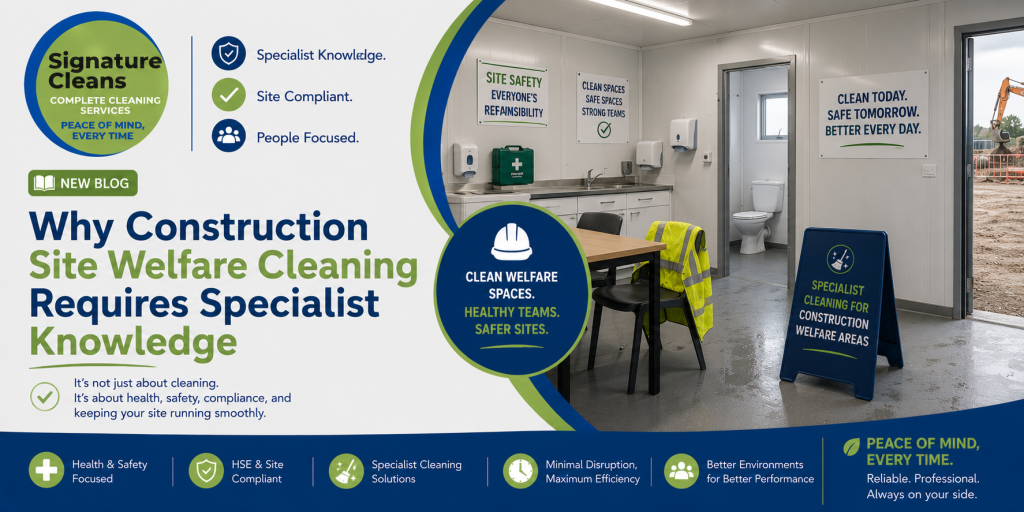
Construction site welfare cleaning is a world apart from office or commercial cleaning. The environment is harsher, the regulations are stricter, and the consequences of getting it wrong are more serious. If you’re a site manager or principal contractor responsible for welfare provision, understanding what specialist welfare cleaning involves—and why a standard cleaning company often isn’t the right fit—will help you maintain compliance and keep your workforce healthy.
The Regulatory Framework
Welfare facilities on construction sites are governed by specific legislation that goes beyond general workplace standards. Two sets of regulations are particularly relevant:
CDM Regulations 2015
The Construction (Design and Management) Regulations 2015 place a duty on principal contractors to ensure that suitable welfare facilities are provided and maintained throughout a project. This includes toilets, washing facilities, drinking water, changing rooms, and rest areas. The key word is “maintained”—it’s not enough to provide a row of portable toilets. They must be kept in a hygienic, functional condition for the duration of the build.
The Construction (Health, Safety and Welfare) Regulations 1996
These regulations set out minimum standards for welfare provision on construction sites, including:
- Toilets must be adequately ventilated, lit, and kept in a clean and orderly condition
- Washing facilities must include hot and cold running water, soap, and towels or other drying facilities
- Rest areas must be provided with seating and facilities for preparing hot drinks
- Drinking water must be readily accessible and clearly marked
HSE inspectors actively check welfare provision during site visits. Poor welfare standards are one of the most common reasons for enforcement action, and they can lead to improvement notices or even prohibition notices that halt work on site.
What Makes Construction Welfare Cleaning Different
A standard commercial cleaning company will typically struggle with construction welfare cleaning for several practical reasons:
- The environment is punishing – Welfare units on construction sites get heavy use from workers in muddy boots, dusty clothing, and sometimes contaminated PPE. A portacabin toilet serving 30 construction workers needs a fundamentally different cleaning approach than an office washroom.
- Access and logistics – Construction sites change constantly. Access routes move, welfare units get relocated, and cleaning teams need to navigate an active building site safely. They need to understand site rules, traffic management plans, and how to work around ongoing construction activity.
- Frequency requirements – Most construction welfare facilities need daily cleaning at minimum, often twice daily on larger sites. The scheduling needs to work around shift patterns and site activities without disrupting productivity.
- Specialist consumables – Welfare units require specific supplies: industrial hand cleaners for heavy contamination, barrier cream dispensers, heavy-duty paper towels, and sanitation products designed for portable facilities. Standard office cleaning products are not adequate.
SSIP Requirements for Site Access
Here’s a factor that catches many people out: any contractor working on a construction site—including cleaning companies—typically needs to hold SSIP (Safety Schemes in Procurement) accreditation. This is a requirement set by most principal contractors and is often written into project specifications.
SSIP accreditation demonstrates that a company has been assessed against core health and safety criteria, including:
- A documented health and safety policy
- Risk assessments and method statements relevant to their activities
- Competent health and safety advice
- Evidence of monitoring and review
- Adequate insurance
If your cleaning contractor doesn’t hold SSIP accreditation, they may not be allowed on site. Even if access is granted informally, using a non-accredited contractor exposes the principal contractor to significant liability if an incident occurs.
Hygiene Standards and Worker Health
The link between welfare cleanliness and worker health on construction sites is direct and well documented. Poor hygiene in welfare facilities can lead to:
- Gastrointestinal illness – Contaminated hand-washing facilities or inadequately cleaned food preparation areas are a common source of stomach bugs that spread quickly across a site workforce.
- Skin conditions – Construction workers are exposed to cement, solvents, and other irritants. Without properly maintained washing facilities and appropriate skin care products, dermatitis and other skin conditions are a real risk.
- Respiratory issues – Poorly ventilated or damp welfare units can harbour mould and bacteria, particularly during winter months when units are sealed against the cold.
Beyond health, welfare standards directly affect worker morale and productivity. Workers who feel their basic needs are being looked after perform better and are more likely to stay on a project. Substandard welfare is one of the top complaints on construction sites and a common reason for skilled trades leaving a job.
What to Look for in a Welfare Cleaning Provider
When selecting a cleaning company for construction welfare, look for:
- Current SSIP accreditation – Non-negotiable for most sites.
- Construction site experience – Ask for references from other construction clients. A company that mainly cleans offices will not understand the demands of a building site.
- Proper risk assessments – They should provide site-specific RAMS (Risk Assessments and Method Statements) for your project, not generic documents.
- Flexibility – Construction sites are dynamic. Your cleaning provider needs to adapt to changing welfare locations, fluctuating workforce numbers, and evolving site conditions.
- Supply management – A good welfare cleaning provider manages consumable supplies proactively, ensuring toilet rolls, hand wash, paper towels, and sanitiser never run out.
- Reporting – Regular reports on welfare condition, supply usage, and any issues identified give site managers the documentation they need for compliance records.