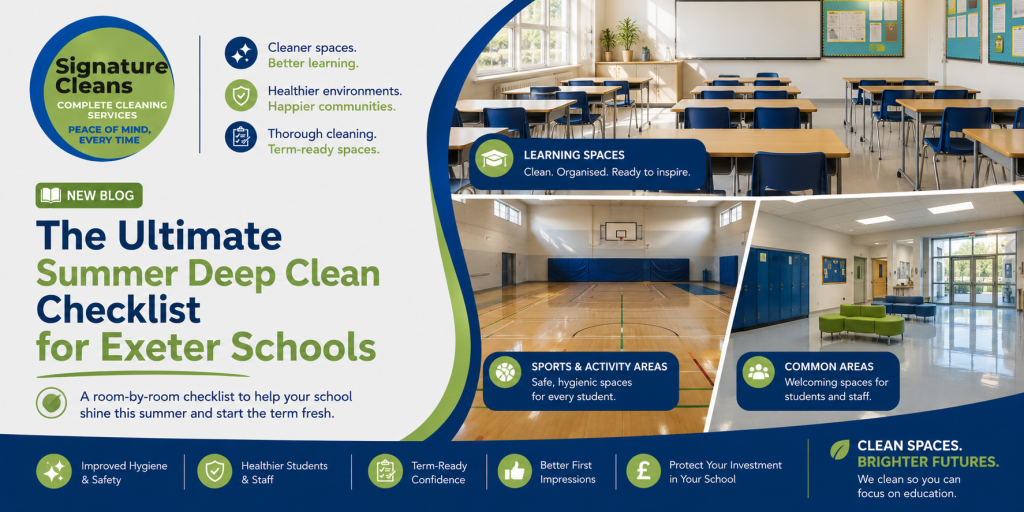
School cleaning in Exeter includes routine cleaning during term time, periodic deep cleaning and additional cleaning during school holidays. A suitable cleaning programme should reflect the school’s premises, activities, safeguarding arrangements and health and safety requirements.
Summer holidays provide an opportunity to tackle cleaning tasks that are difficult to complete during teaching hours.
Signature Cleans offers professional school cleaning services in Exeter, including scheduled cleaning and holiday deep-cleaning programmes tailored to individual educational facilities.
For headteachers, bursars and facilities managers, the challenge is deciding what needs cleaning, which tasks require specialist attention and how to coordinate everything before pupils return.
This guide provides a practical summer cleaning checklist, explains relevant contractor requirements and outlines how to plan an effective school holiday deep clean.
School Cleaning in Exeter: Routine vs Summer Deep Cleaning
Routine cleaning maintains agreed standards throughout the school year.
Summer deep cleaning focuses on more intensive tasks, including areas that cannot easily be accessed during normal operations.
Both are important, but they serve different purposes.
| Routine School Cleaning | Summer Deep Cleaning |
| Daily classroom and shared-area cleaning | Detailed cleaning of agreed classroom surfaces |
| Regular washroom cleaning | Intensive descaling and washroom cleaning |
| Routine floor cleaning | Carpet extraction and specialist floor maintenance |
| Cleaning around teaching hours | Cleaning during agreed holiday access periods |
| Regular quality inspections | Project completion checks and snagging |
Neither column represents a universal legal checklist.
The final scope should reflect the school’s risk assessments, premises, surface materials and agreed cleaning requirements.
Schools needing ongoing support can also consider regular contract cleaning services alongside periodic holiday cleaning.
Why Summer Deep Cleaning Matters for Exeter Schools
Schools experience substantial daily footfall.
Classrooms, corridors, toilets, dining areas and sports facilities are used repeatedly by pupils, staff and visitors.
Routine cleaning addresses everyday requirements. However, intensive tasks may require additional time, specialist equipment or temporary access restrictions.
The summer break offers an opportunity to:
- Clean behind movable classroom furniture.
- Address accumulated dirt in corners and difficult-to-reach areas.
- Arrange appropriate carpet and floor treatments.
- Complete detailed washroom cleaning.
- Coordinate cleaning with maintenance and refurbishment work.
- Inspect completed areas before the new term.
A summer deep clean is not automatically a separate legal requirement for every school.
Nevertheless, schools must manage applicable health, safety and hygiene responsibilities throughout the year.
A planned holiday programme can support those responsibilities while reducing disruption.
The Complete Summer Deep Clean Checklist
Use this checklist to prepare a cleaning specification and discuss the scope with potential contractors.
Not every task will be suitable for every school.
Specialist work, surface treatments and maintenance activities should be assessed and agreed separately.
1. Classrooms and Learning Spaces
Classrooms contain furniture, learning resources and equipment that may be difficult to clean thoroughly during term time.
Consider the following tasks:
- Clean desks, chairs and accessible furniture surfaces.
- Wipe door handles, switches and other agreed touchpoints.
- Clean accessible internal glazing.
- Vacuum carpets and soft furnishings.
- Arrange carpet extraction where appropriate.
- Clean skirting boards, shelving and accessible radiator surfaces.
- Remove cobwebs from accessible areas.
- Clean suitable storage areas after contents have been removed.
- Address marks and accumulated dirt on washable surfaces.
Interactive whiteboards, computers and specialist teaching equipment require manufacturer-approved methods.
Similarly, floor stripping, polishing or resealing should only take place where suitable for the material.
2. Toilets and Changing Rooms
School washrooms require appropriate cleaning methods, products and inspection arrangements.
A summer deep clean may include:
- Detailed cleaning of toilets, basins and accessible fixtures.
- Descaling suitable sanitaryware and taps.
- Cleaning cubicle partitions, doors and handles.
- Cleaning tiled surfaces and accessible grout.
- Washing suitable changing benches and lockers.
- Cleaning shower areas where included.
- Removing accumulated dirt around floor edges.
- Inspecting accessible areas for damage or maintenance concerns.
Cleaning and disinfection should follow the school’s risk assessment and relevant product instructions.
Hospital-grade disinfectants are not automatically necessary for every surface.
Pressure washing, mould remediation and ventilation maintenance should be assessed separately rather than assumed to form part of routine deep cleaning.
3. Canteens, Kitchens and Food Preparation Areas
School kitchens need particular care because cleaning activities must align with food safety arrangements.
A cleaning specification may cover:
- Dining tables, chairs and serving areas.
- Accessible floors and wall surfaces.
- Suitable food preparation surfaces.
- Accessible cupboard exteriors and storage areas.
- Agreed kitchen fixtures.
- Waste-related cleaning within the contractor’s scope.
- Detailed cleaning of dining halls and shared eating spaces.
Specialist catering equipment, extraction ductwork and ventilation systems may require separate contractors or additional competence.
Responsibilities should be agreed with the school’s catering team.
Cleaning chemicals must be suitable for their intended use, particularly around food-contact surfaces.
4. Sports Halls, Gyms and PE Facilities
Sports facilities often contain specialist flooring and equipment.
Suitable tasks may include:
- Cleaning accessible sports hall floors.
- Wiping agreed gym equipment and exercise mats.
- Cleaning changing room benches and storage areas.
- Removing dust from accessible fixtures.
- Cleaning spectator seating.
- Addressing accumulated dirt around entrances.
Sports flooring should only be treated using methods approved for the surface.
Timber and specialist resin floors may require different products and equipment.
High-level apparatus and inaccessible fixtures should not be cleaned without appropriate arrangements.
5. Corridors, Stairwells and Shared Areas
Corridors and entrance areas experience frequent use throughout the school day.
Include:
- Detailed floor cleaning.
- Stair treads, landings and accessible edges.
- Handrails and balustrades.
- Entrance mats and reception areas.
- Accessible internal glass.
- Skirting boards and corners.
- Agreed lockers and storage surfaces.
- Suitable touchpoints and shared fixtures.
Consider whether any areas need specialist treatment because of surface condition or accumulated contamination.
Where routine methods are insufficient, professional deep cleaning services may provide additional support.
Safeguarding and DBS Requirements for School Cleaners
Safeguarding is an important consideration when appointing cleaning contractors.
However, schools should not assume every cleaner automatically requires the same level of DBS check.
Requirements depend on the nature of the work, its frequency, whether it constitutes regulated activity and the opportunity for contact with children.
Schools should follow the applicable statutory guidance, including Keeping Children Safe in Education.
Before work begins, agree:
- Relevant staff vetting and DBS requirements.
- Identification and sign-in procedures.
- Supervision and access arrangements.
- Restricted areas and confidential information.
- Procedures for reporting safeguarding concerns.
These requirements remain relevant during school holidays, although the appropriate checks still depend on the circumstances.
Signature Cleans states that its cleaning teams are vetted and DBS-checked where contracts require it.
Schools should verify the arrangements relevant to their own premises.
COSHH Compliance and Safe Cleaning Products
The Control of Substances Hazardous to Health Regulations 2002 apply where cleaning activities involve relevant hazardous substances.
Contractors should assess exposure risks and establish suitable controls.
These may include appropriate dilution, ventilation, protective equipment, storage and staff training.
Importantly, COSHH is not a product approval scheme.
A cleaning product should not be described as COSHH-approved.
Safety Data Sheets provide information about chemical hazards, but they are not substitutes for workplace COSHH risk assessments.
The Health and Safety Executive’s COSHH guidance explains the relevant principles.
School managers should also confirm where products and equipment will be stored during the project.
What Should Schools Verify Before Appointing a Cleaning Contractor?
Relevant credentials can support procurement decisions, but they should not replace practical checks.
For example, SSIP provides a framework for recognised contractor health and safety assessments.
It does not certify the cleanliness of individual classrooms or automatically verify safeguarding arrangements.
Similarly, procurement certifications should be assessed according to their actual issuing scheme and scope.
Signature Cleans publicly identifies SSIP accreditation and PQS certification.
Schools should verify current credentials alongside insurance, staff competence and site-specific procedures.
Six Questions to Ask a School Cleaning Company
- Can you provide a room-by-room specification? Confirm included tasks, exclusions and cleaning frequencies.
- What safeguarding arrangements apply? Establish appropriate vetting, DBS and site-access requirements.
- How do you manage cleaning chemicals? Ask about COSHH assessments, product selection and safe working methods.
- Which tasks require specialist contractors? Clarify kitchen equipment, high-level cleaning and floor treatments.
- Can you coordinate with our timetable? Discuss holiday access, maintenance contractors and building availability.
- How will completed work be checked? Agree inspections, reporting and corrective action.
These questions help schools compare providers against the same requirements.
They also reduce the risk of discovering unexpected exclusions after work begins.
When Should Exeter Schools Plan Their Summer Deep Clean?
Schools should begin planning early enough to complete site assessments, procurement checks and scheduling.
The following timeline is illustrative rather than a guarantee of contractor availability.
| Planning Stage | Recommended Action |
| Initial preparation | Identify cleaning priorities and maintenance work |
| Contractor assessment | Request site visits, quotations and relevant evidence |
| Before term ends | Confirm scope, access arrangements and safeguarding |
| Summer holidays | Complete agreed cleaning tasks |
| Before reopening | Inspect completed work and resolve outstanding issues |
Cleaning should be coordinated with refurbishment, painting, flooring and other building work.
Otherwise, recently cleaned areas may require further attention.
Availability and lead times should be confirmed directly with the contractor.
Post-Clean Inspection and Handover Checklist
A summer deep clean should finish with a documented inspection.
Before signing off the work, the school representative and contractor should confirm:
- Agreed rooms and areas have been completed.
- Cleaning matches the written specification.
- Floor finishes and surfaces are in suitable condition.
- Equipment and chemicals have been removed or safely stored.
- Furniture has been returned to agreed positions.
- Any damage concerns or incomplete tasks are recorded.
- Outstanding issues have an agreed resolution date.
A completion checklist does not automatically prove every task meets the expected standard.
However, it creates a practical record for reviewing the work and arranging corrective action.
Frequently Asked Questions
How Often Should Schools Arrange Deep Cleaning?
Frequency depends on the premises, usage, surface condition and cleaning specification. Some tasks may be completed during shorter term breaks, while others are best scheduled during summer holidays.
Do School Cleaners Need Enhanced DBS Checks?
Not universally. The appropriate check depends on the role and safeguarding requirements. Schools should assess the work and verify the necessary arrangements before access is granted.
Can School Cleaning Take Place During Holidays?
Yes. Holiday cleaning can provide access to classrooms and shared areas that are difficult to clean intensively during teaching hours.
Does Summer Deep Cleaning Include Specialist Kitchen Equipment?
Only where expressly agreed. Specialist equipment, extraction systems and other technical tasks may require separate arrangements.
School Cleaning Services in Exeter and Devon
A successful summer deep clean begins with a clear specification and finishes with a proper inspection.
For bursars, headteachers and facilities managers, the priority is finding a contractor that understands educational premises, works around school schedules and communicates clearly.
Signature Cleans provides school cleaning services in Exeter, including routine cleaning, holiday programmes and tailored cleaning specifications.
Its service includes site assessments, flexible scheduling and ongoing quality monitoring.
Whether you manage a primary school, secondary school, academy or college, the right cleaning programme should reflect your building and operational requirements.
Request a Free School Cleaning Site Assessment
Alternatively, call 01392 535094 to discuss your school’s cleaning requirements and request a tailored quotation.