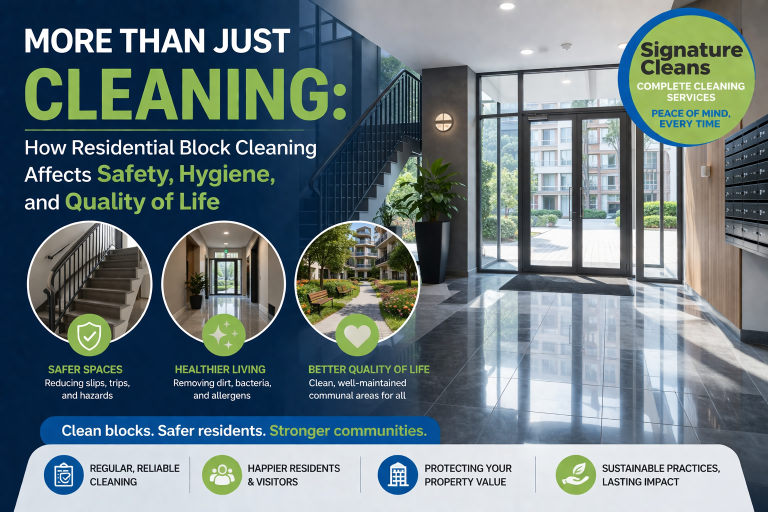
Communal area cleaning is the regular cleaning of shared spaces in residential buildings, including entrance halls, stairwells, corridors, lifts, bin stores and agreed external areas. A professional cleaning programme defines which tasks are included, how frequently they take place and how property managers can verify the results.
For residential blocks in Exeter and Devon, Signature Cleans provides professional contract cleaning services with tailored cleaning specifications, flexible schedules and quality inspections.
However, communal cleaning involves more than maintaining tidy shared spaces.
For property managers, missed visits, inconsistent standards and poor communication can quickly become resident complaints. Those complaints create additional administrative work and may lead to questions about service-charge expenditure.
The objective is to identify problems early, maintain consistent standards and give residents confidence that their building is properly managed.
This guide explains what communal cleaning should include, how to organise a reliable contract and what property managers should check before appointing a provider.
Where Resident Complaints Really Come From
Cleaning complaints often develop gradually.
A resident notices dirt in a stairwell but assumes the next scheduled visit will resolve it. When the same area remains neglected, they may mention it to a neighbour or contact the managing agent.
If the problem continues, an informal concern can become a formal complaint.
Consider this illustrative sequence:
- A scheduled cleaning visit misses an entrance hall or stairwell.
- Dirt and debris accumulate before the next visit.
- Residents notice the problem and question the cleaning schedule.
- The managing agent receives photographs or written complaints.
- The contractor must investigate and arrange corrective work.
- The property manager spends additional time resolving an avoidable issue.
Not every complaint follows this pattern. However, it demonstrates why clear cleaning specifications and communication matter.
A reliable contractor should help managers identify missed tasks, investigate concerns and arrange appropriate corrective action.
Reactive vs Proactive Communal Area Cleaning
The difference between reactive and proactive cleaning lies in how the service is managed.
Reactive providers generally respond when someone reports a problem.
Proactive providers use agreed procedures to monitor standards and identify issues earlier.
| Reactive Cleaning | Proactive Cleaning |
| Investigates missed tasks after complaints | Uses planned inspections to monitor quality |
| Follows an unchanged schedule | Reviews frequency when building usage changes |
| Communicates mainly when problems arise | Reports relevant issues and schedule changes |
| Relies on informal staff instructions | Uses documented site-specific tasks |
| Has unclear escalation arrangements | Agrees responsibility for corrective action |
| Leaves managers chasing information | Provides accessible visit and quality records |
For property managers overseeing several buildings, these differences can significantly affect the time required to manage cleaning contracts.
However, proactive cleaning does not require one particular reporting system.
Digital visit logs, signed checklists and inspection reports can all be useful when they provide reliable information.
The important point is that managers can establish what happened and address problems promptly.
Which Communal Areas Need the Most Attention?
Residents use communal spaces repeatedly throughout the day.
Consequently, even small cleaning issues can become noticeable when they affect frequently used areas.
Entrance Halls and Lobbies
Entrance halls create the first impression of a residential building.
Common requirements include floor cleaning, entrance matting, accessible glass, door handles and removal of tracked-in dirt.
Wet weather may increase the need for attention.
Stairwells and Corridors
Stairwells can accumulate dust, cobwebs and debris around corners, skirting boards and landings.
Cleaning methods should suit the flooring material and building layout.
Lifts
Lift interiors often contain frequently touched buttons, mirrors, door surrounds and floor tracks.
The specification should identify suitable products and the appropriate cleaning frequency.
Bin Stores
Bin stores require clear responsibilities for accessible surfaces, floors, litter and agreed cleaning tasks.
Waste collection, hazardous spill removal and pest control should not automatically be included in a routine cleaning contract.
External Shared Areas
Car parks, pathways and entrances may require agreed litter collection or seasonal cleaning.
Specialist stain removal and external pressure washing should be separately specified where necessary.
What Should a Communal Cleaning Specification Include?
A cleaning schedule tells the contractor when to attend.
A cleaning specification explains what must be completed during those visits.
For effective property management, both documents should work together.
| Communal Area | Typical Cleaning Tasks | Frequency Considerations |
| Entrance halls | Floors, glass, matting and touchpoints | Footfall and weather |
| Stairwells | Steps, landings, handrails and cobwebs | Occupancy and usage |
| Corridors | Vacuuming, mopping and accessible surfaces | Floor finish and traffic |
| Lifts | Floors, buttons, mirrors and door surrounds | Lift usage |
| Bin stores | Agreed floor cleaning, litter and accessible surfaces | Waste collection schedules |
| Shared facilities | Cleaning of included lounges, laundries or washrooms | Facility usage |
| External areas | Agreed litter collection and surface cleaning | Seasonal conditions |
| Periodic tasks | Carpet extraction, internal glazing and high-level dusting | Condition and agreed schedule |
This table provides a starting point rather than a universal cleaning schedule.
A site assessment should establish the final tasks, frequencies, access arrangements and exclusions.
For example, a small converted residential building may need a different programme from a larger apartment development with lifts and shared facilities.
Periodic tasks should also be identified separately.
Where required, professional deep cleaning services can support routine communal cleaning through carpet treatment, intensive floor cleaning or other agreed work.
How Often Should Communal Areas Be Cleaned?
There is no single cleaning frequency suitable for every residential block.
The appropriate schedule depends on occupancy, footfall, building design, surface materials and the condition of shared spaces.
A busy entrance hall may require more frequent attention than an upper-floor corridor with limited traffic.
Similarly, a bin store’s cleaning requirements may change according to waste collection arrangements and usage.
Property managers should consider:
- The number of residents and visitors.
- The size and layout of the building.
- Flooring and surface materials.
- Lift usage and shared facilities.
- Seasonal weather conditions.
- Previous complaints and inspection findings.
- The cleaning budget and agreed service scope.
Review the schedule when circumstances change.
For example, increased occupancy or recurring entrance-floor contamination may justify additional visits.
However, changes should be agreed and documented rather than introduced informally.
How Proactive Cleaning Prevents Repeated Problems
A well-managed communal cleaning contract should establish a straightforward quality-control process.
First, agree the specification. The property manager and contractor identify the tasks and expected standards.
Second, complete the scheduled visit. Cleaning staff follow the relevant site instructions.
Third, record the work. The contractor uses the agreed reporting method.
Fourth, inspect standards. Supervisors or managers check performance against the specification.
Finally, resolve issues. Missed tasks or recurring problems are documented and addressed.
This process helps property managers investigate concerns without relying entirely on competing accounts of what happened.
For example, if residents report a dirty lift, the manager can review the cleaning schedule, relevant records and inspection findings.
The contractor can then identify whether the issue involves a missed task, unsuitable frequency or an unexpected incident.
Where possible, use an approved, anonymised cleaning checklist or inspection record to demonstrate this process.
What Affects the Cost of Communal Area Cleaning?
Communal cleaning costs depend on the work required rather than simply the number of apartments.
A quotation should account for building size, number of floors, lift access, cleaning frequency and the surfaces involved.
Other considerations include bin stores, shared facilities, access arrangements and periodic cleaning.
For example, a multi-storey development with lifts and extensive communal carpeting may require a different cleaning programme from a small block with one entrance and staircase.
When comparing quotations, ask providers to price the same written specification.
A cheaper monthly contract may exclude periodic tasks, inspections or additional visits.
Therefore, the best-value option is not necessarily the lowest headline price.
Choosing the Right Communal Cleaning Provider in Exeter
Property managers should assess whether a contractor can deliver the agreed work consistently.
Experience with occupied residential buildings is particularly useful because access, resident privacy and cleaning schedules require careful management.
Before appointing a provider, ask the following questions.
Do You Have Relevant Residential Cleaning Experience?
Request examples of comparable premises or references where available.
A provider should understand communal access arrangements and the practical challenges of working around residents.
How Do You Maintain Cleaning Standards?
Ask about cleaning specifications, staff instructions, inspections and corrective action.
Consistent teams may improve familiarity with a building, but appropriate cover arrangements are equally important.
How Will You Communicate With Us?
Agree who receives cleaning reports, how schedule changes are communicated and how complaints are escalated.
A named contact can be useful, particularly for larger contracts.
What Credentials and Insurance Do You Hold?
Verify relevant health-and-safety arrangements, insurance and staff competence.
SSIP accreditation provides evidence of assessed contractor health-and-safety capability, but it does not guarantee the quality of individual cleaning visits.
Signature Cleans publicly identifies SSIP accreditation, PQS certification and £5 million insurance.
However, buyers should verify current credentials and their scope.
DBS checks should reflect the role and applicable eligibility rules rather than be treated as a universal requirement for every communal cleaner.
For more advice on contractor selection, read our block cleaning guide for Exeter property managers.
Communal Cleaning, Service Charges and Accountability
Communal cleaning costs may form part of residential service charges where the lease permits.
Consequently, managing agents should ensure that cleaning work is appropriately specified, delivered and documented.
Under Section 19 of the Landlord and Tenant Act 1985, relevant service-charge costs are subject to statutory reasonableness requirements.
Cleaning records and inspections can help explain what services were commissioned and delivered.
However, they do not automatically establish that every charge is reasonable.
Separately, Section 20 of the Landlord and Tenant Act 1985 concerns consultation requirements for certain qualifying works and long-term agreements.
Some cleaning contracts may fall within these requirements depending on their terms and costs.
Section 20 is not a general complaints procedure for poor cleaning.
Property managers should check the lease and obtain appropriate advice where service-charge or consultation questions arise.
Clear specifications and transparent contract management make these matters easier to explain.
Frequently Asked Questions About Communal Area Cleaning
Who Is Responsible for Communal Cleaning?
Responsibility depends on the lease and building management arrangements. The freeholder, residents’ management company or appointed managing agent may arrange the cleaning service.
Does Communal Cleaning Include Bin Stores?
It can. However, the contract should identify the precise tasks, frequency and exclusions. Waste collection and specialist hazardous cleaning require separate consideration.
How Can Property Managers Check Cleaning Quality?
Use a written specification, reliable visit records, periodic inspections and a clear corrective-action process.
Is Deep Cleaning Included in a Regular Contract?
Not necessarily. Periodic cleaning should be listed separately so both parties understand which tasks and costs are included.
Preventing Complaints Before They Start
Effective communal area cleaning depends on clear expectations, consistent delivery and prompt communication.
For property managers, the objective is not simply to arrange cleaning visits. It is to maintain shared spaces to an agreed standard while reducing unnecessary administrative work.
A reliable contractor should understand the building, follow a documented specification and help resolve issues before they become recurring problems.
Signature Cleans provides contract cleaning services across Exeter and Devon, with tailored specifications, trained teams and ongoing quality monitoring.
Whether you manage one residential block or several developments, a site assessment can help establish the right cleaning programme.
Request a Free Communal Cleaning Site Assessment
Alternatively, call 01392 535094 to discuss your requirements and request a tailored quotation.