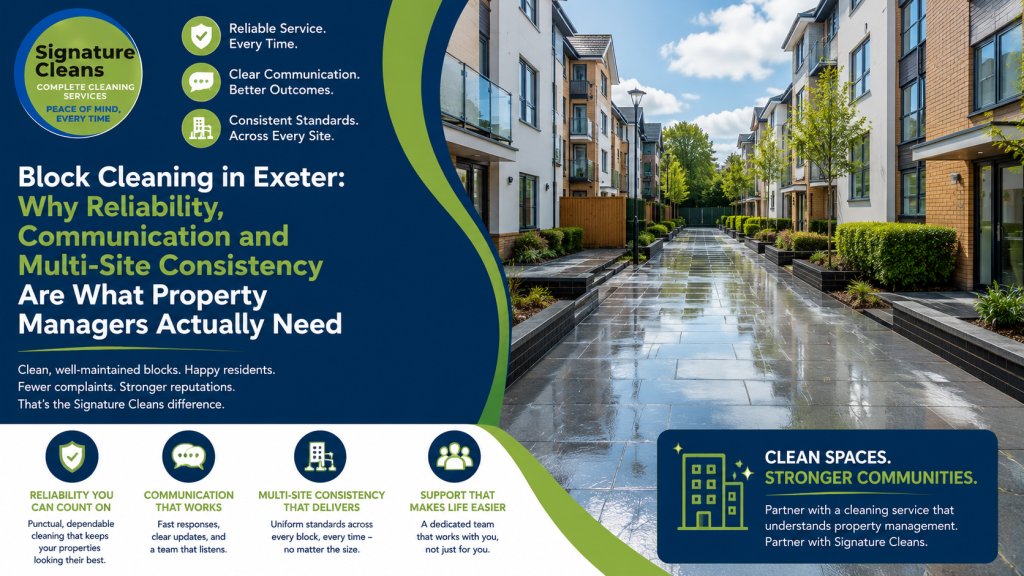
Block cleaning in Exeter covers the routine and periodic cleaning of shared areas in residential buildings, including entrance halls, stairwells, corridors, lifts and bin stores. Managing agents, freeholders and residents’ management companies typically arrange these services to maintain communal areas and provide a consistent standard for residents.
For property managers looking for a reliable provider, Signature Cleans offers professional contract cleaning services in Exeter with cleaning arrangements tailored to individual premises.
However, professional block cleaning involves more than keeping floors and entrances tidy.
Property managers also need reliable attendance, clear communication, appropriate cleaning schedules and evidence that contractors have completed the agreed work.
Whether you manage a single residential block in St Leonards or several developments across Exeter and Devon, the right cleaning arrangements should reduce your workload rather than create additional problems.
This guide explains what professional block cleaning includes, how to evaluate providers and what to consider before requesting a quotation.
What Should Exeter Property Managers Expect From Block Cleaning?
A professional block cleaning service should deliver three essential outcomes: reliable cleaning visits, consistent standards and clear communication.
For property managers, these requirements become particularly important when managing resident expectations and service-charge expenditure.
A missed visit can lead to complaints. Meanwhile, unclear responsibilities can make it difficult to establish whether the contractor has fulfilled the agreed specification.
Therefore, every residential block cleaning contract should define the cleaning tasks, visit frequency, reporting arrangements and responsibilities of both parties.
The specification should reflect the building’s layout, occupancy and communal facilities.
For example, a converted Victorian property near Exeter city centre may require a different approach from a modern apartment development in Pinhoe.
Rather than applying identical cleaning schedules to every property, contractors should assess each building individually.
1. Reliability: The Foundation of Professional Block Cleaning
Reliability is one of the most important considerations when appointing a block cleaning company in Exeter.
However, reliability involves more than simply attending the property.
A dependable service needs consistency across three areas.
Schedule Reliability
Cleaning visits should take place on the agreed days and at the agreed times.
When staff absence, bank holidays or access problems affect the schedule, the contractor should communicate changes promptly.
Property managers should also agree how missed visits will be handled.
Cleaning Standard Reliability
Each visit should meet the agreed specification.
For example, entrance halls, stairwells, corridors and lifts should receive the appropriate attention without standards declining after the initial contract period.
A documented checklist and periodic quality inspections can help identify problems before they become recurring complaints.
Personnel Reliability
Consistent cleaning teams can develop familiarity with individual buildings.
They learn the access arrangements, floor surfaces and areas that require particular attention.
Nevertheless, contractors also need suitable cover arrangements.
When another operative attends, they should receive the relevant site instructions and cleaning specification.
Ultimately, reliable block cleaning depends on clear procedures, effective supervision and realistic scheduling.
2. Clear Communication: What Property Managers Should Expect
Property managers should not need to repeatedly chase contractors for basic information about cleaning visits.
Instead, the contract should establish how the provider communicates completed work, schedule changes and service concerns.
| Property Manager’s Requirement | What to Agree With the Contractor |
| Confirmation of completed visits | A suitable visit record or completion report |
| Notification of missed cleaning | Prompt explanation and revised arrangements |
| Response to complaints | Named contact and agreed response times |
| Updates on recurring issues | Written confirmation of corrective action |
| Bank holiday schedules | Advance notice of any changes |
| Cleaning staff changes | Appropriate handover and access arrangements |
Digital visit logs can make reporting easier, particularly for managing agents overseeing several properties.
However, digital reporting is not the only acceptable method.
The important requirement is a reliable record that both parties can access when necessary.
Additionally, property managers should agree who handles complaints and how quickly the contractor will respond.
A named account contact can simplify communication, while regular service reviews provide opportunities to resolve problems.
These arrangements should form part of the cleaning agreement rather than depend on informal promises.
3. Managing Multiple Residential Blocks Across Exeter
Managing cleaning across several residential developments requires additional coordination.
Each property may have different access procedures, occupancy levels, floor surfaces and cleaning frequencies.
For example, a block in Heavitree may need regular stairwell cleaning, while a larger development in Topsham could require additional attention to lifts and external communal areas.
Therefore, managing agents should expect contractors to maintain individual cleaning specifications for every property.
Five Areas That Require Coordination
- Cleaning staff allocation
Each building needs appropriate staffing arrangements, including cover when regular operatives are unavailable.
- Scheduling
Contractors should coordinate visits around access restrictions, residents and the agreed cleaning frequency.
- Quality inspections
Regular inspections help establish whether each block receives the expected standard of service.
- Property-specific reporting
Managing agents should be able to identify which visits and tasks relate to each building.
- Specification changes
When a property adds communal facilities or changes its cleaning requirements, the contractor should update the relevant documentation.
For larger portfolios, consolidated reporting may help managers identify recurring issues across multiple sites.
However, each building still needs its own clear cleaning requirements.
4. What Does a Professional Block Cleaning Specification Include?
A block cleaning specification should explain exactly which communal areas the contractor will clean, what tasks they will complete and how often visits will take place.
The following table outlines common residential block cleaning requirements.
| Communal Area | Typical Cleaning Tasks | What Determines Frequency |
| Entrance halls | Vacuuming, mopping, entrance glass, mats and letterbox areas | Footfall and entrance conditions |
| Stairwells and corridors | Floor cleaning, handrails, skirting boards and cobweb removal | Occupancy and surface type |
| Lifts | Floors, buttons, panels, doors and accessible tracks | Usage and building size |
| Bin stores | Floor cleaning, spillages, litter and agreed odour-control tasks | Waste collection and usage |
| Car parks | Litter removal, debris and agreed surface cleaning | Exposure and seasonal conditions |
| Periodic cleaning | Internal glazing, carpets and high-level dusting | Condition and agreed schedule |
This table provides an illustrative specification rather than a universal cleaning schedule.
A physical site assessment should establish the actual tasks, frequencies and exclusions.
For example, a busy entrance may require more frequent attention than an upper-floor corridor with limited footfall.
Likewise, carpeted stairwells may need periodic extraction cleaning in addition to routine vacuuming.
Property managers should also establish which consumables, equipment and specialist services the quotation includes.
For further guidance, read the property manager’s guide to communal area cleaning in Exeter.
Where buildings require occasional intensive cleaning, consider whether periodic deep cleaning should form part of the wider maintenance plan.
5. How Often Should Communal Areas Be Cleaned?
The appropriate cleaning frequency depends on occupancy, building layout, surface materials and how residents use communal spaces.
Consequently, there is no single schedule that suits every residential block in Exeter.
A small apartment building with limited communal space may need fewer visits than a large development with busy entrances, multiple lifts and shared facilities.
However, managers should consider the condition of each area rather than relying solely on the number of apartments.
Entrance halls and lifts often experience regular contact and footfall.
Meanwhile, bin stores may require additional attention around collection days or periods of heavy usage.
Seasonal conditions can also affect requirements.
For example, wet weather may increase the amount of dirt entering communal hallways.
A suitable contract should therefore allow property managers to review cleaning frequencies when building usage changes.
6. What Affects Block Cleaning Costs in Exeter?
Block cleaning costs in Exeter depend on the size of the development, the cleaning specification and the resources required to complete the work.
Several factors influence the quotation:
- Number of communal floors, stairwells and entrances.
- Presence of lifts, bin stores and shared facilities.
- Required cleaning frequency and visit duration.
- Floor finishes and specialist equipment requirements.
- Access arrangements and working hours.
- Periodic carpet cleaning, glazing or deep cleaning.
- Whether the contract covers one building or several properties.
A larger building does not automatically require a more expensive service per apartment.
However, additional communal areas and higher visit frequencies generally increase the work involved.
To compare quotations fairly, provide each contractor with the same cleaning specification.
Then examine the tasks, exclusions, visit frequency and proposed reporting arrangements.
The cheapest quotation is not necessarily the best value if it excludes essential work.
For an accurate price, request a site assessment and an itemised proposal rather than relying on generic monthly estimates.
7. Why Communal Cleaning Matters to Residents
Communal cleaning directly influences how residents experience their building.
Entrance halls, stairwells and corridors are shared spaces that residents use regularly.
When these areas remain clean and presentable, they contribute to a well-maintained environment.
Conversely, persistent dirt, unpleasant odours or missed cleaning visits can generate complaints.
For managing agents, this creates an additional administrative burden.
Service-Charge Accountability
Where communal cleaning forms part of the service charge, residents may reasonably expect evidence that the agreed service takes place.
Therefore, property managers benefit from clear cleaning specifications, visit records and an established complaints process.
These records can help explain what the contractor provides and identify whether corrective action is necessary.
However, cleaning responsibilities and recoverable costs depend on the lease and relevant management arrangements.
The objective is straightforward: deliver an appropriate standard, maintain useful records and resolve concerns before they become persistent problems.
8. How to Choose a Block Cleaning Company in Exeter
Choosing a residential block cleaning provider requires more than comparing monthly prices.
Before appointing a contractor, ask practical questions about service delivery and accountability.
Questions Worth Asking
How will you maintain cleaning standards?
Request details of the cleaning specification, supervision and inspection arrangements.
What happens when your regular cleaner is absent?
The contractor should explain how it provides cover and briefs replacement staff.
How will you confirm completed visits?
Agree a suitable reporting method, whether digital or otherwise.
Who handles complaints and contract queries?
Establish a named contact and realistic response arrangements.
Can you manage several properties?
For portfolio contracts, ask how the provider coordinates scheduling, reporting and quality checks across different sites.
What credentials and insurance do you hold?
Verify relevant insurance, health-and-safety arrangements and any accreditations required by your procurement policy.
SSIP recognition or other certifications may support contractor assessment, but no single accreditation is universally mandatory for every residential block cleaning contract.
Likewise, DBS checks should reflect the role, eligibility and applicable safeguarding requirements rather than an assumption that every cleaner needs enhanced clearance.
Finally, review the contract’s notice period, price-review provisions and arrangements for additional work.
9. Pre-Contract Checklist for Exeter Property Managers
Before signing a block cleaning agreement, confirm the following:
- Site assessment: Has the contractor inspected the communal areas?
- Cleaning specification: Are all tasks, frequencies and exclusions documented?
- Staffing: Are regular attendance and cover arrangements clear?
- Quality control: How will the contractor inspect completed work?
- Reporting: How can the property manager check visit records?
- Communication: Who handles queries, complaints and schedule changes?
- Insurance and safety: Has the contractor supplied suitable evidence?
- Contract terms: Are notice periods, pricing and additional charges clear?
For managing agents overseeing multiple buildings, confirm that each property will have its own specification.
This approach helps prevent disagreements and makes performance easier to assess.
Frequently Asked Questions
Who Is Responsible for Communal Area Cleaning?
Responsibility usually depends on the lease and management arrangements. The freeholder, residents’ management company or appointed managing agent may arrange the service, with costs potentially recovered through service charges where permitted.
Can One Contractor Clean Several Residential Blocks?
Yes. However, the contractor should maintain individual cleaning specifications, suitable staffing arrangements and clear reporting for each property.
Does Block Cleaning Include Deep Cleaning?
Routine contracts do not necessarily include carpet extraction, high-level cleaning or other specialist tasks. Therefore, check which periodic services the quotation includes and which require separate approval.
How Do I Get a Block Cleaning Quote in Exeter?
Provide details of the building, communal areas and preferred cleaning frequency. A site assessment can then help establish the appropriate specification and quotation.
Looking for Reliable Block Cleaning in Exeter?
Professional block cleaning should make residential property management easier.
Reliable visits, clear cleaning specifications and straightforward communication help property managers maintain communal areas and respond effectively to residents.
Signature Cleans provides commercial cleaning services across Exeter and Devon, with cleaning arrangements tailored to individual premises.
If you manage a residential block or a portfolio of properties, discuss your communal cleaning requirements and request a quotation based on the building’s actual needs.
Request a Tailored Cleaning Quotation
Alternatively, call 01392 535094 to discuss your cleaning requirements.