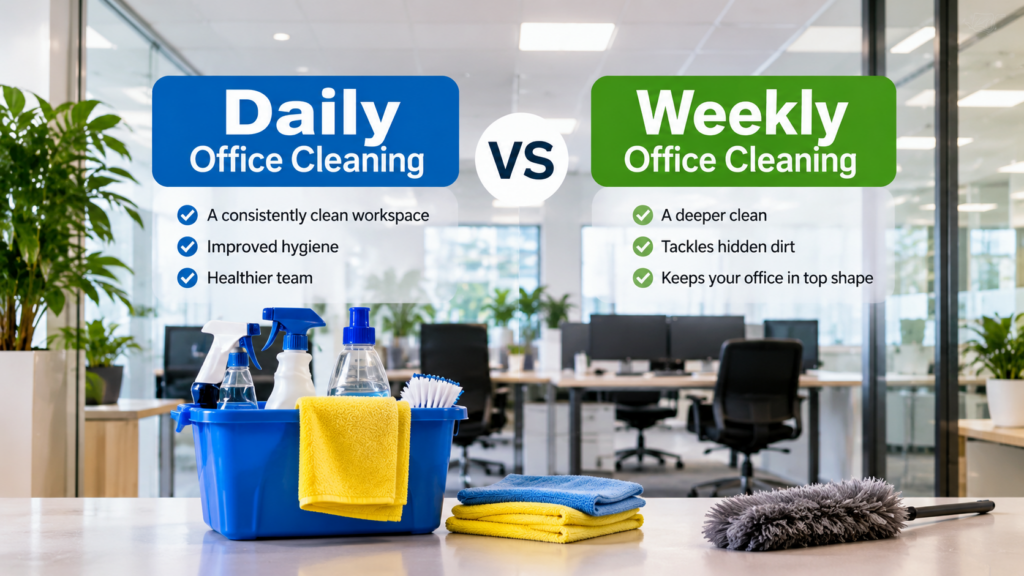
Daily office cleaning is generally better for busy workplaces with heavily used washrooms, kitchens and shared areas. Weekly office cleaning may suit smaller, lightly occupied offices when essential cleaning tasks are handled between visits. For many businesses, a mixed schedule provides the best balance between cleanliness and cost.
If you’re choosing between daily and weekly office cleaning in Exeter, consider five factors: employee numbers, occupancy patterns, washroom usage, shared kitchens and visitor traffic.
This guide compares both options, explains typical cleaning tasks and costs, and helps you choose a schedule that maintains consistent standards without unnecessary visits.
Daily vs Weekly Office Cleaning: What’s the Difference?
Daily office cleaning involves professional cleaning every working day, focusing on high-use facilities, shared surfaces, waste and busy areas.
Weekly office cleaning involves one professional visit per week. It generally suits workplaces with lower occupancy, provided essential hygiene tasks are managed between visits.
| Factor | Daily Office Cleaning | Weekly Office Cleaning |
| Frequency | Every working day | Once per week |
| Best suited to | Busy offices | Small, lightly used workplaces |
| Washrooms | Regular scheduled cleaning | Interim cleaning required |
| Shared kitchens | Frequent surface and waste cleaning | Upkeep needed between visits |
| Reception areas | Consistent presentation | Suitable for low visitor traffic |
| Main advantage | Consistent upkeep | Fewer scheduled visits |
| Main limitation | May be excessive for low-use areas | Standards may deteriorate between visits |
Weekly professional cleaning doesn’t mean your office only needs cleaning once a week. Waste, spills, washrooms and food preparation surfaces still require attention whenever necessary.
Professional office cleaning services in Exeter can be specified around actual workplace usage rather than a fixed visit schedule.
Employers must also maintain suitable workplace facilities, as explained in the Health and Safety Executive’s workplace facilities guidance.
Which Office Cleaning Schedule Is Right for Your Business?
The right frequency depends on how your office operates and how quickly different areas become dirty.
| Office Situation | Recommended Starting Point |
| Small office occupied 1–2 days weekly | Weekly cleaning with interim upkeep |
| Medium office used most weekdays | Several visits weekly or daily |
| Busy customer-facing office | Daily cleaning |
| Hybrid office | Visits aligned with busy days |
| Serviced or co-working office | Frequent communal-area cleaning |
| Busy shared facilities, quiet private offices | Mixed cleaning schedule |
These are starting points, not fixed requirements. Even a small office may need daily attention if its washrooms and kitchen receive heavy use.
Why a Mixed Cleaning Schedule Makes Sense
A mixed schedule assigns cleaning frequencies according to each area’s needs.
For example, an office might require daily washroom and kitchen cleaning, twice-weekly floor maintenance, weekly dusting and periodic specialist cleaning.
This avoids unnecessary visits in low-use areas while maintaining cleanliness where it matters most.
Where routine cleaning cannot remove ingrained dirt, periodic deep cleaning services can be arranged separately.
What Should Be Included in Daily Office Cleaning?
Daily office cleaning concentrates on hygiene, waste management and areas receiving frequent use.
Typical tasks include:
- Emptying bins and removing waste.
- Cleaning toilets, sinks and washroom surfaces.
- Checking agreed washroom consumables.
- Wiping kitchen worktops, tables and shared appliances.
- Cleaning frequently touched surfaces where appropriate.
- Vacuuming or mopping busy floors.
- Checking reception areas and meeting rooms.
- Reporting spills, damage or maintenance concerns.
These are common tasks, not universal legal cleaning frequencies.
Washrooms, Kitchens and Shared Spaces
Washrooms and shared kitchens often require the most frequent attention. Even small offices can have heavily used facilities, particularly when employees share kitchens throughout the day.
Busy workplaces may need additional checks during working hours, even when the main clean happens in the evening.
Reception areas and meeting rooms should be maintained according to visitor traffic. Hot-desking also requires consideration because multiple employees may use the same workstations.
For multi-tenant workplaces, serviced office cleaning for shared workplaces can help establish consistent communal-area maintenance.
Safe Cleaning Practices
Cleaning products must be suitable for their intended surfaces and used according to instructions.
Where hazardous substances are involved, employers and contractors should assess relevant risks. The HSE’s COSHH guidance explains the applicable principles.
Cleaning procedures should also address wet floors, equipment safety and premises security.
What Should Be Included in Weekly Office Cleaning?
Weekly office cleaning generally focuses on routine maintenance in lightly used workplaces or tasks that don’t require daily attention.
A weekly visit may include:
- Vacuuming carpets and cleaning hard floors.
- Dusting furniture and accessible fixtures.
- Cleaning meeting rooms and individual workspaces.
- Wiping internal glass partitions.
- Cleaning skirting boards and less frequently touched surfaces.
- Removing marks from doors and furniture.
Weekly cleaning works when the premises remain in acceptable condition between visits.
For example, an office occupied only two or three days weekly may benefit from professional cleaning after its busiest day.
However, designated staff must still manage essential hygiene tasks. A practical office cleaning checklist can clarify responsibilities.
When Weekly Cleaning Isn’t Enough
Weekly cleaning may be insufficient when bins overflow, washrooms deteriorate, kitchens develop odours or floors become visibly dirty before the next visit.
The solution isn’t always daily cleaning throughout the building. Increasing attention to specific areas may be sufficient.
The HSE’s cleaning guidance provides additional information about managing workplace cleaning risks.
How Often Should Different Office Areas Be Cleaned?
Cleaning frequency should reflect occupancy, hygiene requirements and how quickly each area’s condition changes.
| Office Area | Suggested Frequency |
| Toilets and washrooms | Daily or more often when needed |
| Shared kitchens | Daily or as required |
| Waste bins | Check daily; empty as needed |
| Reception | Daily in busy offices |
| Shared desks | According to use |
| Meeting rooms | After heavy use and during scheduled visits |
| Main corridors | Daily or according to traffic |
| Quiet individual offices | Weekly or according to use |
| Internal glass | Weekly or periodically |
| Carpets and upholstery | Routine maintenance and periodic specialist cleaning |
These are suggested starting frequencies, not fixed legal minimums.
Consider Exeter’s Weather Conditions
Wet weather can increase the dirt and moisture brought into entrances and corridors, making additional floor maintenance necessary.
Suitable entrance matting, prompt spill removal and appropriate cleaning procedures help manage these conditions.
The HSE’s slips and trips guidance explains why floor condition and cleaning practices matter for workplace safety.
Example: Cleaning Schedule for a Hybrid Office in Exeter
Consider a hypothetical Exeter office with 20 employees, most attending Tuesdays through Thursdays.
The workplace has two washrooms, a shared kitchen, reception and several meeting rooms.
An initial schedule could include:
| Cleaning Task | Illustrative Schedule |
| Washrooms | Daily checks and cleaning as required |
| Shared kitchen | Daily attention on occupied days |
| Waste bins | Check daily; empty as needed |
| Reception | After busy visitor periods |
| Main floors | Two or three visits weekly |
| Meeting rooms | Check after use |
| Detailed dusting | Weekly |
| Intensive floor or upholstery cleaning | Periodically |
This is an illustrative example, not a Signature Cleans client case study. Actual requirements depend on occupancy and conditions, including whether cleaning is needed on quieter days.
The key principle is to schedule cleaning around actual workplace use rather than assuming every weekday has identical requirements.
How Do Daily and Weekly Office Cleaning Costs Compare?
Daily office cleaning usually involves more visits, but it doesn’t automatically cost five times as much as weekly cleaning.
Pricing depends on cleaning hours, tasks, access arrangements, consumables and contract requirements.
Example: Comparing Cleaning Hours
| Cleaning Arrangement | Weekly Hours | Approx. Monthly Hours |
| Daily: 1 hour × 5 days | 5 | 21.7 |
| Weekly: 3 hours × 1 day | 3 | 13.0 |
| Mixed: 1 hour × 3 days | 3 | 13.0 |
Figures are illustrative, calculated using 52 weeks divided by 12 months. They are not Signature Cleans quotations and don’t establish equivalent cleaning outcomes.
Weekly cleaning may require fewer contracted hours but create additional internal responsibilities. Mixed schedules may provide more frequent attention without cleaning every area daily.
Compare Total Cleaning Costs
When comparing quotations, consider office size, occupancy, facilities, required tasks, cleaning times and consumable responsibilities.
For UK pricing context, the MyJobQuote office cleaning cost guide provides market estimates, although these aren’t quotations for individual Exeter workplaces.
A practical calculation is:
Total monthly cleaning cost = Contractor charges + Consumables + Internal cleaning labour + Management time
Include only applicable costs and avoid double-counting items included in your contract.
It may also help to assess whether professional office cleaning is worth the investment rather than comparing visit prices alone.
The goal is to maintain the required standard at a reasonable total cost.
How to Choose the Right Office Cleaning Frequency
A practical five-step assessment can help establish an appropriate schedule.
- Assess your premises. Identify washrooms, kitchens, workstations and areas requiring frequent attention.
- Review occupancy. Consider employee attendance, visitors and peak usage days.
- Prioritise tasks. Separate daily, weekly and periodic cleaning requirements.
- Assign responsibilities. Confirm who completes each task and checks the results.
- Review after two weeks. Record complaints, missed tasks and areas deteriorating between visits.
Two weeks is a suggested initial review period, not an industry requirement.
For businesses needing documented schedules and defined responsibilities, commercial contract cleaning services can provide a structured arrangement.
For workplace assessment principles, consult the HSE’s risk assessment guidance.
Signs Your Office Needs More Frequent Cleaning
Your current schedule may need adjusting if:
- Bins regularly fill before collection.
- Washrooms become dirty during working hours.
- Kitchens develop persistent odours.
- Floors accumulate noticeable dirt.
- Employees repeatedly report cleaning problems.
- Managers frequently arrange additional cleaning.
However, poor results don’t always mean more visits are necessary.
Is the Problem Frequency or Cleaning Quality?
Cleaning problems generally fall into three categories:
- Insufficient frequency: Areas become dirty again before the next visit.
- Incomplete specification: Important tasks aren’t included in the agreement.
- Inconsistent service: Agreed tasks aren’t completed properly.
Before increasing your cleaning budget, check whether the existing contractor is delivering the agreed work.
Reviewing your office cleaning contract can help identify whether frequency, task coverage or service quality needs changing.
Tracking complaints and inspection findings provides a practical way to measure improvements.
Frequently Asked Questions
Is Weekly Office Cleaning Enough for a Small Office?
Yes, weekly professional cleaning may be sufficient for lightly occupied offices if essential facilities are maintained between visits.
Should Office Toilets Be Cleaned Every Day?
Regularly occupied office toilets will often need daily cleaning, with additional checks in busy workplaces. Frequency depends on usage and condition.
Is Daily Office Cleaning Necessary for Hybrid Workplaces?
Not always. Cleaning can follow peak occupancy, provided shared facilities receive attention whenever required.
Is Daily Office Cleaning More Cost-Effective Than Weekly Cleaning?
Daily cleaning may offer better value for busy offices, while weekly cleaning may cost less for lightly used workplaces. Compare total costs against the required standards.
Can Office Cleaning Take Place Outside Working Hours?
Yes, where the contractor offers that service. Access, security arrangements and any additional charges should be agreed beforehand.
For more information, consult the HSE’s workplace facilities guidance.
Get the Right Office Cleaning Schedule for Your Exeter Business
Choosing between daily and weekly office cleaning depends on how your workplace operates, which facilities require attention and the standards you need to maintain.
For some Exeter businesses, weekly professional cleaning with reliable interim upkeep is sufficient. Others require daily attention to washrooms, kitchens and shared spaces.
A mixed schedule may provide the most practical balance, combining essential daily cleaning with weekly maintenance and periodic specialist work.
Signature Cleans provides commercial cleaning services for businesses in Exeter and surrounding areas.
Whether you’re reviewing an existing contract or arranging a new service, discuss your office size, occupancy, shared facilities and preferred cleaning times to establish an appropriate cleaning specification.
Request an Office Cleaning Assessment
Find out whether daily, weekly or mixed-frequency cleaning is right for your Exeter business.


