Is Your Dental or Medical Practice Getting the Cleaning Standard It Deserves?

Quick answer

A dental or medical practice cleaning service should be CQC-aligned, use EN-certified clinical disinfectants, operate a colour-coded equipment system, and provide a documented audit trail for inspection purposes. A general commercial cleaning company is not equipped to deliver this, and using one in a registered clinical setting carries infection control and regulatory compliance risk. Practice managers reviewing their current provider should assess compliance credentials and documentation, not just cleaning frequency and cost, before deciding whether to stay, renegotiate, or switch. 

Three Questions Every Practice Manager Should Be Able to Answer About Their Cleaning

Clinical environments are held to a different standard than commercial ones, not by preference, but by regulation. The CQC’s Fundamental Standards, the NHS National Standards of Healthcare Cleanliness 2025, and COSHH legislation all place specific obligations on how cleaning is carried out in registered healthcare settings. The cleaning company you use either meets those obligations or it doesn’t.

1.  Are standards consistent day to day, or does the practice look noticeably different depending on who cleaned it last?

2.  Is your current provider able to produce EN-certified product data sheets and a written COSHH risk assessment for every chemical used on your premises?

3.  Could you demonstrate a documented cleaning audit trail if the CQC requested evidence of your infection control processes today?

If any of these drew a blank, it’s not necessarily the fault of the person doing the cleaning. It’s a structural issue with the contract, and in a clinical setting, structural issues with the cleaning contract carry regulatory consequences that go beyond a missed bin or a smudged surface.

The risk of staying with a provider you don’t fully trust in a clinical setting is not abstract. It includes CQC inspection findings, infection control failures, and most visibly to patients, a practice environment that contradicts the standard of care being delivered inside it.

Why Staying With the Wrong Provider is the Bigger Risk?

Switching cleaning providers can feel like an operational risk, notice periods, new faces, a period of adjustment. These are real concerns, and they deserve a real answer. But they sit alongside a different question: what is the cost of staying with a service you don’t fully trust in a setting where the cleaning standard is a patient safety and compliance matter?

The visible risk: what patients see

Patients use the cleanliness of a dental or medical environment as a direct proxy for its clinical quality. Research consistently shows that visible dirt, staining, or poor presentation in waiting rooms, treatment areas, and washrooms reduces patient confidence, even when the quality of care is high. In an environment where trust is everything, a cleaning standard that doesn’t match your clinical standard undermines the impression your practice works hard to create.

The compliance risk: what the CQC sees

CQC inspections assess infection prevention and control as a core regulatory requirement under Fundamental Standard 15: Safe Care and Treatment. Inspectors look for evidence that cleaning is being carried out to a documented, consistent standard, not just that the practice looks presentable on the day. A cleaning provider who cannot supply audit documentation, COSHH records, or a site-specific cleaning specification is leaving your practice exposed at precisely the point where evidence is required.

CQC Fundamental Standard 15

Registered providers must assess the risk of, and prevent, detect and control the spread of infections. Cleaning is a core component of this obligation. The CQC expects to see documented processes, not just a clean environment, when assessing compliance.

The operational risk: what staff experience

Inconsistent cleaning creates operational friction that practice managers absorb daily, fielding complaints, arranging extra cleans ahead of inspections, re-briefing a different person each week who doesn’t know the site. In a clinical environment, where staff time and attention should be on patient care, this overhead is both avoidable and costly.

General Commercial Cleaning vs. Qualified Clinical Cleaning

The gap between a general commercial cleaning contractor and a provider qualified to clean registered clinical settings is not a matter of effort or frequency; it’s a matter of training, products, systems, and documentation.

Standard⚠ General commercial provider✓ Qualified clinical provider
ProductsGeneral-purpose disinfectants, no EN certificationEN 1276/EN 13697-certified clinical disinfectants with specified contact times
Equipment systemShared cloths and mops across zonesNHS colour-coded equipment — separate sets per zone to prevent cross-contamination
Audit trailNo documentation providedDigital or written audit trail per visit, available for CQC inspection
CQC alignmentNo awareness of Fundamental StandardsCleaning spec built around CQC Fundamental Standard 15: Safe Care and Treatment
NHS StandardsNot referencedAligned to NHS National Standards of Healthcare Cleanliness 2025 (FR3–FR4)
COSHH complianceVerbal assurance onlyWritten COSHH risk assessments for all clinical products used on site
Staff trainingGeneric inductionClinical cleaning protocols, infection control, decontamination procedures
AccountabilityNo named contact, reactive to complaintsNamed account manager, proactive reporting, monthly scored audits

A general commercial cleaning company operating in a dental or medical practice is not automatically doing anything wrong, but it is operating without the systems that clinical compliance requires. That gap tends to be invisible until it matters, at which point it matters considerably.

What medical practice cleaning should include?

Professional medical and dental practice cleaning requires EN 1276 and EN 13697-certified clinical disinfectants with specified contact times, NHS colour-coded equipment systems to prevent cross-contamination between zones, a documented audit trail per visit for CQC inspection purposes, and staff trained in infection control and decontamination procedures. These requirements distinguish qualified clinical cleaning from standard commercial cleaning, which does not include these elements as standard.

What it Looks Like When the Cleaning Reflects the Care?

A dental or medical practice that has invested in a properly specified clinical cleaning contract sees a consistent effect: the environment reflects the standard of the work being done inside it. Treatment rooms are visibly clinical. Reception areas are presented to a standard patients notice. Washrooms are reliably stocked and sanitised. The practice manager isn’t thinking about cleaning because the cleaning doesn’t require intervention.

That consistency is not incidental. It’s the result of a specific set of structural elements:

Structural elementWhat it delivers
Named, consistent teamThe same people attend every visit — they know the site, the clinical zones, the access protocols, and the patient-facing areas that require particular attention
Site-specific specificationA written cleaning programme built around your practice’s layout, clinical zones, Functional Risk categories and CQC obligations, not a generic commercial checklist
Colour-coded equipmentSeparate, dedicated equipment per zone prevents cross-contamination between clinical and non-clinical areas as standard, not as an add-on
Documented audit trailA written or digital record of every clean, shared with the practice manager and available for CQC inspection without advance preparation
EN-certified clinical productsCOSHH risk assessments for every product used on site, with evidence of certification available on request
Proactive communicationIssues flagged by the provider before a complaint is raised, not reactive responses to problems the practice has already noticed

Switching to a Qualified Clinical Cleaning Provider

The concern about switching providers is almost always about the transition period — a gap in service, a disruption to clinical routines, time spent re-briefing. A properly structured handover eliminates all three.

Handover stageWhat happens
Step 1: Free site assessmentA director visits within 48 hours to scope the premises, understand your clinical zones, and assess your CQC compliance requirements before any proposal is made
Step 2: Documented specificationA written cleaning programme covering each area, frequency, product selection, colour-coding system and audit format, agreed and signed off before the first clean
Step 3: Team onboardingA named, vetted team is trained specifically to your site’s protocol before their first visit — including infection control, COSHH procedures and clinical zone awareness
Step 4: First clean and sign-offThe first clean is conducted to the agreed specification, documented, and reviewed with the practice manager before the ongoing contract begins
Step 5: Ongoing auditsMonthly scored audits and a single named point of contact from that point on — so standards are measurable and accountable, not assumed

From first enquiry to first clean with Signature Cleans is typically under two weeks. Notice periods with existing providers are factored into the transition plan so there is no gap in clinical cleaning coverage.

Frequently Asked Questions

Can a general commercial cleaning company clean a dental or medical practice?

A general commercial cleaning company can physically clean a dental or medical practice, but it does not typically have the EN-certified product range, colour-coded equipment system, staff training in infection control, or audit documentation that CQC compliance requires. Using a general commercial provider in a registered clinical setting carries infection control risk and may leave the practice unable to demonstrate compliant cleaning processes during a CQC inspection.

What does CQC-aligned dental practice cleaning actually require?

CQC-aligned cleaning in a dental or medical practice requires a documented, site-specific cleaning specification; EN 1276 and EN 13697-certified disinfectants with specified contact times; an NHS colour-coded equipment system separating clinical and non-clinical zones; COSHH risk assessments for all products used on site; and a written or digital audit trail per visit that can be produced for inspection.

How do I switch my practice to a qualified clinical cleaning provider without disrupting operations?

A structured handover with a qualified provider takes under two weeks. The new provider conducts a site walkthrough to scope clinical zones and compliance requirements, agrees a documented specification, and trains a dedicated named team to your site’s protocol before the first clean. With correct notice given to the outgoing provider, there is no gap in clinical cleaning coverage.

What is the difference between clinical-grade and standard disinfectants in practice cleaning?

Clinical-grade disinfectants carry EN 1276 (bactericidal) and EN 13697 (surface disinfection) certification, confirming they achieve the required log reduction in pathogenic bacteria within a specified contact time. Standard commercial disinfectants do not carry this certification and are not appropriate for use in treatment rooms, decontamination areas, or clinical zones in registered healthcare settings.

How often should a dental practice be cleaned?

Dental practices typically fall within Functional Risk categories FR3 to FR4 under the NHS National Standards of Healthcare Cleanliness 2025, which require daily cleaning of all clinical and patient-facing areas: treatment rooms, decontamination rooms, waiting areas, and washrooms. High-touch clinical surfaces may require cleaning between patients. A properly specified cleaning programme will define frequency by zone and risk category, not as a blanket schedule.

Does Signature Cleans provide clinical cleaning for dental and medical practices in Exeter and Devon?

Yes. Signature Cleans provides SSIP-accredited, COSHH-compliant clinical cleaning for dental practices, GP surgeries, private clinics, and healthcare facilities across Exeter and Devon. Every contract includes a site-specific specification, colour-coded equipment, EN-certified products, a documented audit trail, and a named account manager. Free site assessment within 48 hours of first enquiry. 

Related Reading

For the full regulatory and compliance detail behind clinical cleaning standards, NHS National Standards 2025, CQC Fundamental Standards, and the specific product and equipment requirements, see the companion article below:

PageWhy it’s relevant
Why Medical Cleaning Services Can’t Afford to Cut CornersThe compliance detail – NHS National Standards 2025, CQC Fundamental Standards, EN-certified products and colour-coded systems.
Medical & Dental Cleaning – Service PageWhat Signature Cleans delivers for GP surgeries, dental practices and private clinics across Devon.
Switching Office Cleaning Companies in ExeterHow a structured handover works – relevant to any provider switch, including clinical settings.
The Real Cost of Cutting CornersWhy unaccredited cleaning costs more than it saves — risk, liability, and audit failure.

Ready to raise the standard your practice deserves?

If your review has surfaced concerns about compliance, consistency, or confidence in your current provider, a free site assessment is the clearest next step. A director will visit your premises within 48 hours to scope your clinical cleaning requirements, with no obligation to proceed.

Peace of mind, every time.

Is It Time to Review Your Communal Cleaning Contract?

Quick Answer

A communal cleaning contract should be reviewed when standards are inconsistent, resident complaints are rising, or service reliability has declined not solely when the renewal date or price comes up. The most effective signal is complaint volume: a well-managed cleaning contract reduces complaints over time, while a declining one tends to generate the same recurring issues. Property managers reviewing a contract should assess consistency, accountability and communication alongside cost before deciding whether to renew, renegotiate, or switch providers. 

Why cost is the wrong place to start a contract review?

When a communal cleaning contract comes up for renewal, the easiest question to ask is also the least useful one: is this still the cheapest option? Price matters, but it tells you almost nothing about whether the contract is actually working and a property manager who reviews on price alone will often end up switching to a provider with the same underlying problems at a marginally lower rate.

Three questions reveal far more about whether a contract is performing than the invoice does:

1.  Are standards consistent? Or does the building look noticeably better in the week before an inspection than the rest of the month?

2.  Are complaints low? A pattern of repeated complaints about the same areas: bins, entrances, stairwells is a reliability signal, not a one-off.

3.  Is the service reliable? Are visits happening on schedule, or has the management company stopped tracking whether they do?

If the answer to any of these is no, the contract is underperforming regardless of what it costs and a review on cost alone will miss that entirely. 

When to review a communal cleaning contract?

A communal cleaning contract should be reviewed based on consistency of standards, frequency of resident complaints, and service reliability, not primarily on cost. Recurring complaints about the same communal areas, such as entrances, bins, or stairwells, typically indicate an underperforming contract rather than an isolated issue. Property managers are advised to assess these operational factors before a renewal decision, since switching to a cheaper provider with the same underlying issues does not resolve the original problem.

A supplier cleans your building. A partner maintains its standard.

Most cleaning contracts are written, and most cleaning companies operate as a transactional supply relationship: a task list, a price, a schedule. The cleaner attends, completes the list, and leaves. Nothing about that arrangement is wrong, but it’s also not what most managed buildings actually need.

A residential block or managed building isn’t a fixed set of tasks. It’s a living environment where new issues emerge constantly: a recurring damp patch, a bin store that needs attention sooner than scheduled, a stairwell carpet showing wear faster than expected. A supplier completes the list and moves on. A partner notices, flags, and helps the management company stay ahead of it.

AreaA SupplierA Partner
ApproachTurns up, cleans the specified tasks, leavesActively monitors and flags building standard issues beyond the task list
CommunicationResponds when contacted about a problemProactively reports issues before they become complaints
AccountabilityNo audit process – quality is assumedScheduled audits and documented reporting shared with the management company
RelationshipTransactional – priced per visit, reviewed only at renewalOngoing understands the building, residents, and recurring problem areas
Resident impactStandards fluctuate; complaints handled reactivelyConsistent standards reduce complaint volume and resident turnover risk

This distinction is what separates a cleaning contract that quietly protects a building’s standard from one that simply ticks along until something goes visibly wrong.

The Direct Link Between Cleaning Standards and Property Management Workload

It’s a simple causal chain, but one that’s easy to underestimate: higher and more consistent cleaning standards lead to fewer resident complaints, a better resident experience, and a smoother management workload overall. Each of these compounds.

OutcomeWhat it means in practice
Fewer complaintsLess time spent by management company staff fielding and resolving cleaning-related issues
Better resident experienceLower likelihood of complaints escalating to leaseholder disputes or tenancy non-renewal
Smoother managementFewer reactive site visits, fewer emergency call-outs, more predictable budgeting

None of this requires a more expensive contract, it requires a more consistent one. That’s the practical case for treating cleaning quality as a property management priority rather than a background cost.

What to look for if you decide to switch providers?

•   Experience specifically in residential blocks or managed buildings not just general commercial premises

•   A documented, site-specific cleaning specification rather than a generic task list

•   Scheduled audits and reporting that the management company can actually see, not just verbal assurance

•   A named point of contact who understands your building, not a rotating call centre

•   A provider willing to flag building issues beyond the cleaning brief the supplier-versus-partner distinction in practice

These criteria matter more than the headline price, because they’re what determines whether the contract actually reduces your workload or simply shifts the same problems to a new invoice.

Frequently Asked Questions 

How do I know if it’s time to switch communal cleaning providers? 

Signs it’s time to switch include inconsistent standards between visits, a pattern of recurring complaints about the same communal areas, missed or irregular visits, and no audit or reporting process to verify the work is being done to specification. If two or more of these apply, it’s worth reviewing alternatives rather than renewing by default. 

What’s the difference between a cleaning supplier and a cleaning partner for managed buildings? 

A cleaning supplier completes a fixed task list on a schedule and leaves. A cleaning partner actively monitors the overall condition of the building, flags issues beyond the immediate cleaning brief, and works with the management company to maintain standards proactively rather than reactively addressing complaints. 

Does better cleaning actually reduce resident complaints? 

Yes. Consistent, higher cleaning standards in communal areas directly reduce the volume of resident complaints, because the most common sources of complaint — untidy entrances, poorly maintained bin stores, neglected communal areas are addressed proactively rather than only after a complaint is raised. 

Should I review my communal cleaning contract based on price alone? 

No. Reviewing a contract on price alone often results in switching to a similarly priced provider with the same underlying issues. A more effective review assesses consistency of standards, complaint frequency, and service reliability alongside cost. 

How quickly can I switch to a new communal cleaning provider? 

With Signature Cleans, the process from initial enquiry to first clean is typically under two weeks, including a free site assessment, a documented proposal, and onboarding of a dedicated team trained to your building’s specific requirements. 

Related reading

If you’re reviewing your current contract or comparing providers, these pages give more detail on what a properly run communal cleaning service should look like:

PageWhy it’s relevant
Communal Cleaning: A Guide for UK Property ManagersWhat professional communal cleaning should cover and how to assess provider experience.
5 Signs Your Cleaning Contractor Isn’t PerformingA practical diagnostic for spotting a declining cleaning standard before residents do.
Specialist ServicesHandover cleans, infection control and façade cleaning for managed buildings and one-off projects.
Contract CleaningDaily, weekly and scheduled cleaning delivered to a documented playbook for communal areas.

Ready for a cleaning partner, not just a supplier?

If your review has raised more questions than confidence, a free site assessment will show you exactly what a properly documented, accountable communal cleaning contract looks like — and what it would take to put one in place.

Peace of mind, every time.

Why Your Showroom Cleaning Is a Brand Decision?

Quick answer

Showroom cleaning standards directly affect how customers perceive a brand, because the environment is processed visually before any sales interaction takes place. Low-cost cleaning contracts in premium retail settings tend to result in declining standards over time, because the cleaning budget cannot sustain the consistency, equipment, and accountability the environment requires. Value-led cleaning, prioritising reliability and consistency over the lowest price, is what protects a showroom’s brand presentation day after day. 

Start With The Environment, Not The Sales Pitch

Every dealership reviews its sales process, its stock, its marketing. Fewer review the one thing every customer experiences before any of that, the environment itself.

Walk into your own showroom as if you were a customer. Does the floor reflect the brand standard on the cars sitting on it? Does the glass match the precision of the vehicles behind it? Does the reception area feel as considered as your sales material? If the answer is anything other than yes, it’s worth addressing because customers are answering that question whether you ask it or not.

Why Cheap Cleaning Rarely Stays Cheap in a Premium Showroom

Cleaning is one of the easiest line items to cut when reviewing overheads, it’s invisible right up until it isn’t. But a premium showroom is an unusually unforgiving environment for a cut-price cleaning contract, because the standard it requires is also unusually visible.

What happens when price drives the contract?

A cleaning company competing purely on price has one place left to find margin: labour. That typically means fewer hours on site, less experienced staff, and higher turnover of the people actually doing the work. None of this is announced, it shows up gradually, in exactly the way standards tend to drift when nobody is actively managing them.

Where it showsWhat tends to happen
StaffingCheapest providers cut hours and use inexperienced or rotating staff to protect margin
ConsistencyWithout a named, trained team, the same task gets done differently or skipped week to week
EquipmentPremium floor and glass finishes need specific products; budget contracts default to generic ones
AccountabilityLow-margin contracts rarely include audits or reporting issues go unnoticed until a customer sees them first
Brand riskA showroom is processed visually before a single sales conversation happens, a declining standard is a declining first impression, repeated daily

This is the pattern behind the phrase “value over cheap.” Value isn’t the most expensive option, it’s the contract structured so the standard doesn’t quietly erode the moment it’s signed. 

Why cheap commercial cleaning often fails in premium environments?

Low-cost cleaning contracts in premium retail and showroom environments frequently lead to declining standards over time. This happens because providers competing primarily on price reduce labour hours, use less experienced or rotating staff, and rely on generic products rather than those suited to high-finish surfaces. Without consistent staffing, proper equipment, and ongoing accountability such as audits, cleaning quality typically erodes gradually rather than failing all at once.

Your Showroom is a Brand Statement Before Anyone Speaks

A customer forms an impression of your dealership within seconds of walking in — long before a salesperson reaches them. That impression is shaped by the floor, the glass, the smell of the space, the state of the waiting area. None of it is incidental. All of it is part of the brand experience you’ve already invested in building through marketing, training and stock presentation.

A showroom cleaned to a consistent, high standard protects that investment every single day it’s open. A showroom cleaned inconsistently undermines it, regardless of how strong the brand looks on paper.

What “protecting the brand” actually requires?

•        A cleaning standard that matches the standard of the vehicles and the space, not a generic commercial benchmark

•        Consistency day to day, not just on the days a manager happens to notice

•        A provider who treats reliability as the baseline, not as something to highlight as a bonus

•        A contract structured around maintaining the standard, not the lowest price that wins the tender

What to Check if You’re Reviewing Your Current Showroom Standard

1.      Walk the floor as a customer would, does it reflect the brand on display?

2.      Check glass and reflective surfaces under full showroom lighting, not daylight

3.      Ask whether the same cleaning team attends consistently, or whether staff rotate

4.      Ask your current provider what’s included for the price and what isn’t

5.      Consider whether your contract includes any form of audit or reporting at all

If most of these raise more questions than answers, the contract is very likely priced for the provider’s margin, not for your brand’s standard.

Related reading

For the operational detail behind a premium showroom cleaning standard, scheduling, equipment, and franchise audit requirements, see our companion guide below:

PageWhy it’s relevant
Car Showroom Cleaning in ExeterThe operational deep-dive, out-of-hours scheduling, floor equipment, glass protocols and franchise audits.
5 Signs Your Cleaning Contractor Isn’t PerformingHow to recognise a slipping standard before it shows up in front of customers.
The Real Cost of Cutting CornersWhy unaccredited, cut-price cleaning costs more in the long run than it saves.
Specialist ServicesFaçade, glass and handover cleaning for premium retail and commercial environments.

FAQs: Showroom Cleaning Standards

 Why does cheap cleaning tend to fail in premium showrooms?

Cheap cleaning contracts protect their margin by reducing labour hours, using less experienced or frequently rotating staff, and relying on generic cleaning products rather than those suited to high-finish floors and glass. In a premium showroom, where the cleaning standard is highly visible, this typically results in a gradually declining presentation standard rather than an immediate, obvious failure.

How does showroom cleaning affect customer perception of a brand?

A showroom is visually processed by customers within seconds of entering, before any sales interaction takes place. The condition of the floor, glass, and customer-facing areas directly shapes the first impression of brand quality, regardless of how strong the marketing or sales process is. A consistently high cleaning standard reinforces brand positioning; an inconsistent one undermines it.

What does ‘value’ mean in a showroom cleaning contract, if not the cheapest price?

Value in a cleaning contract refers to consistency and reliability sustained over time, not the lowest quoted price. A value-led contract is structured so that staffing, equipment, and accountability are sufficient to maintain the standard the environment requires, rather than priced so low that standards inevitably decline.

How can I tell if my current showroom cleaning contract has been priced too low?

Signs include rotating or unfamiliar cleaning staff, no audit or reporting process, generic cleaning products being used on high-finish surfaces, and a standard that looks good immediately after onboarding but gradually declines. If your contract includes none of these checks, it’s worth reviewing what’s actually included for the price.

Does Signature Cleans provide showroom cleaning specifically for car dealerships in Exeter?

Yes. Signature Cleans provides specialist car showroom cleaning across Exeter and Devon, with consistent named teams, documented audits, and a cleaning specification built around the presentation standard your brand requires, not a generic commercial cleaning package.

Make sure your showroom always looks the part

If you’re reviewing your current cleaning contract and suspect price has been driving the standard, a free site assessment will show you exactly what a properly resourced contract looks like and what it costs to do it right.

Peace of mind, every time.

Switching Office Cleaning Companies in Exeter: What a Disruption-Free Handover Actually Looks Like

Quick Answer: Switching office cleaning companies in Exeter does not have to disrupt day-to-day operations. A structured handover — a documented onboarding plan, a clear point of contact, and a defined start date, allows a new provider to take over with no gap in service and no impact on staff or visitors. The risk most businesses associate with switching usually comes from a previous provider’s poor communication, not from the act of switching itself.

“We’d switch, but it feels like a hassle”

It’s one of the most common reasons businesses stay with an underperforming office cleaning company in Exeter for far longer than they should. The cleaning isn’t good enough. The communication has gone quiet. Standards have slipped. But switching feels riskier than putting up with it.

That hesitation is understandable, and it’s also based on a false assumption. Switching providers is only disruptive when the new provider doesn’t have a structured process for taking over. With the right onboarding approach, a change in cleaning company should feel like a step forward, not a risk.

What a structured cleaning handover should include

A disruption-free switch isn’t about luck — it’s about process. Before agreeing to a new contract, a facilities manager or business owner should expect a new provider to set out exactly how the transition will work, in writing, before the first clean takes place.

What to expectWhy it matters
Site walkthroughA director or manager visits the site before the contract starts, to understand layout, access, existing schedules and any sensitivities (e.g. occupied desks, client-facing areas).
Defined start dateA fixed handover date agreed in advance – not an open-ended transition that drags on for weeks.
Named point of contactOne person responsible for the account from day one, so questions and adjustments don’t get lost between people.
Documented scopeA written specification of tasks, frequency and standards, removing ambiguity about what’s included.
Overlap or notice periodEnough notice with the outgoing provider that there’s no gap in coverage between contracts.
First-week check-inA scheduled follow-up in the first week to catch and resolve any teething issues immediately.

If a prospective cleaning company can’t describe this process clearly before you’ve signed anything, that’s a signal worth paying attention to, the same lack of structure is likely to show up in the cleaning itself.

Why most cleaning problems start with communication, not cleaning

It’s a pattern that shows up across the commercial cleaning industry: the issue a client complains about is rarely the root cause. A missed bin, a smudged window, an unstocked washroom, these happen with almost every provider occasionally. What turns a minor lapse into a reason to switch is what happens next.

The communication gap that causes most complaints

Without a clear feedback loop, small issues go unreported until they accumulate into a bigger frustration. No updates after a clean. No way to flag a problem quickly. No accountability for how an issue was resolved, or whether it was resolved at all. None of this is about the standard of cleaning, it’s about the absence of a system around it.

What good communication looks like in practice

•   A single named contact who knows your site, not a call centre

•   A clear channel to report an issue the same day it happens

•   Visibility on what was done – not just an assumption that it was

•   A response and resolution, not just an acknowledgement

This is also why monthly audits and documented reporting matter more than they might seem to on paper. They turn cleaning quality into something you can see and measure, rather than something you only notice when it’s gone wrong.

Reliability is the Baseline – Not a Selling Point

Turning up on time. Doing the job properly. These shouldn’t be features a cleaning company highlights as a differentiator, they’re the minimum expectation of any commercial contract. Yet in commercial cleaning, this is consistently where providers fall short.

The businesses that switch providers most often aren’t chasing a cheaper price or a longer list of extras. They’re looking for a company that simply does what it says it will do, every time, without needing to be chased. That consistency is what allows a facilities manager to stop thinking about cleaning altogether — which is the actual goal of outsourcing it in the first place.

What causes most office cleaning complaints? Most commercial cleaning complaints originate from poor communication rather than the cleaning itself. Common causes include a lack of regular updates, no clear channel to report issues, and no accountability for how problems are resolved. Reliable providers address this with a named point of contact, documented audits, and a consistent team assigned to each site.

Signs it’s time to switch your office cleaning provider

1.  You’ve stopped reporting issues because nothing changes when you do

2.  Different cleaners turn up each week with no consistency

3.  There’s no documented schedule — just a vague sense of what’s covered

4.  You have no way to verify the cleaning standard beyond a visual check

5.  Your current provider can’t produce accreditation (SSIP, PQS, or equivalent) on request

If two or more of these sound familiar, the cost of staying is usually higher than the perceived cost of switching

Frequently Asked Questions: Switching Office Cleaning Providers

Will switching office cleaning companies disrupt my office?

It shouldn’t. A properly structured handover — including a site walkthrough, a fixed start date and an overlap or notice period with your outgoing provider — means a new cleaning company can take over with no gap in service and no impact on your day-to-day operations.

How much notice do I need to give my current cleaning company?

This depends on your existing contract terms, which typically range from 30 to 90 days. Check your current agreement for a specific notice period, and plan your new provider’s onboarding to begin once that notice period is confirmed.

What should I ask a new cleaning company before switching?

Ask how they handle onboarding and handover, who your single point of contact will be, how issues get reported and resolved, and whether they provide documented audits or reporting. Their answers to these questions tend to predict the day-to-day experience more reliably than the price they quote.

Why do most office cleaning complaints happen?

Most complaints trace back to poor communication rather than the cleaning itself — no updates, no clear way to report a problem, and no accountability when something is missed. A provider with a clear communication process tends to resolve small issues before they become recurring ones.

How long does it take to switch to a new office cleaning provider in Exeter?

With Signature Cleans, the process from first enquiry to first clean is typically under two weeks. This includes a free site assessment, a documented proposal, and onboarding of a dedicated team trained to your site before their first visit.

Related Reading

If you’re weighing up a switch, these pages cover the standards and accreditation worth checking before you sign a new contract:

PageWhy it’s relevant
Office Cleaning ExeterOur core office cleaning service — SSIP-accredited, dedicated teams, documented audits.
Contract CleaningDaily, weekly and out-of-hours commercial cleaning delivered to a documented playbook.
The Real Cost of Cutting CornersWhy accreditation and documented standards reduce risk and hidden cost.
Why Professional Office Cleaning Is a Sound InvestmentThe business case for accredited office cleaning over ad-hoc or in-house cleaning.

Switching shouldn’t feel like a risk

If your current office cleaning in Exeter isn’t being communicated clearly, or basic reliability has become the exception rather than the rule, a structured switch can solve both — without disrupting your week.

📋 Book a free site assessmentsignature-cleans.co.uk/contact📞 Call us direct01392 931035

Peace of mind, every time.

What CQMS Certification Really Means for Medical and Office Cleaning Safety in Exeter 

Most people think cleaning compliance means having a certificate on the wall. It does not. It means a cleaner using the wrong colour mop head in a treatment room. It means a COSHH data sheet that was last reviewed three years ago. It means an office kitchen sponge used on a bathroom surface because nobody checked.

These are not hypothetical failures. They are the kinds of real-world compliance gaps that CQMS,  the Constructionline Quality Management Scheme is specifically designed to identify, document, and eliminate. And in high-specification environments like medical facilities, dental practices, and professional offices in Exeter, the consequences of getting them wrong range from infection outbreaks to regulatory enforcement and reputational damage that cannot be undone.

This article demystifies what professional cleaning standards actually mean in practice. It explains what CQMS certification requires of a cleaning company, not in abstract terms, but in the specific, operational behaviours that separate compliant cleaning from the appearance of compliant cleaning. And it explains why Signature Cleans, as a CQMS-certified cleaning company in Exeter, delivers a standard that genuinely protects the organisations we serve.

Quick Answer:  CQMS certification verifies that a cleaning company has documented, audited quality management systems covering COSHH compliance, colour-coded cleaning protocols, risk assessments, operative training, and formal quality control processes. It is the difference between a cleaning company that claims professional standards and one that has had those standards independently verified.

Why Cleaning Standards Matter More Than You Think – Especially in Exeter

Exeter’s commercial and healthcare landscape creates specific and demanding cleaning compliance requirements. The city is home to the Royal Devon and Exeter NHS Foundation Trust, a significant primary care estate, dozens of dental and physiotherapy practices, GP surgeries, and a large professional office sector across the city centre, Sowton Business Park, and Marsh Barton.

Each of these environments has occupants who are vulnerable to infection risk in ways that the average office environment does not. A medical waiting room sees immunocompromised patients. A dental surgery handles clinical waste and biological material. A GP surgery is a high-turnover environment where cross-contamination risks are real and consequential.

Yet many of these facilities are cleaned by contractors whose compliance credentials are unverified, companies that can describe their cleaning standards confidently but cannot demonstrate them through independent audit. CQMS certification is the mechanism that closes that gap.

The Compliance Gap:  A cleaning company saying it meets professional cleaning standards and a cleaning company having those standards independently verified are two very different things. In regulated environments, medical facilities, schools, and care settings only the latter is sufficient.

What Is CQMS Certification and What Does It Actually Audit?

The Constructionline Quality Management Scheme(CQMS) — is an independently verified quality management certification for contractors operating in construction, facilities management, and specialist service sectors. It assesses whether a company has the documented systems, processes, and controls in place to deliver consistent, compliant, and accountable service.

For cleaning companies, CQMS certification is not a box-ticking exercise. The audit is specifically designed to assess real-world operational compliance, the kind of detail that tells you whether a cleaning company’s standards hold up when the auditor is not in the room.

Here is what a CQMS audit examines for a professional cleaning company:
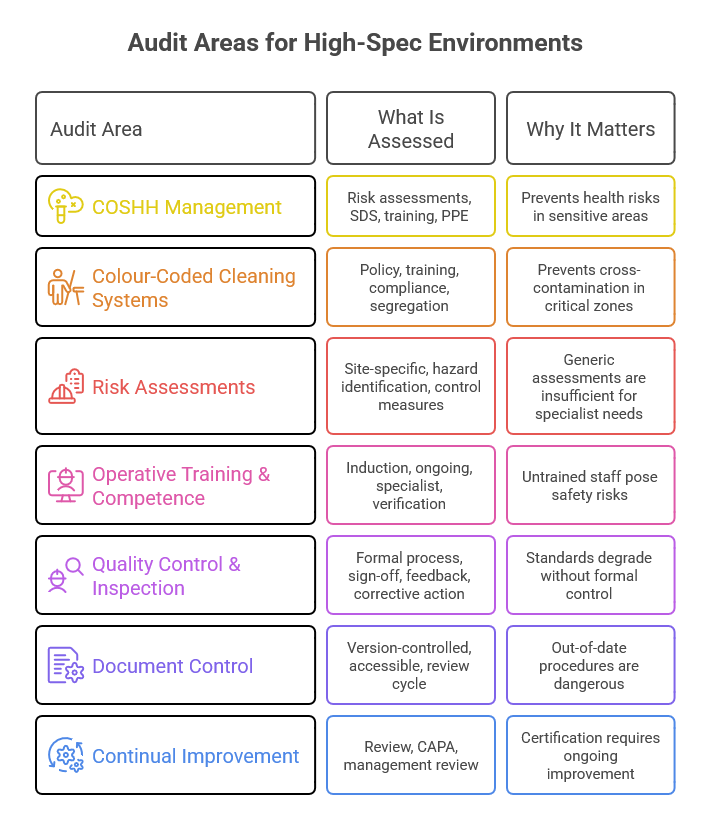
COSHH in Practice: What Compliant Chemical Use Actually Looks Like

The Control of Substances Hazardous to Health(COSHH) Regulations 2002 — is the legal framework governing how hazardous chemicals are managed in UK workplaces. For cleaning companies, it is one of the most frequently misunderstood and most frequently breached compliance requirements in the sector.

Most cleaning companies will tell you they are COSHH compliant. Very few can demonstrate it. CQMS certification requires documented evidence of COSHH compliance across every dimension, not a verbal assurance.

What COSHH Compliance Actually Requires of a Cleaning Company

•  Written COSHH risk assessment for every product: not a generic template, but a specific assessment for each chemical used, covering the hazards it presents, the exposure routes, and the control measures in place

•  Current Safety Data Sheets (SDS): SDS documentation for every product must be current (reviewed within the last three years), accessible to operatives, and understood, not filed in a folder nobody reads

•  Substitution principle applied: COSHH requires that the least hazardous product capable of achieving the required result is used. Using a highly caustic chemical where a milder alternative would suffice is a COSHH breach

•  Correct dilution and application: using a cleaning product at the wrong dilution, typically too concentrated, is both a COSHH risk and a surface damage risk. Operative training must cover correct dilution ratios

•  Secure storage: all chemicals must be stored in locked, labelled, and ventilated storage away from food, patient areas, and public access

•  PPE provision and use: appropriate personal protective equipment must be provided and must actually be worn. CQMS audits check both the provision and the evidence of use

•  Emergency procedures: operatives must know what to do in the event of a chemical spill, exposure, or accidental ingestion and those procedures must be documented and trained

COSHH in Medical Cleaning Environments: The Higher Standard

In medical and healthcare-adjacent settings, COSHH compliance demands an additional layer of consideration. Cleaning products used in clinical areas must be effective against the pathogens relevant to that environment, including MRSA, C. difficile, and norovirus, while being safe for use around patients, medical equipment, and clinical materials.

This requires product selection that goes beyond cost and convenience. Signature Cleans’ CQMS-certified approach to medical and healthcare-adjacent cleaning in Exeter includes:

•  Environment-specific product selection: products are chosen for their efficacy against clinically relevant pathogens, not simply for general surface cleaning

•  Compatibility assessment: cleaning products are assessed for compatibility with medical equipment surfaces, including disinfectants that may damage electronic equipment or degrade plastics over time

•  Residue management: in clinical environments, chemical residue on surfaces can affect patient care, CQMS-compliant cleaning protocols include residue control as a specific documented step

•  Product rotation protocols: in high-infection-risk environments, routine rotation of disinfectant products helps prevent pathogen resistance — a consideration absent from general commercial cleaning standards

Common COSHH Failure:  The most frequent COSHH breach in cleaning operations is not the use of dangerous chemicals — it is the use of the right chemicals in the wrong way. Incorrect dilution, missing PPE, or out-of-date SDS documentation are all COSHH failures regardless of which products are used. CQMS certification audits all three.

Colour-Coded Cleaning: The System That Prevents Cross-Contamination

Of all the operational cleaning standards that separate professional, accredited cleaning from unverified alternatives, colour-coding is the one most often misunderstood, most often claimed, and most often incompletely implemented.

The colour-coded cleaning system is a UK industry standard, endorsed by the British Institute of Cleaning Science (BICSc) and required in all healthcare and food-handling environments by infection control and food safety legislation. Its purpose is simple: to ensure that cleaning equipment used in high-contamination areas,  toilets, clinical spaces, food preparation areas, is never used in lower-contamination areas such as offices, reception areas, or communal spaces.

The standard colour allocation used across the UK is:
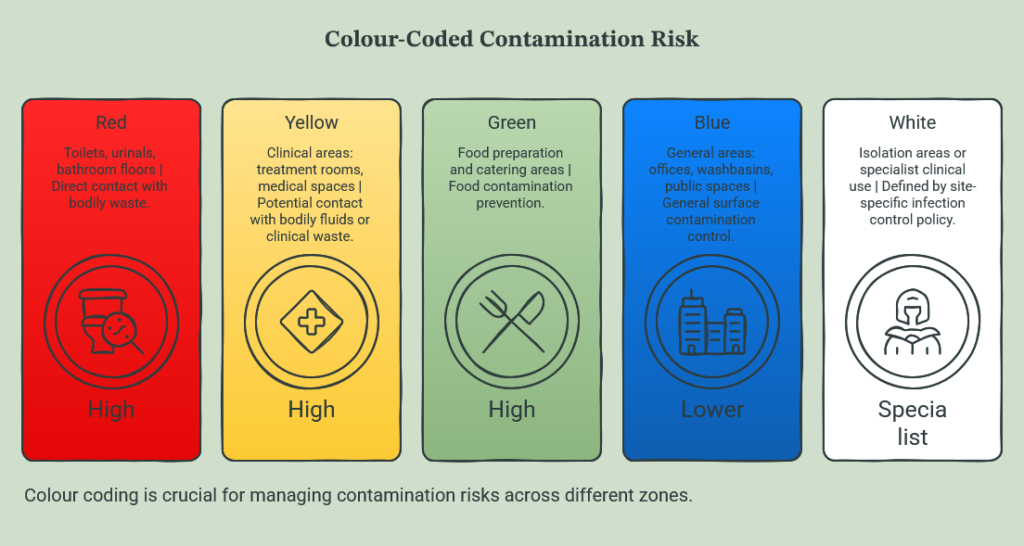
Why This Matters in Practice:  A mop head used to clean a toilet that is then used on an office floor does not simply spread bacteria — it creates an infection pathway that is invisible to the building’s occupants. In a medical waiting room or GP surgery, that pathway connects clinical waste with patient seating areas. The colour-coding system exists precisely to prevent this. CQMS certification verifies that the system is not just described in a policy document but implemented, trained, and audited in practice.

What CQMS Certification Requires of a Colour-Coding System

Describing a colour-coding policy in a document is not the same as implementing one. CQMS certification audits the operational reality, including:

•  Written colour-coding policy: a documented, version-controlled policy specifying which colour applies to which zone, for which equipment types, and how breaches are identified and managed

•  Operative training records: evidence that every operative has been trained on the colour-coding system, not just told about it, but trained with documented assessment of understanding

•  Equipment labelling and segregation: physical colour-coded equipment (mop heads, buckets, cloths, scrubbing pads) that are stored separately and cannot be confused

•  Cross-contamination incident procedure: a documented process for what happens if colour-coding is breached, including reporting, quarantine of affected equipment, and retraining requirements

•  Site-specific adaptation: standard colour-coding zones are adapted to the specific layout and risk profile of each client site, a dental surgery has different zoning requirements than a commercial office building

Colour-Coding in Exeter’s Medical and Office Environments

Exeter’s NHS and primary care facilities operate under NHS infection prevention and control (IPC) standards, which mandate colour-coded cleaning systems as a baseline requirement. Private medical practices, dental surgeries, and physiotherapy clinics in Exeter are subject to CQC (Care Quality Commission) inspection, and cleaning standards, including colour-coding compliance, are assessed as part of the safe environment domain.

For professional offices in Exeter, colour-coding is best practice rather than a regulatory requirement, but in any environment with kitchen facilities, washrooms, and communal areas, the contamination risk that colour-coding addresses is real regardless of whether a regulator is checking for it.

Risk Assessments for Cleaning: Generic vs Site-Specific

Every cleaning company operating in the UK is legally required under the Management of Health and Safety at Work Regulations 1999 to conduct risk assessments for all cleaning activities. The question is not whether a cleaning company has risk assessments, it is whether those assessments are meaningful.

Generic risk assessments, the kind downloaded from a template library and filed unchanged, satisfy the letter of the law but not its purpose. They describe hypothetical risks in hypothetical environments. They do not identify the specific hazards present in your building, the specific control measures required for your occupants, or the specific actions needed if something goes wrong in your specific location.

CQMS certification requires site-specific risk assessments. This means:

Generic Risk AssessmentCQMS-Standard Site-Specific Risk Assessment
Describes ‘slip and trip hazards’ in general termsIdentifies specific floor types in each area, their slip resistance when wet, and the cleaning methods and products that maintain that resistance
Lists ‘chemical hazards’ without product specificsDocuments every product used on-site by name, with cross-referenced COSHH assessments and SDS for each
Mentions ‘vulnerable persons’ as a generic categoryIdentifies the specific vulnerable occupants in this environment, immunocompromised patients, elderly residents, young children, and adapts control measures accordingly
Covers ‘manual handling’ in standard termsAddresses the specific manual handling challenges of this site, heavy equipment on stairs, awkward access to plant rooms, specific furniture configurations
Updated ‘annually’ without evidence of reviewReviewed when the site, its occupants, or the cleaning scope changes, with dated version control and documented sign-off
Signed by a manager who has not visited the siteProduced by or with the operative responsible for the site, verified by a supervisor with site knowledge

Risk Assessments for Medical Cleaning in Exeter

In healthcare and medical cleaning environments, risk assessments must go beyond the standard cleaning risk framework to incorporate infection control considerations. A CQMS-certified cleaning company operating in Exeter’s medical sector will produce risk assessments that cover:

•  Pathogen-specific risks: identification of the specific infection risks relevant to the clinical environment and the cleaning protocols required to mitigate them

•  Waste handling procedures: clinical waste, sharps containers, and contaminated materials require specific handling protocols that must be documented in the cleaning risk assessment

•  Patient and visitor protection: risk controls that account for the presence of vulnerable patients during cleaning activities, including noise, chemical fumes, slip hazards, and access disruption

•  Equipment decontamination: cleaning equipment itself is a contamination risk if not decontaminated between uses and between zones, the risk assessment must document the decontamination procedure

Operative Training: The Human Element of Cleaning Standards

Cleaning standards are ultimately implemented by people. The most comprehensive COSHH documentation, the most detailed colour-coding policy, and the most thorough risk assessment are worthless if the operative cleaning your building does not understand them, has not been trained on them, or has been trained but not assessed for competence.

CQMS certification audits operative training as a specific and detailed criterion, because it is where the gap between policy and practice is most likely to exist.

What CQMS-Verified Training Looks Like

•  Documented induction: every new operative receives a formal induction covering health and safety, COSHH, colour-coding, manual handling, and emergency procedures, with a signed record confirming completion

•  Site-specific briefing: before starting at a new client site, operatives receive a briefing specific to that environment, its layout, its specific risks, its occupants, and any non-standard requirements

•  Competence assessment: training is followed by documented assessment of competence, not just ‘did the training happen’ but ‘does the operative understand and can they apply it’

•  Specialist environment training: operatives cleaning medical, food, or education environments receive additional training specific to those sectors, covering infection control, food safety, and safeguarding as relevant

•  Refresher training programme: training is not a one-off event. CQMS-certified companies maintain a documented refresher training schedule, updated when regulations, products, or site conditions change

•  Training records accessible to clients: in regulated environments, clients have the right to verify that the operatives cleaning their premises are trained to the required standard. CQMS-certified companies maintain records that can be produced on request

Training Transparency:  Signature Cleans maintains full training records for every operative across all client sites. If you manage a medical practice, school, or regulated facility in Exeter and need to verify operative training for a CQC inspection, NHS audit, or Ofsted visit, we can provide that documentation immediately, because CQMS certification requires us to have it ready.

CQMS Certification vs ISO 9001: What Is the Difference?

Facilities managers and procurement leads in Exeter sometimes ask how CQMS certification compares to ISO 9001, the international quality management standard. The distinction is important and often misunderstood.

  
What it isSector-specific quality management certification for contractors in the UK construction and facilities management sector
Audit focusOperational compliance in contractor-specific activities: COSHH, colour-coding, risk assessments, site-specific procedures, operative training
Sector relevanceDirectly relevant to cleaning, facilities management, construction, and maintenance contractors — auditors understand the sector
UK procurement recognitionWidely recognised by UK public sector, local authorities, academy trusts, and NHS procurement as satisfying quality management pre-qualification
Cost and accessibilityAccessible to SME cleaning companies; designed for contractors of all sizes
Practical outcome for clientsAssurance that the specific operational activities of cleaning are managed to a documented, audited standard

For cleaning companies operating in Exeter’s healthcare, education, and commercial sectors, CQMS certification is the more operationally relevant standard. It speaks directly to the activities, COSHH management, colour-coding, risk assessments, operative training, that determine whether cleaning is genuinely safe, rather than whether a quality management system exists on paper.

What CQMS-Certified Cleaning Looks Like Across Different Exeter Environments

Medical Practices and GP Surgeries

Medical cleaning in Exeter’s primary care estate demands the highest application of CQMS-verified standards. Signature Cleans delivers:

•  Full colour-coded zoning: clinical areas, waiting rooms, toilets, and staff areas each operate under separate colour-coded protocols

•  CQC-aligned cleaning schedules: cleaning frequencies and methods are documented to align with CQC safe environment inspection criteria

•  Pathogen-specific product selection: disinfectants selected for efficacy against MRSA, norovirus, and C. difficile as relevant to the clinical environment

•  Clinical waste awareness: operatives trained in the identification and correct handling of clinical waste, reporting rather than handling in compliance with the Environmental Protection Act 1990

Dental Surgeries and Allied Health Practices

Dental surgeries in Exeter operate under both CQC and the HTM 01-05 decontamination guidance, a highly specific compliance framework. Cleaning standards in dental environments must account for:

•  Decontamination zone segregation: strict separation of dirty and clean zones, maintained through colour-coded cleaning protocols and documented cleaning sequences

•  Chemical compatibility with dental equipment: surface disinfectants must be compatible with composite surfaces, autoclaves, and electronic dental equipment

•  Handwashing basin priority: handwashing facilities in clinical areas must be maintained to a higher standard than general washrooms, CQMS documentation distinguishes between these zones

Professional Offices and Business Premises

Office cleaning standards in Exeter are lower-risk than medical environments but still demand documented, consistent compliance, particularly in buildings with kitchen facilities, multiple tenants, or high footfall.

•  Kitchen and communal area segregation: food preparation areas are cleaned under green-coded protocols, entirely separate from bathroom and office cleaning

•  Touch-point sanitisation programmes: documented high-frequency touch-point cleaning covering door handles, lift buttons, light switches, and shared equipment

•  Floor-type specific methods: CQMS risk assessments identify the correct cleaning method and product for each floor type, preventing damage to specialist flooring and maintaining slip resistance

•  Out-of-hours cleaning protocols: many Exeter offices require early morning or evening cleaning. CQMS documentation covers lone working risk assessments and emergency procedures for out-of-hours operatives

Educational Facilities and Schools

Exeter schools and educational facilities served by Signature Cleans receive CQMS-verified cleaning standards that satisfy both Ofsted safe environment criteria and local authority procurement requirements:

•  Safeguarding-integrated cleaning: operatives hold DBS certificates and are trained on safeguarding awareness, CQMS training documentation covers both cleaning competence and site-specific safeguarding requirements

•  Child-safe product selection: all products are assessed for safety in environments where children are present, chemical residues, fume levels, and surface compatibility are all considered

•  Holiday deep clean documentation: CQMS post-clean sign-off provides the paper trail that bursars and headteachers need for compliance records and Ofsted readiness

Frequently Asked Questions: CQMS, Cleaning Standards, and Compliance

What is CQMS certification and how is it different from other quality standards?

The Constructionline Quality Management Scheme(CQMS), is an independently verified quality management certification specifically for contractors in the UK construction and facilities management sector. Unlike generic quality standards such as ISO 9001, CQMS audits the specific operational activities of cleaning and facilities contractors, including COSHH management, colour-coded cleaning systems, site-specific risk assessments, and operative training. Signature Cleans holds full CQMS certification, independently audited and verified.

What does colour-coded cleaning prevent?

Colour-coded cleaning prevents cross-contamination, the transfer of bacteria, pathogens, and chemical residues between high-risk and lower-risk areas. By assigning specific equipment colours to specific zones (red for toilets, yellow for clinical areas, green for food preparation, blue for general use), the system creates a physical barrier to contamination pathways. In medical and healthcare environments, cross-contamination can cause Healthcare Associated Infections (HCAIs). In food environments, it can cause food poisoning. CQMS certification verifies that the colour-coding system is implemented, trained, and audited, not just described in a policy.

Is COSHH compliance a legal requirement for cleaning companies?

Yes. The Control of Substances Hazardous to Health Regulations 2002 (COSHH) are a legal requirement under UK health and safety law. Every cleaning company using hazardous chemicals, which includes almost all professional cleaning products, must conduct and document COSHH risk assessments, maintain current Safety Data Sheets, provide appropriate PPE, and ensure operatives are trained in safe chemical handling. CQMS certification audits COSHH compliance as a core criterion. Signature Cleans maintains full COSHH documentation for every product used at every client site.

How do I verify a cleaning company’s CQMS certification?

Ask the cleaning company to provide their current CQMS certification certificate, which will include the issuing body, the scope of certification, and the expiry date. You can also verify certification status directly with Constructionline. Signature Cleans provides CQMS certification documentation as standard during any procurement or onboarding process, no chasing required.

Does CQMS certification cover medical cleaning standards?

CQMS certification covers the quality management systems relevant to medical and healthcare-adjacent cleaning, including COSHH compliance, colour-coded protocols, operative training, and site-specific risk assessments. It does not replace sector-specific standards such as NHS Infection Prevention and Control guidance or CQC safe environment criteria, but a CQMS-certified cleaning company will operate in a way that supports compliance with those standards. Signature Cleans has experience cleaning in healthcare-adjacent environments in Exeter and applies CQMS-verified standards to every medical cleaning contract.

What happens if a CQMS-certified cleaning company breaches a standard?

CQMS certification requires documented corrective action processes. If a cleaning standard is breached — whether identified through internal inspection, client feedback, or an incident, a CQMS-certified company has a formal procedure for reporting, investigating, and correcting the issue. This includes root cause analysis, corrective action, and preventive measures to ensure the breach does not recur. This accountability framework is what distinguishes CQMS-certified cleaning from informal arrangements where service failures are handled (or not) at the operative’s discretion.

Why Signature Cleans Delivers Exeter’s Highest Standard of Cleaning Compliance

Signature Cleans is a CQMS-certified cleaning company serving medical practices, dental surgeries, professional offices, schools, and commercial premises across Exeter and Devon. Our CQMS certification is not a marketing credential, it is the documented, independently audited evidence that our cleaning standards hold up when the auditor is not in the room.

Every Signature Cleans contract in Exeter is delivered to the CQMS-verified standard:

StandardWhat It Means for Your Premises
CQMS CertifiedIndependently audited quality management systems covering COSHH, colour-coding, risk assessments, training, and quality control. The most operationally rigorous quality standard for cleaning contractors in the UK.
SSIP AccreditedHealth and safety independently verified. Satisfies your contractor H&S pre-qualification requirement. Employer’s liability and public liability insurance confirmed.
PQS CertifiedFull pre-qualification credentials, financial standing, insurance, environmental policy, equality compliance, independently assessed. Streamlines procurement for public sector and regulated environments.
DBS Checked (all operatives)Every Signature Cleans team member holds a current enhanced DBS certificate. Essential for schools, medical practices, and any environment with vulnerable occupants.
COSHH CompliantFull Safety Data Sheets and COSHH risk assessments for every product used on your premises. Correct dilution, PPE, storage, and disposal, documented and audited.
Colour-Coded ProtocolsSite-specific colour-coded cleaning system implemented, trained, and audited. Contamination pathways eliminated, not just policy-described, but operationally enforced.
Site-Specific Risk AssessmentsRisk assessments that reflect your specific environment, occupants, and hazards, not generic templates. Reviewed when your site changes. Signed off by supervisors with site knowledge.
Our Promise:  When Signature Cleans cleans your Exeter premises, you are not simply buying a cleaning visit. You are buying a CQMS-verified compliance framework, COSHH-managed, colour-coded, risk-assessed, and documented, that protects your occupants, satisfies your regulators, and gives you the paper trail you need if you are ever asked to demonstrate your contractor’s cleaning standards.

Whether you manage a GP surgery in St Leonard’s, a dental practice in Heavitree, a professional office in the city centre, or a school in Pinhoe, Signature Cleans delivers the cleaning standard that your environment demands and your compliance obligations require.

Medical Cleaning Services: Flexibility, Process & Results

What Effective Medical Cleaning Actually Requires

When most people think about medical cleaning services, they think about what they can see: floors that shine, bins that have been emptied, waiting rooms that look presentable. Visible cleanliness matters — but in a clinical environment, it is only the surface of what an effective cleaning service actually delivers.

Dental practices and healthcare facilities operate under pressures that most commercial environments do not face. Appointments run continuously throughout the day. Clinical staff are focused entirely on patient care. Infection prevention standards are non-negotiable. Compliance obligations must be evidenced, not merely assumed.

In these environments, a professional cleaning provider is not assessed by how quickly they complete a task. They are assessed by how reliably they work around clinical operations, how clearly they communicate, and how consistently they follow the correct process — every visit, without exception.

Q: What are medical cleaning services and what makes them different?
Medical cleaning services are specialist cleaning programmes designed for healthcare environments — dental practices, GP surgeries, clinics, and hospitals. They differ from standard commercial cleaning in three fundamental ways: they must work around continuous clinical operations without disrupting patient care; they require documented accountability systems to evidence compliance; and they depend on consistent, repeatable processes rather than speed to maintain infection prevention standards.

The Three Principles That Define Professional Medical Cleaning Services

The most effective medical cleaning services are not built on the fastest teams or the lowest prices. They are built on three operational principles that directly support the clinical environments they serve.

1. Flexibility2. Accountability3. Process
Working around your clinical schedule — not the other way around. Morning, evening, out-of-hours, and deep clean scheduling that adapts to your operations.Clear documentation of what was cleaned, when, by whom, and to what standard. Evidence your compliance team can rely on without having to chase.Repeatable, documented cleaning procedures followed consistently across every visit — so standards are predictable, not dependent on individual habits.

These three principles are not aspirational. They are the operational baseline that any professional medical cleaning provider should be able to demonstrate before a contract begins — not promise to develop after one.

Q: What should medical cleaning services include?
Professional medical cleaning services should include: flexible scheduling that works around clinical operating hours; documented accountability for every visit including what was cleaned, when, and by whom; consistent cleaning processes aligned to infection prevention requirements; trained staff following colour-coded equipment protocols and COSHH-compliant chemical use; and a named account manager responsible for quality and communication. These are operational requirements, not optional enhancements.

1. Flexibility: Working Around Clinical Operations, Not Against Them

The principle:  A dental practice cannot accommodate a cleaning team that turns up mid-morning during peak appointments. Professional medical cleaning services adapt to the facility — the facility does not adapt to them.

Healthcare facilities rarely operate on a standard schedule — and the best medical cleaning services are built to reflect that reality. Dental practices often begin seeing patients early in the morning and continue throughout the day, sometimes into evenings or weekends. GP surgeries manage high footfall across extended hours. Private clinics vary their schedules by specialty and season.

For a cleaning provider, this creates a scheduling challenge. For the healthcare facility, it should never create a problem. A professional medical cleaning service adapts its schedule to the operational requirements of the practice — not the other way around.

What flexible scheduling looks like in a clinical context:

•  Early morning cleans completed before the first patient appointment — typically between 6am and 8am — so clinical staff arrive to a fully prepared environment.

•  Evening or overnight cleaning following the last appointment of the day, ensuring treatment rooms and patient areas are fully reset for the following morning.

•  Flexible scheduling around specialist clinic days, extended hours, and weekend working — without requiring the facility manager to renegotiate the contract every time the schedule changes.

•  Planned deep cleans and periodic intensive treatments scheduled during closure periods — bank holidays, annual leave blocks, or designated maintenance windows.

•  Rapid-response availability for unplanned cleaning needs — post-incident cleans, unexpected spills, or additional capacity before an inspection or patient event.

The goal of genuine flexibility is straightforward: cleaning supports clinical operations rather than competing with them. When this works correctly, staff focus on patient care without interruption, and the cleaning team is simply part of the background infrastructure of a well-run facility.

Q: When should medical cleaning take place in a dental practice?
Medical cleaning in a dental practice should be scheduled to avoid disruption to patient appointments — typically early morning before the first patient (6am–8am) or in the evening after the practice closes. Deep cleans and periodic intensive treatments should be planned during closure periods. A professional medical cleaning provider will develop a schedule around the practice’s specific operating hours, including flexibility for extended clinics, weekend working, and unplanned cleaning requirements.

2. Accountability: The Evidence That Compliance Depends On

The principle:  In a clinical environment, assumptions are not enough. A practice manager needs to know what was cleaned, when it was cleaned, and by whom — without having to ask.

Accountability in medical cleaning is not simply about good communication. It is about creating a documented record that demonstrates compliance — one that can withstand scrutiny from a CQC inspector, a practice owner, or a patient safety review.

For practice managers and facilities managers carrying multiple responsibilities, clear accountability from a cleaning provider removes a significant source of administrative uncertainty. The question should never be ‘was this area cleaned?’ — it should be immediately answerable from the records the provider maintains and shares.

What was completed

Every cleaning task should be clearly defined in a written specification, and completion of each task documented per visit. This creates transparency and removes ambiguity about what is included in the service — and what is not.

When it was completed

Time-stamped visit records provide confidence that cleaning activities were carried out according to the agreed schedule. This is particularly important for high-touch areas and treatment environments where the timing of a clean relative to patient contact matters.

Who completed the work

Named operatives with confirmed training records create a direct accountability chain. Consistency of personnel — the same trained cleaner attending regularly rather than a rotating roster of unfamiliar faces — further strengthens this accountability and improves the quality of the clean itself.

How issues are reported and resolved

A clear escalation pathway for issues identified during a clean — a damaged surface, a consumable that needs restocking, a concern about a specific area — ensures that problems are communicated to the facility manager promptly and resolved in a documented, traceable way.

Q: How do medical cleaning companies provide accountability to healthcare facilities?
Professional medical cleaning companies provide accountability through: written cleaning specifications that define every task included in the service; time-stamped digital visit logs confirming completion of each task per visit; named operatives with documented training records; and a formal issue-reporting process with documented resolution. This audit trail supports CQC compliance, evidences due diligence in the event of a patient safety concern, and removes uncertainty for practice managers overseeing multiple responsibilities.

3. Process: Why Consistency Protects Standards More Than Speed

The principle:  In clinical cleaning, speed without process creates risk. The most effective medical cleaning services complete tasks correctly — every time — rather than completing them quickly.

In many industries, efficiency and speed are legitimate competitive advantages. In medical cleaning services, speed without the correct process is a liability. A treatment room cleaned quickly but incorrectly — with the wrong product, an insufficient contact time, or a missed high-touch surface — is not a clean treatment room. It is a risk that has been documented as complete.

The most effective clinical cleaning operations are built on documented procedures followed consistently across every visit. These procedures are not improvised by individual operatives — they are defined, trained, supervised, and audited. When the process is correct and consistent, the outcome is predictable. And predictable outcomes are precisely what healthcare facilities require.

What a documented clinical cleaning process covers:

•  Zone-based task sequencing: Cleaning proceeds in a defined order — from cleanest to dirtiest zones — to prevent cross-contamination between clinical and non-clinical areas.

•  Colour-coded equipment discipline: NHS-aligned colour coding for cloths, mops, and buckets ensures equipment used in washrooms never crosses into treatment or waiting areas.

•  Contact time compliance: Disinfectant products applied with the correct dwell time — not wiped off immediately — to achieve the efficacy claimed on the product label.

•  High-touch point protocols: Door handles, light switches, chair controls, bracket tables, and reception surfaces sanitised with defined frequency — not on an ad-hoc basis.

•        Product selection and COSHH compliance: Cleaning chemicals selected for clinical efficacy (EN 14476 and EN 13727 standards), with COSHH risk assessments documented and accessible to all cleaning staff.

Q: Why is process more important than speed in medical cleaning?
In medical cleaning, speed without the correct process creates infection risk rather than reducing it. A surface disinfected with insufficient contact time, the wrong product, or using cross-contaminated equipment has not been effectively cleaned — regardless of how quickly the task was completed. Documented cleaning procedures that define product selection, contact times, colour-coded equipment use, and task sequencing ensure outcomes are consistent and repeatable — which is what infection prevention requires.

4. Consistency Over Occasional Excellence: The Standard That Actually Matters

There is a common misconception about what makes a cleaning service excellent: that it is measured by its best performance. In reality, healthcare facilities benefit far more from consistency than from occasional excellence.

A dental practice that receives an outstanding clean once a month and an adequate clean the rest of the time has not received a professional medical cleaning service. It has received an unreliable one with occasional peaks. The patients and staff who experience the adequate cleans are not reassured by knowing that last Tuesday was exceptional.

Who notices consistency in a clinical environment:

•  Patients: Research consistently shows that patients use environmental cleanliness as a proxy for clinical quality. A consistently clean waiting room and treatment area builds confidence before a clinician has said a word.

•  Clinical staff: Staff working in a consistently well-maintained environment report higher confidence in their facility’s infection control standards — and lower tolerance for lapses when they do occur.

•  Practice managers: Consistency means no complaints to manage, no conversations to have with the contractor, and no explanation required to a patient or inspector. It is the outcome that makes every other aspect of managing a practice easier.

•  Compliance assessors: CQC inspectors and infection prevention auditors look for evidence of sustained standards over time — not a facility that performs well on inspection days. Consistent process and documentation are what create that evidence.

This is why robust processes, clear communication, and structured accountability are not just operational preferences — they are the mechanisms that make consistency achievable at scale, visit after visit, without depending on individual motivation or managerial supervision.

Q: Why is consistency more important than occasional excellence in healthcare cleaning?
Healthcare environments require consistent cleaning standards because the risks of lapses — infection transmission, compliance failures, patient confidence erosion — are not mitigated by previous excellent performance. Patients, clinical staff, and compliance assessors all assess cleanliness based on what they encounter consistently, not on what the facility was like on its best day. Consistent outcomes require consistent processes — documented procedures, trained staff, and regular quality audits — not individual effort or goodwill.

5. Questions to Ask Before Choosing a Medical Cleaning Provider

The difference between a provider who delivers genuine medical cleaning services and one who delivers standard commercial cleaning with a clinical label applied becomes clear quickly when you ask the right questions. These five questions will reveal more about a provider’s long-term reliability than any discussion about price.

1. Can you work around our clinical schedule — including early mornings, evenings, and unplanned requests? The answer should describe specific operational capability, not a general willingness.

2. How do you document completed work, and how does that documentation reach us? The answer should describe a digital, time-stamped system — not a manual sign-in sheet or verbal confirmation.

3. What cleaning procedures do your teams follow in clinical areas — specifically regarding contact times, colour coding, and product selection? A provider who cannot answer this specifically is not operating a clinical cleaning programme.

4. How do you handle issues identified during a clean, and what is your response time for urgent requests? The answer should describe a documented escalation pathway with defined response timeframes.

5. How do you ensure the same standard is delivered on every visit, not just the first? The answer should describe quality audits, named operatives, and process-based delivery — not assurances about motivation or experience.

Q: What questions should I ask a medical cleaning company before hiring them?
Before hiring a medical cleaning company, ask: Can you work around our clinical schedule including early mornings and evenings? How do you document completed work and how does that reach us? What specific cleaning procedures do your teams follow regarding contact times, colour coding, and product selection? How do you handle issues and what is your response time? How do you ensure the same standard on every visit — not just the first? Providers who cannot answer each question specifically are not operating a genuine clinical cleaning programme.

6. What the Future of Medical Cleaning Services Requires

Healthcare facilities are operating in an environment of increasing scrutiny — from CQC inspections and infection prevention audits to patient feedback platforms and the NHS Commitment to Cleanliness framework. In this context, the expectations placed on medical cleaning services are not static. They are rising.

The facilities that manage this well are not the ones with the largest cleaning budgets. They are the ones with the right provider — one who understands that a clinical cleaning contract is not a commodity service, but a compliance-critical operational partnership.

What that partnership requires in practice:

•  A provider who understands the regulatory framework — NHS National Standards of Healthcare Cleanliness 2025, CQC Regulation 15, COSHH — and can demonstrate alignment to it without being prompted.

•  A cleaning programme that is reviewed and updated as the facility’s needs change — not set at contract start and left unchanged.

•  An account manager with genuine healthcare cleaning knowledge who can contribute to infection prevention discussions, not just scheduling ones.

•  A reporting framework that provides the evidence a practice manager needs for compliance documentation — automatically, not on request.

•  Accreditations that confirm independent assessment of the provider’s standards: SSIP, CQMS, PQS, ISO 9001, and BICSc affiliation are the markers of a provider operating at a genuinely professional level.

Q: What accreditations should a medical cleaning company hold?
A professional medical cleaning company should hold: SSIP accreditation (independent health and safety assessment); CQMS verification (quality management systems); PQS certification (pre-qualification standard covering insurance, financials, and H&S); ISO 9001 quality management certification; and public liability insurance of at least £5 million. BICSc affiliation confirms ongoing investment in staff training. Providers holding all of these have been independently assessed against professional standards — not simply self-declared compliant.

Frequently Asked Questions

Q: How is medical cleaning different from standard commercial cleaning?
Medical cleaning differs from standard commercial cleaning in its regulatory requirements, process discipline, and accountability infrastructure. Medical cleaning requires EN-certified disinfectants applied with correct contact times, NHS colour-coded equipment to prevent cross-contamination, documented visit logs for compliance evidence, and staff trained in infection prevention and control. Standard commercial cleaning does not include these requirements and is not appropriate for registered healthcare facilities.
Q: How often should a dental practice be professionally cleaned?
Dental practices typically require a professional clean every operational day — either early morning before the first appointment or in the evening after the last. High-touch clinical areas (treatment rooms, bracket tables, door handles, and reception surfaces) should be sanitised between every patient contact as part of standard infection control. Periodic deep cleans — typically monthly or quarterly — supplement daily cleaning and address areas not covered by the routine programme.
Q: What is the NHS colour-coded cleaning system and why does it matter?
The NHS colour-coded cleaning system assigns specific colours to cleaning equipment (cloths, mops, and buckets) for use in defined areas: red for washrooms and toilets, yellow for clinical and isolation areas, blue for general areas, and green for catering and food preparation. The system prevents cross-contamination between zones by ensuring equipment used in high-risk clinical areas is never used elsewhere. Any medical cleaning provider operating in a healthcare facility must implement and enforce this system rigorously.

The Foundation of a Reliable Clinical Cleaning Partnership

The best medical cleaning services are not defined by how quickly tasks are completed. They are defined by how reliably they support the clinical environment they serve — visit after visit, across the full duration of the contract.

Flexibility that genuinely works around clinical operations. Accountability that provides evidence without requiring the practice manager to chase it. Processes that deliver consistent outcomes because they are documented and followed, not because individual operatives happen to be having a good day.

For dental practices and healthcare facilities, these are not ambitious expectations. They are the operational baseline that a professional cleaning partner should deliver as standard. The questions in this guide will help you identify whether a provider you are considering can actually meet them — before you sign a contract rather than after.

Looking for a medical cleaning provider built around clinical operations?We deliver professional medical cleaning services to dental practices and healthcare facilities — with flexible scheduling, digital accountability, documented processes, and SSIP, CQMS, and PQS accreditations. Get in touch for a free, no-obligation site assessment and compliance review.

Block Cleaning in Exeter: Why Reliability, Communication and Multi-Site Consistency Are What Property Managers Actually Need

What Exeter Property Managers Actually Need From a Block Cleaning Provider

Ask any property manager in Exeter what they want from their block cleaning provider and the answer is rarely complicated: turn up when expected, deliver the same standard every time, and communicate clearly when something changes.

These are not ambitious expectations. They are the basics. And yet, for too many property managers overseeing residential blocks across Exeter and Devon, these basics are where most providers fall short, not dramatically, not all at once, but gradually and consistently enough to create the kind of low-level operational friction that consumes time, generates resident complaints, and erodes confidence in the service.

This guide is written for property managers who want to understand what professional block cleaning in Exeter should look like in practice, whether you are managing a single residential block in St Leonards or overseeing multiple developments across the wider Devon area. It covers reliability, communication, multi-site management, and the systems that make all three possible to sustain over time.

What do property managers need from a block cleaning company in Exeter?

Property managers in Exeter consistently identify three core requirements from a block cleaning provider: reliability (turning up as scheduled and delivering a consistent standard every visit); clear communication (proactive updates about schedule changes, issues, and completion without the manager having to chase); and, for those managing multiple sites, the operational systems to maintain the same standard across every block in their portfolio. Providers who cannot deliver all three create management overhead rather than reducing it.

1. Reliability: The Foundation That Everything Else Depends On

In communal cleaning, reliability is everything. Turning up when expected. Delivering the same standard every time. It sounds simple, but it’s where many providers fall short.

Reliability in block cleaning is not just about whether a provider shows up. It is about whether they show up consistently, at the right time, delivering the right standard, visit after visit, week after week, across the full duration of the contract.

The reason reliability matters so much in communal residential environments is that the consequences of unreliability are highly visible and highly social. A missed clean in an office affects the people who work there. A missed clean in a residential block affects residents at home — in their most personal space — and the reaction is proportionally more emotional and more likely to escalate.

For block cleaning in Exeter, reliability has three distinct dimensions:

Schedule reliability

Visits happen on the agreed days, at the agreed times, without requiring the property manager to chase, confirm, or verify. When something affects the schedule, operative absence, a bank holiday, adverse weather, the property manager is notified in advance with a clear rescheduled date, not informed after the fact that a visit was missed.

Standard reliability

Every visit delivers the same level of cleanliness. Not excellent on the first visit and acceptable thereafter. The same standard, entrance hall, stairwells, lifts, corridors, bin stores, every time. This requires a named operative who knows the building, a documented specification that defines what that standard looks like, and a quality audit process that detects drift before it becomes visible to residents.

Personnel reliability

The same operative, or small consistent team, attends the building regularly. Not a different face every week. Consistency of personnel is a direct driver of standard reliability: an operative who knows a building knows where issues tend to arise, what the property manager’s priorities are, and what the residents expect. That institutional knowledge cannot be transferred by a checklist.

Why is reliability so important in residential block cleaning?

Reliability is the most critical quality in residential block cleaning because unreliability is immediately visible to residents in their home environment, where the emotional stakes are higher than in a commercial setting. A missed clean or inconsistent standard generates resident complaints, service charge disputes, and reputational damage for the property manager. Reliability requires three specific operational disciplines: schedule consistency, standard consistency, and personnel consistency — all of which depend on the provider’s systems, not just their intentions.

2. Clear Communication: What Property Managers Should Never Have to Chase

Property managers don’t need surprises. They need clear communication and quick responses. The best providers keep everything straightforward so you’re always in the loop, without having to ask.

Communication in a block cleaning relationship is not a supplementary feature, it is a core operational requirement. A property manager who has to chase their cleaning provider for confirmation of visits, responses to queries, or explanations of missed areas is carrying a management burden that the cleaning contract was supposed to remove, not create.

The standard for communication that Exeter property managers should expect, and hold providers to, is straightforward: proactive rather than reactive, specific rather than vague, and fast enough to be useful rather than delivered after the problem has already generated a resident complaint.

What You Should Never Have to Chase

What a Good Provider Does Instead

Confirmation that a visit happened Sends a digital completion report before you think to ask
Explanation of why a visit was missed Notifies you in advance with a rescheduled date confirmed
Response to a quality concern raised Acknowledges within hours with a specific resolution timeline
Update on a recurring issue flagged Provides written follow-up after the next visit confirming it was addressed
Schedule for an upcoming bank holiday Sends adjusted schedule automatically, not on request
Name of operative attending the building Named operative confirmed at contract start and when cover is required

The communication standard above is not aspirational, it is the baseline of a professionally managed block cleaning contract in Exeter. Any provider who cannot deliver it consistently is creating administrative work for your team that compounds over time.

What good communication infrastructure looks like in practice:

• Digital visit logs: Time-stamped completion records accessible to the property manager without having to request them, a digital log that updates automatically after each visit.

• A named account manager: One person with genuine accountability for your contract, not a general customer service number that routes to whoever is available.

• A defined response SLA: A clear, documented commitment to acknowledge queries and concerns within a specific timeframe, typically same-day for urgent issues and within 24 hours for routine matters.

• Regular written reporting: Monthly or quarterly written summaries of service delivery, quality audit findings, and any issues identified and resolved, not just verbal assurances during a phone call.

• Advance notice of all schedule changes: Any change to visit dates, operative assignments, or service scope communicated before it takes effect, never retrospectively.

How should a block cleaning company communicate with property managers?

A professional block cleaning company should communicate with property managers proactively — not reactively. This means: digital visit logs sent automatically after each clean; a named account manager as the single point of contact; a documented response SLA (same-day for urgent issues, 24 hours for routine queries); advance notice of all schedule changes; and regular written reporting on service delivery and quality audit outcomes. Property managers should never have to chase their cleaning provider for information that should have been sent automatically.

3. Managing Multiple Sites: The Systems Challenge That Separates Good Providers from Great Ones

Cleaning across multiple blocks requires organisation and consistency. Without the right systems, standards can vary quickly between sites. Every block in your portfolio deserves the same level of service, and maintaining that at scale requires more than good intentions.

For property managers overseeing multiple residential blocks across Exeter and the wider Devon area, whether that is two developments or twenty, the challenge of block cleaning is fundamentally different from managing a single site. The question is not simply whether each block is being cleaned well. It is whether every block is being cleaned to the same standard, on the same schedule, with the same accountability infrastructure in place across all of them.

This is the point at which most cleaning providers begin to struggle. Delivering a strong service to one block is a staffing and scheduling challenge. Delivering a consistent service across multiple sites in different locations, with different access arrangements, different resident demographics, and different cleaning specifications, is a systems challenge. And systems, not goodwill, are what determine whether consistency holds.

The specific challenges of multi-site block cleaning:

• Operative allocation and cover: Each site needs a consistently assigned operative who knows the building. When cover is required, due to absence, illness, or planned leave, the cover operative needs to be briefed on the site-specific specification, not sent in with a generic checklist.

• Schedule coordination: Multiple sites with different visit frequencies, access requirements, and resident-sensitive time windows require a scheduling infrastructure that manages complexity without producing errors. A missed visit at one site should not be masked by strong performance at others.

• Quality audit coverage: Every site in a portfolio needs to be audited regularly, not just the ones that have recently generated complaints. A quality programme that only activates in response to problems is reactive, not managed.

• Reporting across the portfolio: A property manager overseeing multiple blocks needs consolidated, site-specific reporting, not a single monthly call that covers everything vaguely. Each site should have its own documented audit trail, accessible independently.

• Consistent specification management: When a site’s cleaning specification changes — a new access arrangement, an additional area coming into scope, a change in visit frequency — that change needs to be documented, communicated to the operative, and reflected in the audit standard immediately.

How do you maintain consistent block cleaning standards across multiple sites in Exeter?

Maintaining consistent block cleaning standards across multiple sites requires four operational systems: site-specific cleaning specifications for every block, with changes documented and communicated immediately; a named operative assigned to each site with a structured cover briefing process; regular independent quality audits conducted at every site on a rotating schedule; and consolidated, site-specific digital reporting accessible to the property manager for each block in the portfolio. Providers who manage multiple sites through informal coordination rather than documented systems will always produce inconsistent results.

4. What a Professional Block Cleaning Specification Should Cover in Exeter

One of the most consistent gaps in underperforming block cleaning contracts is the absence of a properly developed, site-specific cleaning specification. A specification is not a generic task list applied uniformly across every block a provider services. It is a document that reflects the specific layout, surface types, occupancy pattern, and access arrangements of a particular building and defines clearly what is cleaned, how often, to what standard, and how completion is verified.

For property managers in Exeter managing blocks across areas including St Leonards, Heavitree, Pinhoe, Topsham, and the wider city and Devon region, the variation between buildings can be significant. A Victorian-era converted apartment block in the city centre has different communal cleaning requirements from a modern purpose-built development on a new-build estate on the city’s edge. Both deserve a specification written for them, not a standard package applied to both.

A comprehensive Exeter block cleaning specification should include:

• Entrance halls and lobbies: Frequency, specific tasks (mopping, vacuuming, glass cleaning on entrance doors, letterbox areas, notice boards), and standard for completion, including how the area should look under both natural and artificial light.

• Stairwells and corridors: Floor cleaning method appropriate to the surface type (hard floor, carpet, or mixed), handrail sanitisation, skirting board maintenance, and high-level cobweb removal on a defined periodic basis.

• Lifts: Interior floor, wall panels, door surrounds, call buttons, and floor track, with a specific frequency reflecting the lift’s usage and the building’s occupancy.

• Bin stores: Floor cleaning, odour management, and overflow clearance, one of the most complaint-generating areas in any residential block, and one that requires a specific rather than generic approach.

• Car parks and external communal areas: Litter collection, seasonal debris management, and any hard floor treatment, with frequency adjusted for the specific exposure of the site.

• Periodic deep clean items: High-level dusting, internal window cleaning of communal areas, carpet extraction in carpeted stairwells — listed with frequency and included or excluded from the base contract scope.

• Verification method: How each visit is recorded, what constitutes completion, and how the property manager accesses the record.

What should a block cleaning specification include for a residential building in Exeter?

A residential block cleaning specification in Exeter should cover: entrance halls and lobbies with defined tasks and frequency; stairwells and corridors with surface-appropriate cleaning methods; lifts including floor track, buttons, and wall panels; bin stores with odour management and overflow protocols; car parks and external areas with seasonal adjustment; periodic deep clean items listed separately with frequency; and a defined verification method for each visit. Generic task lists applied without a site survey are not adequate for professional block management contracts.

5. The Resident Experience: Why Block Cleanliness Is a Property Management Issue, Not Just a Facilities One

For property managers in Exeter, the standard of communal area cleaning in a residential block is not a back-office operational detail. It is one of the most visible and most commented-upon aspects of the service charge residents are paying for, and in a leasehold or managed development context, that makes it a relationship issue as much as a facilities one.

Residents do not typically distinguish between the property manager’s responsibilities and the cleaning contractor’s performance. If the block looks poorly maintained, the complaint comes to the property manager. If the entrance hall smells stale on a Monday morning, it is the property manager’s problem to resolve — regardless of whether the cleaning operative was the direct cause.

How block cleanliness affects the resident relationship:

• First impressions for new residents: The communal areas of a block are the first thing a new resident experiences when they move in. A well-maintained entrance hall and clean stairwells set a tone of care and professionalism that is difficult to establish later if the initial impression is poor.

• Day-to-day quality of life: Residents in communal buildings pass through shared spaces multiple times a day. Consistent cleanliness — entrance halls, corridors, lifts — contributes directly to how they feel about where they live. Persistent issues in these areas erode that feeling steadily.

• Service charge value perception: Residents paying a service charge expect visible evidence that their contribution is being applied effectively. Communal cleaning is one of the most tangible and visible services in the service charge budget. If it is not being delivered to a clear standard, it becomes the focus of service charge challenges.

• Online reviews and block reputation: Increasingly, residents of managed blocks leave reviews, on Google, Trustpilot, and property platforms, that comment on communal maintenance. A block with consistently poor cleaning standards accumulates negative reviews that affect resale values, lettings velocity, and the overall desirability of the development.

How does communal area cleanliness affect residents in a managed block?

Communal area cleanliness directly affects resident satisfaction, service charge value perception, and the overall reputation of a managed block. Residents pass through shared spaces multiple times daily, and consistent cleanliness or persistent neglect, shapes their view of the property management service they are receiving. Poor communal cleaning standards are among the most common triggers for service charge challenges, formal complaints to the First-tier Tribunal, and negative online reviews that affect property values and letting appeal.

6. Choosing the Right Block Cleaning Provider in Exeter: What Actually Matters

For property managers evaluating providers for block cleaning in Exeter, whether for a single development or a multi-site portfolio, the following questions will quickly separate providers with the operational infrastructure to deliver reliably from those who are willing but structurally unprepared for the demands of communal residential cleaning.

The questions that matter most:

1. How do you ensure the same operative attends our building consistently, and what is your cover process when they are absent? The answer should describe a specific briefing process for cover operatives, not a reassurance that cover will be provided.

2. Can you provide digital visit logs accessible to us after every clean, without us having to request them? If the answer is no, or involves a manual sign-in sheet, the communication infrastructure is not at the required level.

3. Who is our named account manager, and how often will they conduct a site audit? A named individual with a defined audit frequency is essential, not a general customer service contact.

4. For multi-site portfolios: how do you manage scheduling and quality consistency across different buildings? The answer should describe specific systems, scheduling software, site-specific specifications, portfolio-level reporting, not general reassurances about experience.

5. What accreditations do you hold? SSIP, CQMS, and PQS are the procurement accreditation baseline. Providers such as Signature Cleans holding all three have been independently assessed against professional standards. ISO 9001 and BICSc affiliation are strong additional markers.

6. Can you provide references from property managers currently using your service for residential block cleaning? References from managing agents or RMCs with comparable portfolios are the most useful; follow them up directly.

7. What is the notice period in your contract, and what are the price review terms? A fair, transparent contract with a reasonable notice period signals a provider confident in their service. Excessive lock-in periods signal the opposite.

What should I look for when choosing a block cleaning company in Exeter?

When choosing a block cleaning company in Exeter, prioritise: a consistently assigned named operative with a structured cover process; digital visit logs sent automatically after every clean; a named account manager who conducts regular site audits; for multi-site portfolios, documented systems for scheduling and quality consistency across all buildings; SSIP, CQMS, and PQS accreditations; and references from current property management clients. A provider who cannot answer each of these questions specifically is not yet operating at the level residential block management requires.

Your Pre-Contract Checklist: 10 Confirmations Before You Sign

Block Cleaning Exeter – Pre-Contract Checklist

✓ Named operative confirmed for each building, with structured cover briefing process

✓ Digital visit logs confirmed — automatically delivered, not on request

✓ Named account manager identified with defined audit frequency

✓ Site-specific cleaning specification to be developed after physical site survey

✓ Multi-site portfolio reporting confirmed as site-specific, not consolidated only

✓ SSIP, CQMS, and PQS accreditations confirmed and current

✓ ISO 9001 certification and public liability insurance (min. £5m) verified

✓ DBS checks confirmed for all operatives accessing occupied buildings

✓ References from current residential block management clients provided

✓ Contract notice period and price review terms reviewed and accepted

Frequently Asked Questions

How much does block cleaning cost in Exeter?

Block cleaning costs in Exeter vary depending on the size of the development, number of communal areas, visit frequency, and whether specialist services (lift cleaning, bin store deep cleans, car park maintenance) are included. Most small-to-medium residential blocks of 10 to 40 units can expect a monthly contract cost of between £200 and £700. Multi-site portfolio contracts may attract a consolidated rate. Always request itemised quotes based on physical site surveys — quotes without a survey are not reliable for residential block environments.

How often should communal areas in a residential block be cleaned in Exeter?

In most Exeter residential blocks, entrance halls and high-traffic corridors benefit from two to three cleans per week; lifts typically require daily or five-day cleaning given their usage intensity; bin stores should be cleaned at least weekly; and stairwells are usually maintained two to three times per week depending on occupancy. Car parks and external areas are typically cleaned fortnightly or monthly. The right frequency for any specific building should be determined by a site survey and occupancy assessment, not a standard package.

Who is responsible for communal area cleaning in a leasehold block in Exeter?

In leasehold residential blocks in Exeter, responsibility for communal area cleaning typically sits with the freeholder, the residents management company (RMC), or the appointed managing agent — depending on the specific terms of the lease. The cost is ordinarily recovered through the service charge. Property managers acting on behalf of freeholders or RMCs are responsible for procuring, managing, and evidencing the cleaning service to the standard required by the lease, relevant legislation, and RICS professional standards where applicable.

The Standard Your Residents See Every Day

The entrance hall. The stairwell. The lift. The bin store. These are the spaces residents of a managed block pass through every day and their condition, consistently maintained or consistently neglected, is one of the most immediate reflections of the quality of the property management service being provided.

Professional block cleaning in Exeter that turns up reliably, communicates proactively, and maintains the same standard across every building in a portfolio does not happen by accident. It happens because the right provider has the right systems behind their service; systems that make reliability a structure rather than an aspiration, and communication a discipline rather than an afterthought.

For Exeter property managers who are tired of chasing, tired of inconsistency, and tired of managing their cleaning provider as much as their buildings, the right standard is achievable. The checklist above will help you find the provider who can deliver it.

Managing one block or ten, let’s talk about what reliable looks like.

Signature Cleans provides professional block cleaning across Exeter and Devon — named operatives, digital visit logs, documented quality audits, and a single account manager across your entire portfolio. Get in touch for a free, no-obligation site assessment for each of your buildings.


Car Showroom Cleaning in Exeter: Why Daily Standards and Out-of-Hours Reliability Are What Actually Matter

The Cleaning Challenge That’s Unique to Automotive Retail

Running a car showroom in Exeter presents a cleaning challenge that most commercial environments simply do not face. The floor needs to be immaculate — but vehicles are constantly moving across it. The glass needs to be streak-free — but customer traffic leaves fingerprints by the hour. The entire space needs to communicate precision and premium quality — but it has to be cleaned without disrupting the sales operations that run through it every day.

This is why car showroom cleaning in Exeter is a specialist discipline, not a variation of standard office cleaning. The products are different. The protocols are different. The scheduling demands are different. And the standard — because everything in the showroom is engineered to look perfect — is unforgiving.

This guide is written for Exeter dealership managers who want to understand what professional car showroom cleaning should look like in practice: how it works around your sales environment, how daily standards are maintained rather than just achieved once, and what separates a truly reliable provider from one that simply shows up and hopes for the best.

Q: What makes car showroom cleaning different from standard commercial cleaning?

Car showroom cleaning differs from standard commercial cleaning in three key ways: the environment contains high-value display stock that must be protected during every clean; surfaces — including polished floors, large-format glass, and chrome fixtures — require specialist products and techniques to maintain their finish; and cleaning must take place outside of trading hours without disrupting sales operations. Providers without specific automotive retail experience routinely underestimate these requirements.

Working Around Sales: The Out-of-Hours Imperative

The insight:  A busy showroom can’t be disrupted. That’s why professional car showroom cleaning works around your operations — early mornings or out of hours. No interference. Just a clean, ready-to-go environment when your doors open.

A car showroom in full operation is not a space that cleaning can share. Customers are walking the floor, salespeople are conducting demonstrations, and vehicles are being moved, inspected, and presented. Introducing cleaning operatives into that environment — with equipment, chemicals, and the inevitable disruption that comes with them — creates friction that no well-managed dealership should tolerate.

The answer is not complex, but it requires a provider with the operational discipline to deliver it consistently: cleaning happens outside of trading hours, every time, without exception.

For most Exeter car dealerships, this means one of two windows: early morning cleans completed before the showroom opens — typically between 5am and 8am — or evening and overnight cleans following close of business. Both are viable. Both require a provider who can staff them reliably, manage access and security protocols professionally, and deliver a finished result that is ready for customers without requiring any preparation from your team.

What out-of-hours showroom cleaning should deliver:

•  A showroom floor that is clean, dried, and safe before a single member of your sales team arrives.

•  All glass — internal partitions, external windows, and display cases — cleaned and checked under showroom lighting before opening, not just under ambient conditions.

•  Customer-facing areas — reception, waiting lounge, handover bay — reset and presented to a standard consistent with the brand environment around them.

•  No cleaning equipment, chemical residue, or operational evidence left in the showroom when your doors open.

•  A confirmed completion record accessible to your manager before the start of trading, not provided retrospectively on request.

The last point matters more than it might seem. A digital, time-stamped completion record that confirms what was cleaned and when is not just an administrative convenience — it is the evidence that the clean actually happened, delivered to the standard agreed, at the time scheduled. For dealership managers responsible for franchise compliance, it is also part of your audit trail.

Q: When should car showroom cleaning take place to avoid disrupting sales?

Car showroom cleaning should take place outside of trading hours — either early morning before the showroom opens (typically 5am–8am) or in the evening following close of business. Cleaning during trading hours creates friction with sales operations and risks disrupting customer interactions. A professional out-of-hours cleaning provider will manage access independently, deliver a confirmed completion record before trading begins, and ensure the showroom is fully ready without requiring preparation from your team.

Daily Standards: Why Anyone Can Clean a Showroom Once

The insight:  Anyone can deliver a good clean once. The challenge — and where most providers fall short — is maintaining that standard daily. That’s where systems, processes, and accountability come in.

This is the central challenge of professional car showroom cleaning in Exeter, and the one that most dealership managers have experienced the hard way: the first clean is excellent. The provider is attentive, thorough, and clearly understands the environment. And then, gradually, the standard that seemed so clearly established begins to drift.

It is not a dramatic failure. It is the slow accumulation of small compromises — a section of floor that gets mopped rather than properly treated, a glass panel that gets wiped rather than cleaned to a streak-free finish under full lighting, a wheel arch surround that gets skipped because it is behind a vehicle and nobody will notice. Each one is minor. Together, over days and weeks, they represent a showroom that no longer looks the way it did.

The difference between a provider who maintains daily standards and one who does not is not effort or intention — it is structure. Specifically, three things:

1. A documented, site-specific cleaning specification

Every area of your showroom — floor zones, glass surfaces, reception, waiting areas, washrooms, handover bay, sales desks — should have a specific task list with defined methods, products, and quality criteria. This specification is the standard against which every clean is measured, and the document that makes ‘good enough’ an objective question rather than a subjective one.

2. Regular, independent quality audits

Quality audits should be conducted by someone other than the operative who performed the clean — typically a named account manager who visits the site on a scheduled and unannounced basis. Audits compare delivery against specification, document findings formally, and create an escalation pathway when the standard is not met. Without audits, there is no mechanism to detect drift before it becomes visible to your team or your customers.

3. A named operative with genuine site familiarity

Consistency of personnel is not a minor preference — it is a fundamental quality driver. A named operative who cleans your showroom regularly develops an intuitive understanding of what it requires: where tyre marks accumulate, which glass panels take longest to clean correctly under the showroom lighting, how long the floor treatment needs before it can be walked on safely. That knowledge cannot be imported by a new face with a generic checklist, however willing they are.

Q: How do you maintain consistent cleaning standards in a car showroom every day?

Consistent daily cleaning standards in a car showroom require three structural elements: a documented, site-specific cleaning specification that defines tasks, methods, and quality criteria for every area; regular independent quality audits that compare delivery against the specification and document findings; and a consistently assigned named operative who develops genuine familiarity with the site. Providers who rely on goodwill and general competence without these systems in place will always drift from the standard over time.

Reliable, Not Reactive: The Proactive Standard That Protects Your Brand

The insight:  The best showroom cleaning is proactive — not waiting for issues to be raised, but preventing them in the first place. That’s the difference between a provider who manages your standard and one who reacts to its failure.

Reactive cleaning in a car showroom context means this: an issue develops, a member of your team notices it, it is raised with the cleaning provider, there is a temporary improvement, and the cycle begins again. This pattern is familiar to too many dealership managers — and it represents a fundamental misalignment between what a professional cleaning contract should deliver and what it is actually providing.

Proactive cleaning operates differently. Issues are identified and resolved by the cleaning provider before your team notices them. Schedule adjustments are communicated before they affect service delivery. Seasonal changes — increased footfall in spring and summer, additional mud and moisture in autumn and winter — are anticipated and built into the cleaning programme rather than addressed retrospectively. The cleaning provider is, in the truest sense, managing your standard — not merely responding to its absence.

What proactive showroom cleaning looks like in practice:

•  Pre-trading inspection: A brief walkthrough of the showroom on arrival, before cleaning begins, to identify any areas requiring additional attention — tyre marks from the previous day, glass that has been affected by overnight condensation, surfaces that need treatment beyond the standard routine.

•  Seasonal programme adjustment: Exeter’s climate — wet winters, increased visitor footfall during summer — creates predictable patterns of additional cleaning demand. A proactive provider adjusts the cleaning programme in advance, not in response to complaints about muddy entrance matting or streaked windows.

•  Consumables management: Waiting lounge supplies — refreshments area surfaces, magazine displays, seating — managed and restocked as part of the routine, not flagged as a separate issue.

•  Advance communication: Any change to schedule, personnel, or scope is communicated to your manager before it affects service delivery — not reported after the fact.

•  Franchise audit preparation: For franchised dealerships subject to manufacturer presentation audits, a proactive provider understands audit requirements and adjusts the cleaning programme to ensure the showroom is audit-ready at all times — not only in the days before an inspection.

Q: What is the difference between reactive and proactive car showroom cleaning?

Reactive showroom cleaning addresses problems after they have been identified — typically through complaints from sales staff or management. Proactive showroom cleaning uses structured systems to prevent problems before they arise: pre-trading inspections, seasonal programme adjustments, consumables management, advance communication about schedule changes, and franchise audit readiness maintained continuously. Proactive cleaning requires stronger operational infrastructure but produces consistently better results and significantly reduces the management burden on dealership staff.

The Specific Cleaning Challenges of an Exeter Car Showroom

Every car showroom presents cleaning challenges that standard commercial environments do not. But Exeter dealerships — serving a market that includes both high-volume franchise operations and prestige independents across the city and surrounding Devon area — face a specific combination of factors that any cleaning provider must understand before they can serve the environment effectively.

High-finish flooring

Polished concrete, large-format porcelain, and resin floors are standard in modern automotive showrooms — and each requires a specific maintenance programme to preserve its appearance. The wrong cleaning product can cause micro-etching, dulling, or chemical staining that accumulates invisibly over months before the floor simply stops looking the way it should. Professional scrubber-dryer equipment, appropriate for the specific floor finish, is essential — a mop-and-bucket approach is not adequate for a showroom floor under display lighting.

Large-format glass

Showroom glazing — external windows, internal partitions, and display cases — presents one of the most demanding regular cleaning tasks in any retail environment. Streak-free results require the right products, the right technique, and — critically — the right lighting conditions during the cleaning process. Glass cleaned under ambient light that appears clean will often show streaks and smears when the showroom’s display lighting is switched on. Professional glass cleaning in a showroom environment must be checked and finished under full trading light conditions.

Display vehicles and surrounding floor areas

Every wheel arch surround, tyre sidewall, and floor panel adjacent to a display vehicle is part of that vehicle’s presentation. Cleaning around display stock without touching it requires discipline, appropriate equipment, and an operative who understands that the vehicle and its immediate environment are a single visual unit. Cleaning the floor between vehicles while leaving the area beneath and around them unattended is not adequate — and in a premium environment, it is immediately visible.

Customer touchpoints

Reception surfaces, sales desk counters, digital displays, refreshment areas, and waiting lounge seating are high-frequency touchpoints that accumulate visible use rapidly through a trading day. These areas require both regular attention and the right products — particularly for touchscreen surfaces and upholstered seating — to maintain the standard that customers expect from a premium automotive retail environment.

Workshop and forecourt interfaces

Where a showroom connects to a service workshop or vehicle forecourt, the risk of contamination — oil residue, tyre rubber, road grime — is significant and ongoing. Managing this interface requires specific cleaning protocols for transition zones, appropriate matting systems, and a cleaning programme that treats these boundaries as a primary focus rather than an afterthought.

Q: What are the specific cleaning requirements for a car showroom floor?

Car showroom floors — typically polished concrete, large-format porcelain, or resin — require professional scrubber-dryer equipment appropriate for the specific surface finish, pH-neutral cleaning solutions to avoid micro-etching or chemical staining, regular maintenance treatments to preserve the floor’s reflective quality, and targeted attention to tyre marks and scuff marks that accumulate daily around display vehicles. Generic mopping is not adequate for a showroom floor under display lighting.

Franchise Compliance: Why Cleaning Is Part of Your Audit Score

For franchised car dealerships in Exeter — operating under manufacturer agreements with BMW, Mercedes-Benz, Audi, Toyota, and other brands — showroom presentation is not simply a customer experience consideration. It is a compliance requirement with direct financial and contractual implications.

Manufacturer audits assess presentation standards alongside sales and aftersales performance. A showroom that consistently fails presentation criteria does not just receive a lower audit score — it risks affecting bonus structures, territory agreements, and the renewal terms of the franchise itself. Cleaning is not peripheral to this assessment. In a precision-engineered brand environment, it is central to it.

What franchise auditors typically assess in relation to cleanliness:

•  Showroom floor condition — appearance, maintenance standard, and freedom from marks under display lighting.

•  Glass and glazed surfaces — streak-free finish on all internal and external glass.

•  Vehicle presentation areas — floor condition around and beneath display stock.

•  Customer areas — reception, waiting lounge, refreshments area, and washrooms.

•  Signage and branded elements — display stands and model identifiers cleaned and maintained.

•  Handover bay — presentation standard at the point of vehicle collection.

A car showroom cleaning provider in Exeter who understands the franchise audit environment will align their cleaning specification to the brand standard requirements of your manufacturer agreement — not apply a generic programme and hope it passes. The difference, at audit time, is measurable.

Q: How does car showroom cleaning affect franchise manufacturer audits?

Franchise manufacturer audits for car dealerships assess showroom presentation as a formal scoring criterion, alongside sales and aftersales performance. Poor presentation scores — including cleaning standard findings — can affect dealer bonus structures, territory terms, and franchise renewal conditions. A cleaning provider aligned to the brand’s presentation requirements and maintaining audit-ready standards continuously is a material advantage for any franchised dealership, rather than one that improves its programme reactively in advance of an inspection.

Choosing the Right Provider: Questions Exeter Dealership Managers Should Ask

Not every commercial cleaning company is equipped to deliver professional car showroom cleaning in Exeter. The questions below will quickly identify whether a provider has the specific experience, operational infrastructure, and accountability systems your environment requires.

•  Do you have specific experience cleaning automotive showrooms or prestige retail environments? Ask for examples of comparable contracts and, if possible, contact references directly.

•  Can you operate on an early morning or out-of-hours schedule, every visit, without exception? Confirm staffing reliability for unsociable hours — not just a theoretical willingness.

•  What equipment do you use for showroom floors? The answer should reference professional scrubber-dryer equipment appropriate for the specific floor type — not manual mopping.

•  How do you handle glass cleaning in a showroom environment? The answer should reference checking under display lighting, not just ambient conditions.

•  What does your quality audit process look like? A named account manager conducting documented audits on a scheduled basis is the standard — not informal reviews triggered by complaints.

•  What accreditations do you hold? SSIP, CQMS, and PQS are the procurement accreditation baseline. ISO 9001 and BICSc affiliation are strong additional markers. Providers such as Signature Cleans holding all three procurement accreditations have been independently assessed against standards that many companies only self-declare.

•  Will the same named operative be assigned to our showroom consistently? Consistency of personnel is a direct quality driver — not just a preference.

•  Can you align your cleaning specification to our manufacturer’s presentation standards? For franchised dealerships, this is a specific and important question — not all providers will understand what it means.

Q: What should I look for when choosing a car showroom cleaning company in Exeter?

When choosing a car showroom cleaning company in Exeter, look for: demonstrable experience in automotive or prestige retail environments; confirmed out-of-hours operational capability; professional floor equipment (scrubber-dryers, not mops); a documented quality audit process with a named account manager; SSIP, CQMS, and PQS accreditations; consistently assigned named operatives; and the ability to align their cleaning specification to your manufacturer’s franchise presentation standards if applicable.

Your Pre-Contract Checklist: 10 Confirmations Before You Sign

Car Showroom Cleaning — Pre-Contract Checklist

✓  Provider has confirmed experience in automotive showroom or prestige retail environments

✓  Out-of-hours schedule confirmed — early morning or evening, every visit

✓  Professional scrubber-dryer equipment specified for your floor type

✓  Glass cleaning protocol includes check under full display lighting

✓  Named operative assigned to your showroom consistently

✓  Site-specific cleaning specification developed after physical survey

✓  Named account manager identified with regular audit commitment

✓  SSIP, CQMS, and PQS accreditations confirmed and current

✓  Digital visit logs accessible to your manager before trading begins

✓  Franchise presentation standards incorporated into specification (if applicable)

Frequently Asked Questions

Q: How often should a car showroom be professionally cleaned?

Most car showrooms require a professional clean every trading day — either early morning before opening or following close of business. High-footfall days and periods around major launches or manufacturer events may require additional or more intensive cleans. Periodic deep cleans — typically monthly or quarterly — address floor maintenance treatments, high-level surfaces, and detail-level attention to display areas that daily cleaning does not cover. The frequency should be determined by a site survey, not a standard package.

Q: How much does car showroom cleaning cost in Exeter?

Car showroom cleaning in Exeter typically costs more than standard commercial cleaning, reflecting the specialist equipment, out-of-hours scheduling, and higher standard required. Most showrooms of 3,000 to 8,000 sq ft can expect a monthly contract cost of between £600 and £2,000, depending on trading hours, floor type, frequency, and scope. Always request itemised quotes based on a physical site survey — quotes provided without a visit are not reliable for showroom environments.

Q: Can a standard commercial cleaning company clean a car showroom?

A standard commercial cleaning company can perform basic cleaning tasks in a showroom environment, but is unlikely to have the specialist equipment, product knowledge, or protocols required to maintain a premium automotive retail standard. Key gaps typically include: inadequate floor equipment for high-finish surfaces, glass cleaning that does not account for display lighting conditions, and no experience working around display vehicles without risk to paintwork. For a franchise-standard result, a provider with specific automotive retail experience is strongly recommended.

The Standard That Sells Before Anyone Says a Word

A car showroom in Exeter that is cleaned to the right standard — every morning, without disruption, without your team having to think about it — does something that no amount of sales training or marketing can replicate: it communicates quality at the moment a customer walks through the door.

That communication happens in seconds. The floor. The glass. The environment around the vehicles. The waiting area. All of it is processed before a salesperson has made eye contact. And all of it is a direct reflection of the standard your cleaning provider is maintaining — or failing to maintain — day after day.

Professional car showroom cleaning in Exeter that works around your sales operations, sustains daily standards through systems rather than goodwill, and prevents issues rather than reacting to them is not a premium. It is the baseline that a premium automotive environment requires.

The right provider for that standard exists. The checklist above will help you find them.

Ready for a showroom that’s ready before you are — every morning?

Signature Cleans provides specialist car showroom cleaning across Exeter and Devon — out-of-hours delivery, named operatives, documented quality audits, and a cleaning specification built around your brand standard and franchise requirements. Get in touch for a free, no-obligation site assessment.

The Real Cost of Cutting Corners: Why SSIP-Accredited Cleaning Standards Save UK Facilities Managers Time, Money, and Risk

Most facilities managers and procurement leads think of cleaning as a cost to be minimised. The logic seems sound: cleaning is a commodity, competition drives prices down, and the cheapest compliant quote wins the contract.

This thinking is wrong, and it is costing organisations across Exeter and the wider UK far more than they realise.

The true cost of a cleaning contract is not the invoice. It is the invoice plus the staff hours spent vetting the contractor, plus the legal exposure from inadequate health and safety compliance, plus the insurance liability from unvetted operatives on your premises, plus the reputational and regulatory risk if something goes wrong.

When you hire an SSIP-accredited cleaning company, you are not paying more for the same clean. You are buying out of all of those hidden costs and transferring a significant portion of your compliance burden to a contractor who has already been independently verified to meet it.

This article explains exactly how that works: what cleaning standards actually mean in a UK procurement context, how SSIP’s mutual recognition framework eliminates duplicated vetting, and why Signature Cleans‘ accredited cleaning service in Exeter is a risk-mitigation tool as much as it is a cleaning service.

Quick Answer: Hiring a non-SSIP-accredited cleaning contractor in the UK forces your organisation to conduct its own health and safety vetting, a process that can take weeks and exposes you to legal liability if the vetting is incomplete. An SSIP-accredited contractor like Signature Cleans has already been independently assessed. The accreditation is the vetting.

What Do ‘Cleaning Standards’ Actually Mean in a UK Context?

The phrase ‘cleaning standards’ is used loosely by cleaning companies marketing their services, by facilities managers specifying contracts, and by regulators enforcing compliance. It is worth being precise about what it means, because the gap between marketing language and legal obligation is where most procurement risk lives.

In the UK, cleaning standards operate across three distinct layers:

1. Legal Standards – The Baseline You Cannot Go Below

UK law establishes the minimum compliance requirements for any cleaning contractor operating on commercial or public premises. The key legislation includes:

• Health and Safety at Work Act 1974: places a duty of care on both the employer and the client organisation to ensure that contractors working on their premises operate safely. If a cleaning operative is injured on your premises due to inadequate safety management, your organisation shares the liability

• Control of Substances Hazardous to Health Regulations 2002 (COSHH): requires that any hazardous cleaning chemical be subject to a written risk assessment, stored safely, handled by trained operatives, and disposed of correctly. Non-compliance is a criminal offence

• Management of Health and Safety at Work Regulations 1999: requires employers, including cleaning contractors, to conduct and document risk assessments for all work activities

• Employer’s Liability (Compulsory Insurance) Act 1969: requires all UK employers to hold current employer’s liability insurance. A cleaning company without it is operating illegally

Legal Exposure: If you hire a cleaning contractor that does not comply with any of the above, your organisation may share legal liability for incidents that occur on your premises. ‘We didn’t know’ is not a defence under UK health and safety law — you have a duty to verify contractor compliance before granting site access.

2. Procurement Standards – What Best Practice Looks Like

Above the legal baseline, best practice procurement standards provide a framework for verifying contractor quality, reliability, and compliance before appointment. In the UK, the most widely recognised procurement framework for contractor health and safety verification is SSIP, the Safety Schemes in Procurement.

SSIP establishes a set of core criteria that any cleaning contractor must meet to achieve accreditation. These criteria are aligned to the standards set by the Health and Safety Executive (HSE) and are recognised across the public and private sector as satisfying the pre-qualification health and safety assessment requirement.

3. Operational Standards – How the Work Is Actually Done

The third layer covers the day-to-day cleaning standards that determine service quality: frequency and depth of clean, product selection and COSHH compliance, operative training, quality control processes, and documentation. In a professional, accredited cleaning company, these are not left to individual judgement, they are governed by documented quality management systems, independently verified through schemes such as CQMS (Constructionline Quality Management Scheme).

What Is SSIP and Why Does It Matter for Facilities Managers?

SSIP – Safety Schemes in Procurement, is a UK government-supported umbrella body that coordinates health and safety pre-qualification schemes for contractors. It was created specifically to solve a problem that facilities managers and procurement leads know all too well: the duplication and administrative burden of contractor health and safety vetting.

Before SSIP, a cleaning contractor working across multiple clients or sectors might be required to complete a separate health and safety pre-qualification questionnaire for each one, a process that could take weeks per client and produced no standardisation. Clients could not easily compare assessments. Contractors were drowning in paperwork. And the quality of vetting varied enormously.

SSIP solved this by establishing a common set of core criteria, aligned to HSE standards — that any member scheme must assess. A contractor that achieves accreditation with any SSIP member scheme (such as CHAS, Constructionline, SafeContractor, or Acclaim) is deemed to have met the core criteria for all other SSIP member schemes.

SSIP Mutual Recognition – Plain English: If Signature Cleans is SSIP accredited, your organisation does not need to conduct a separate health and safety pre-qualification assessment. The SSIP accreditation is the assessment. It has already been done — by an independent body, to a nationally recognised standard, at the contractor’s expense, not yours.

What SSIP Accreditation Actually Assesses

To achieve SSIP accreditation, a cleaning contractor must demonstrate compliance across a defined set of core criteria. These include:

Core Criterion

What Is Assessed

Why It Matters to You

Health & Safety Policy Written H&S policy signed by a director or senior manager, covering legal obligations and organisational responsibilities Confirms the contractor takes legal compliance seriously at board level
Risk Assessments Written risk assessments for all cleaning activities, including COSHH assessments for all chemicals used Confirms operatives are working to documented safe methods — reducing your liability if an incident occurs
Employer’s Liability Insurance Current EL insurance certificate with minimum cover verified Confirms the contractor can meet claims from their own employees — without that liability falling to you
Public Liability Insurance Current PL insurance certificate, typically minimum £5m for commercial and public sector work Confirms you are protected if the contractor damages your property or injures a third party
Training & Competence Evidence that all operatives have received appropriate health, safety, and task-specific training Confirms the people cleaning your premises know what they are doing and how to do it safely
Accident & Incident Reporting Procedures for reporting and investigating accidents, including RIDDOR compliance where applicable Confirms the contractor has formal processes for managing incidents — and a paper trail if something goes wrong
Subcontractor Management Processes for ensuring any subcontractors meet the same standards Confirms compliance is maintained throughout the supply chain, not just at the top level

The Hidden Cost of Hiring a Non-SSIP-Accredited Cleaning Company

This is the conversation most cleaning companies do not want facilities managers to have, because it makes price comparison much more complicated than it looks.

When you hire a non-SSIP-accredited cleaning contractor, the health and safety pre-qualification work does not disappear. It transfers to you. Your procurement team, your H&S manager, or your facilities management function must now conduct the verification that an SSIP accreditation would have already provided.

Here is what that actually costs:

Hidden Cost What It Involves Realistic Time / Cost Eliminated by SSIP?
H&S Pre-Qualification Questionnaire Reviewing, chasing, and assessing the contractor’s H&S documentation — policy, risk assessments, insurance certificates, training records 4–12 staff hours per contractor; more for complex tenders YES — SSIP mutual recognition satisfies this requirement
Insurance Verification Requesting and verifying current EL and PL insurance certificates, checking coverage levels and exclusions 1–3 staff hours; potential legal review costs YES — verified as part of SSIP accreditation
COSHH Documentation Review Requesting Safety Data Sheets for all products; assessing adequacy of COSHH risk assessments 2–4 staff hours; specialist input may be needed YES — COSHH compliance assessed in SSIP audit
Operative Vetting DBS checking, right-to-work verification, and training record review for all operatives accessing your premises Variable; £18–£38 per DBS check, plus processing time PARTIAL — SSIP covers training; DBS must be confirmed separately
Ongoing Monitoring Annual re-verification of all documentation; tracking insurance renewals and certificate expiry 2–6 staff hours per year per contractor YES — SSIP re-accreditation is the contractor’s responsibility
Incident Liability Exposure Legal costs, insurance claims, and regulatory penalties if a non-compliant contractor causes an incident on your premises Potentially unlimited; HSE fines up to £20,000+ per offence SIGNIFICANTLY REDUCED — accreditation demonstrates due diligence

The Real Comparison: A non-SSIP-accredited cleaning company quoting 10–15% less than an accredited alternative is not necessarily cheaper once you account for the internal staff time, legal review costs, and ongoing monitoring burden that accreditation would have eliminated. And it does not account for the liability exposure if something goes wrong.

The Tender Process: Where SSIP Mutual Recognition Saves the Most Time

The impact of SSIP accreditation is felt most acutely in the tender process. Whether you are running a formal OJEU-threshold procurement, a mini-competition under a framework agreement, or a straightforward three-quote process, health and safety pre-qualification is typically the most time-consuming stage.

For public sector organisations in Exeter: schools, local authority bodies, NHS-adjacent facilities, and academy trusts, the procurement rules are clear: contractor health and safety must be pre-qualified before appointment. The question is whether that pre-qualification is conducted by your team or accepted from a recognised external scheme.

SSIP mutual recognition means the answer is the latter. An SSIP-accredited contractor satisfies the health and safety pre-qualification requirement across all SSIP member schemes, including the most widely used ones in UK public sector procurement. No duplicate questionnaire. No document chase. No weeks of back-and-forth.

Time Saving in Practice: Procurement teams that specify SSIP accreditation as a requirement at the start of a cleaning tender report reducing the H&S pre-qualification stage from 2–4 weeks to a single verification check. For a facilities manager overseeing multiple sites or running several procurement exercises simultaneously, this saving compounds significantly.

SSIP, CQMS, and PQS: How Accreditation Layers Work Together

SSIP accreditation addresses health and safety compliance. But for facilities managers procuring cleaning services in Exeter and across the UK, it is one component of a broader compliance picture. Two additional accreditation layers complete the picture for professional cleaning procurement:

CQMS Verification: Cleaning Standards Beyond Health and Safety

CQMS (Constructionline Quality Management Scheme) – verifies that a cleaning contractor has documented quality management systems governing how work is planned, delivered, inspected, and improved. Where SSIP focuses on whether the work is done safely, CQMS focuses on whether it is done consistently and to a documented standard.

For facilities managers, CQMS verification addresses the operational risk that SSIP does not cover: what happens if the quality of the clean degrades over time, if different operatives deliver inconsistent results, or if there is no formal process for raising and resolving service issues?

A CQMS-verified cleaning company has documented answers to all of these questions — and an independent body has verified that the answers are implemented in practice, not just written in a policy document.

PQS Certification: Streamlining the Full Pre-Qualification Picture

PQS (Pre-Qualification Scheme) – certification extends the pre-qualification framework beyond health and safety and quality to cover the full range of supplier assessment criteria: financial standing, insurance adequacy, environmental management policy, equality and diversity compliance, and supply chain management.

For organisations operating under formal procurement frameworks — Exeter City Council, Devon County Council, multi-academy trusts, NHS procurement hubs — PQS certification means a cleaning contractor has already been assessed against the criteria that procurement rules require you to verify. It does not replace the need for due diligence, but it provides independently verified evidence that dramatically reduces the burden of conducting it.

Accreditation What It Eliminates From Your Procurement Process
SSIP Accreditation Health and safety pre-qualification questionnaire, insurance verification, risk assessment review, training record assessment — all replaced by the SSIP certificate
CQMS Verification Quality management assessment, service standard verification, quality control process review — replaced by CQMS verified status
PQS Certification Financial standing checks, environmental policy review, equality compliance assessment, supply chain audit — replaced by PQS certificate
DBS Checking (all operatives) Individual operative vetting for criminal history — confirmed by the cleaning company rather than conducted by your team
COSHH Compliance Review Chemical risk assessment review, Safety Data Sheet collection, product suitability assessment — confirmed through accreditation documentation

Cleaning Standards in Practice: What Accredited Looks Like on the Ground

Accreditation is only meaningful if it translates into better operational cleaning standards. Here is what SSIP-accredited, CQMS-verified cleaning looks like in practice and how it differs from an unaccredited alternative.

Before the Job Starts

• Method statements and risk assessments provided: a COSHH-compliant cleaning company provides written method statements and risk assessments for the specific site before any work begins — not a generic template, but a document that reflects the actual environment

• Safety Data Sheets available for every product: you can request and receive SDS documentation for every chemical that will be used on your premises before the contractor arrives

• Operative DBS status confirmed: for schools, healthcare facilities, and any environment with vulnerable occupants, DBS certificates are confirmed in writing before site access is granted

• Insurance certificates on file: current EL and PL certificates are provided as a matter of course — no chasing required

During the Clean

• Documented cleaning schedule: operatives work to a written, room-by-room scope of works — not a verbal brief that varies by visit

• COSHH-compliant product handling: chemicals are used, stored, and disposed of in accordance with COSHH regulations; PPE is worn as required

• Supervision and quality checks: a CQMS-verified company has formal supervision processes; quality is checked against the agreed standard during and after the clean

After the Job

• Post-clean documentation: a CQMS-verified company provides written confirmation of work completed — a signed checklist, post-clean certificate, or inspection report that forms part of your compliance paper trail

• Formal sign-off process: issues are identified, documented, and resolved through a formal process — not a conversation in a car park

• Incident reporting: any incident, near miss, or service failure is reported and recorded in accordance with the contractor’s SSIP-assessed procedures

What Non-Compliant Cleaning Actually Costs: Real Scenarios

The risks of non-compliant cleaning are not theoretical. Here are four scenarios that play out regularly in UK organisations that have prioritised price over cleaning standards:

Scenario 1: The Uninsured Incident

A cleaning operative employed by a non-SSIP-accredited contractor slips on a wet floor while cleaning a school corridor in Exeter. The contractor’s employer’s liability insurance has lapsed, a fact that was not checked at procurement. The injured operative pursues a claim. Without valid EL insurance, the contractor cannot pay. The school’s own insurers and legal team are now involved. The ‘saving’ from choosing the cheaper contractor is gone within weeks.

SSIP Prevention: SSIP accreditation requires verified, current employer’s liability insurance as a mandatory criterion. An SSIP-accredited contractor cannot hold its accreditation with lapsed or inadequate insurance.

Scenario 2: The COSHH Enforcement Notice

A cleaning company used by an Exeter office building is found to be using a hazardous chemical without a COSHH risk assessment. The Health and Safety Executive issues an improvement notice. The HSE investigation finds that the client organisation failed to verify the contractor’s COSHH compliance before awarding the contract. Both parties receive enforcement notices. The senior facilities manager faces a formal interview under caution.

SSIP Prevention: COSHH risk assessments for all cleaning chemicals are a core criterion of SSIP accreditation. Hiring an SSIP-accredited contractor provides documented evidence that COSHH compliance was verified — satisfying your due diligence obligation.

Scenario 3: The Failed Ofsted Inspection

A Devon school’s cleaning contractor is found, during an Ofsted inspection, to have been operating without current DBS checks for two of its three operatives. The inspection report notes the safeguarding failure. The headteacher and governing body are required to explain their contractor vetting procedures. The cleaning company is terminated immediately, creating a service gap days before term begins.

SSIP Prevention: While SSIP accreditation covers training and competence broadly, Signature Cleans maintains enhanced DBS certificates for all operatives as a non-negotiable operating standard — documented and available for inspection at any time.

Scenario 4: The Procurement Challenge

A local authority in Devon awards a cleaning contract to a company that cannot demonstrate health and safety pre-qualification to the standard required by the authority’s standing orders. A competing tenderer challenges the award. The authority’s procurement team cannot produce evidence that the appointed contractor’s H&S compliance was assessed to the required standard. The contract is suspended pending re-tender. The reputational and operational cost is significant.

SSIP Prevention: SSIP mutual recognition means that specifying SSIP accreditation as a requirement in the tender and appointing an accredited contractor like Signature Cleans, creates an auditable, defensible procurement trail. The accreditation is the evidence.

How to Specify Cleaning Standards in Your Next Contract: A Practical Guide for Exeter Facilities Managers

Specifying cleaning standards correctly at the procurement stage is the single most effective way to reduce compliance risk and administrative burden over the life of a cleaning contract. Here is a practical framework for facilities managers and procurement leads in Exeter:

Step 1: Define Your Compliance Requirements Upfront

Before issuing a tender or requesting quotes, establish the minimum compliance standards your organisation requires. For most Exeter organisations, this should include:

• SSIP accreditation: specify the name of the SSIP member scheme or simply state ‘current SSIP accreditation’, any member scheme satisfies the mutual recognition requirement

• CQMS verification: for contracts where service consistency and documented quality control matter (which is most of them)

• PQS certification: for local authority, academy trust, or NHS-adjacent procurement where full pre-qualification credentials are required

• Enhanced DBS certificates for all operatives: mandatory for schools, healthcare settings, and any environment with vulnerable occupants

• Public liability insurance: specify minimum coverage – £5m is standard for commercial and public sector premises

• COSHH documentation on request: state that Safety Data Sheets and COSHH risk assessments must be provided before work begins

Step 2: Include Accreditation as a Pass / Fail Criterion

Do not treat SSIP accreditation as a scored criterion that can be offset by a lower price. Make it a pass/fail gateway: any contractor that cannot demonstrate current SSIP accreditation does not proceed to the evaluation stage. This eliminates the hidden cost of vetting non-accredited contractors and creates a defensible procurement trail.

Step 3: Request Evidence, Not Assurances

In your tender documents, specify that contractors must provide:

• Current SSIP accreditation certificate (not expired)

• Current public liability and employer’s liability insurance certificates

• Sample COSHH risk assessment for a relevant cleaning activity

• Confirmation that all operatives hold enhanced DBS certificates, with evidence available on request

• A sample post-clean checklist or quality sign-off document

Step 4: Include Cleaning Standards in the Contract KPIs

Once appointed, hold the contractor to the cleaning standards you specified at tender. Include in the contract:

• Maintenance of SSIP accreditation: the contractor must notify you immediately if accreditation lapses

• Annual documentation review: request updated certificates and documentation annually

• Incident reporting obligations: specify that all incidents, near misses, and RIDDOR-reportable events must be reported to you within 24 hours

• Quality KPIs and sign-off process: define the frequency of quality inspections and the process for raising and resolving service issues

Procurement Template Note: If your organisation uses a standard supplier questionnaire or pre-qualification form, note that SSIP mutual recognition means an SSIP accreditation certificate satisfies the health and safety section in its entirety. You do not need to assess it separately — reference the SSIP accreditation number and move on.

Frequently Asked Questions: SSIP, Cleaning Standards, and Procurement

What is SSIP mutual recognition and how does it work?

SSIP mutual recognition means that accreditation achieved with any SSIP member scheme (such as CHAS, SafeContractor, Constructionline Gold, or Acclaim) satisfies the health and safety pre-qualification core criteria for all other SSIP member schemes. A cleaning contractor accredited through one scheme does not need to be separately assessed by another. For clients, this means a single SSIP certificate from a contractor like Signature Cleans satisfies your H&S pre-qualification requirement — regardless of which SSIP scheme your organisation uses or recognises.

Is SSIP accreditation a legal requirement for cleaning companies in the UK?

SSIP accreditation is not a statutory legal requirement in the same sense as employer’s liability insurance. However, the underlying compliance standards that SSIP assesses, health and safety policy, risk assessments, insurance, COSHH compliance, operative training, are legal requirements under UK law. SSIP accreditation is the most efficient and widely recognised way to demonstrate that a cleaning contractor meets those requirements. For public sector procurement in particular, SSIP accreditation is widely treated as a de facto requirement.

What is the difference between SSIP and CQMS?

SSIP (Safety Schemes in Procurement) focuses specifically on health and safety compliance, the legal and operational safety of contractor activities. CQMS (Constructionline Quality Management Scheme) focuses on quality management systems. The processes, documentation, and controls that ensure consistent service delivery. Both are independently verified, but they address different dimensions of contractor compliance. A cleaning company holding both, as Signature Cleans does, provides assurance across health and safety and service quality.

How do I verify a cleaning company’s SSIP accreditation?

Ask the cleaning company to provide their current SSIP accreditation certificate, which will include the issuing scheme name, the company name, the scope of accreditation, and the expiry date. You can also verify accreditation directly with the issuing SSIP member scheme. Signature Cleans is happy to provide accreditation documentation at any stage of the procurement or onboarding process.

Does SSIP accreditation cover DBS checking?

SSIP accreditation covers operative training, competence, and health and safety, but DBS (Disclosure and Barring Service) checking is a separate safeguarding requirement rather than a health and safety criterion. For cleaning companies working in schools, healthcare settings, or any environment with vulnerable occupants, DBS checking should be confirmed separately. Signature Cleans maintains current enhanced DBS certificates for all operatives, independently of SSIP accreditation.

Can a small cleaning company in Exeter be SSIP accredited?

Yes. SSIP accreditation is available to cleaning companies of all sizes, from sole traders to large contractors. The criteria are the same regardless of company size, what matters is whether the company has the documented policies, procedures, and insurance in place, not how many operatives it employs. Signature Cleans is an SSIP-accredited cleaning company serving Exeter and Devon, providing the full compliance credential set regardless of contract size.

Why Signature Cleans Is Exeter’s Accredited Cleaning Standard

Signature Cleans was built on the understanding that cleaning standards are not a nice-to-have, they are a risk management and procurement tool that directly affects the organisations we serve.

The Signature Cleans Guarantee: When you appoint Signature Cleans, you receive a complete compliance package alongside the cleaning service. SSIP accreditation satisfying your H&S pre-qualification. CQMS-verified quality management systems. PQS certification eliminating your supplier due diligence burden. This is what professional cleaning standards look like in Exeter.

If you are a facilities manager, procurement lead, or bursar in Exeter or the wider Devon area, we welcome the conversation about how Signature Cleans’ accredited cleaning service can reduce your compliance burden, protect your organisation from liability, and deliver consistent, documented cleaning standards across your estate.

Why Professional Office Cleaning Services Are a Sound Investment for UK Business Owners

What are office cleaning services?

Office cleaning services are professional cleaning solutions designed specifically for commercial and workplace environments, from small business suites and medical practices to large corporate offices and industrial units. Unlike domestic cleaning, these services are tailored to handle high footfall, shared workspaces, washrooms, kitchens, and communal areas on a regular, agreed schedule.

Providers typically offer daily, weekly, or monthly arrangements depending on the size of your premises and the nature of your business. Sectors such as healthcare, education, hospitality, and food service often require more frequent and specialist cleaning routines to meet both operational and regulatory standards.

Why cleanliness directly affects your business?

A clean workplace is far more than a matter of appearances. It has measurable, real-world effects on staff productivity, employee wellbeing, and how clients and visitors perceive your organisation.

Staff health and productivity

Research consistently shows that workplace hygiene has a direct bearing on the frequency of sick days. Shared surfaces – keyboards, door handles, communal kitchens, are well-documented vectors for illness. Regular disinfection and professional cleaning routines reduce absenteeism and help your team remain at full capacity throughout the working week.

Client and visitor first impressions

The condition of your premises is often the very first physical impression a client forms of your business. A well-maintained, fresh-smelling office conveys professionalism and attention to detail — qualities clients naturally associate with the quality of your products or services. Conversely, a poorly maintained workspace can quietly undermine confidence before a single word is spoken.

Compliance and duty of care

Depending on your sector, maintaining a clean and safe workplace may be a legal requirement under the Health and Safety at Work Act 1974 and the Workplace (Health, Safety and Welfare) Regulations 1992. Professional office cleaning services ensure that sanitation standards are consistently upheld, reducing your risk of compliance breaches and potential liability arising from unsafe working conditions.

What’s typically included in a commercial cleaning package?

Most office cleaning services packages cover a standard range of tasks, with optional add-ons for deeper or more specialist cleaning. Here’s what you can generally expect:

Routine visit inclusions

Regular visits typically include vacuuming and mopping floors, emptying waste bins, wiping down desks and surfaces, cleaning washrooms, sanitising kitchen and break room areas, and dusting furniture and fixtures throughout the premises.

Deep cleaning and specialist services

Commercial cleaning providers often offer periodic deep cleaning – including carpet steam cleaning, window washing, upholstery care, and air vent maintenance. These are typically scheduled quarterly or biannually to complement routine visits and maintain a higher standard of hygiene across the whole facility.

Contract cleaning vs. janitorial services

Janitorial services tend to focus on ongoing, day-to-day maintenance tasks – restocking consumables, waste removal, surface wipe-downs, whilst contract cleaning addresses broader scheduled cleaning visits. Many businesses use a combination of both for comprehensive coverage tailored to their operational needs.

Why accreditation and certification matter?

When selecting a cleaning provider for your premises, accreditation and professional certification should sit near the top of your checklist. In the UK, a number of recognised schemes exist to verify that a cleaning company meets rigorous standards in health and safety, quality management, and professional practice. Choosing an accredited provider isn’t simply a box-ticking exercise, it is a genuine safeguard for your business, your staff, and your clients.

Key accreditations to look for in a UK cleaning company

The following certifications are widely recognised within the UK facilities management and procurement sector as indicators of a trustworthy, professionally run cleaning operation:

SSIP (Safety Schemes in Procurement)

An umbrella framework for health and safety prequalification in the UK. SSIP accreditation confirms that a company has demonstrated competence in health and safety management, a requirement for many facilities managers and procurement teams before awarding contracts.

CQMS (Contractor Quality Management Scheme)

Verifies that a contractor operates to consistent quality management standards. Holding CQMS accreditation signals that systems and processes are documented, auditable, and reliable – not simply improvised on the day.

PQS (Pre-Qualification Scheme)

A prequalification standard commonly used in construction and facilities environments to streamline supplier vetting. PQS certification demonstrates that a provider has met baseline requirements around financial standing, competence, and compliance before being considered for contract work.

A practical example: Signature Cleans

Exeter-based Signature Cleans holds SSIP accreditation, CQMS verification, and PQS certification, the combination of credentials that facilities managers and procurement teams in the South West routinely require before appointing a commercial cleaning contractor. Their client roster includes organisations such as Porsche and Bouygues UK, both of which demand verifiable standards from their supply chain partners. It is a clear illustration of how accreditation translates directly into client confidence and contract eligibility.

Why accreditation protects you as a business owner?

Engaging an unaccredited cleaning company may appear to save money in the short term, but it carries meaningful risk. Should an incident occur on your premises, a slip, an injury to a cleaner, or a health and safety breach, you may find yourself exposed if the contractor cannot demonstrate compliance with recognised standards. An accredited provider, by contrast, carries the necessary insurance, follows documented safe working practices, and has been independently assessed to verify those claims.

“The standards facilities teams require” is not marketing language – it reflects a genuine procurement reality. Many larger organisations and public sector bodies will simply not engage a cleaning contractor that cannot evidence relevant accreditation. For smaller businesses, choosing accredited providers demonstrates the same commitment to due diligence.

How to choose the right provider?

Not all cleaning companies are equal. When evaluating office cleaning services for your business, the following considerations will help you separate professional operators from those simply offering the lowest quote:

Experience with commercial environments

A provider experienced in office and commercial settings will understand out-of-hours scheduling, site security protocols, and the specific demands of a professional workplace. Ask how long they have been operating and request references from businesses of a similar size or sector to your own.

Insurance and bonding

Always verify that the company holds valid public liability insurance and that its staff are DBS-checked where appropriate. This protects your business in the event of accidental damage, loss, or injury on your premises.

Tailored cleaning schedules

Your premises are unique. Look for providers who offer bespoke cleaning schedules matched to your square footage, footfall patterns, and specific operational requirements, rather than off-the-shelf packages that may under- or over-deliver.

Commitment to green and responsible cleaning

Green cleaning practices have become an important differentiator in the UK market. The use of non-toxic, biodegradable products is better for employee health, reduces chemical exposure in the workplace, and aligns with the sustainability expectations of clients, stakeholders, and increasingly, regulatory bodies.

Transparency and quality audits

The best providers don’t simply turn up and clean, they document their work. Look for companies that conduct regular quality audits and share the results with you directly. Transparency of this kind builds trust and gives you confidence that standards are being maintained consistently, not just when you happen to be watching.

In-house vs. outsourced: which works better?

Some business owners consider hiring in-house cleaning staff rather than engaging a third-party contractor. Both approaches have their merits, though for most small-to-medium enterprises, outsourcing tends to be more cost-effective and considerably simpler to manage.

With an in-house member of staff, you take on responsibility for payroll, employer’s National Insurance contributions, holiday and sick pay, equipment procurement, supply management, and cover during absences. With a contracted office cleaning service, those responsibilities transfer to the provider — freeing you to concentrate on running your business rather than managing a cleaning operation.

Outsourcing also gives you access to trained teams equipped with professional-grade machinery and established systems, typically at a lower all-in cost than a salaried employee when the full employment burden is accounted for. The right choice will ultimately depend on the scale of your premises, your required cleaning frequency, and your budget, but for most businesses, a reputable contractor represents the more practical and economical route.

Frequently Asked Questions

How often should a business use office cleaning services?

Most UK offices benefit from a minimum of two to three cleaning visits per week. High-footfall environments or those with shared facilities, such as canteens, gyms, or waiting rooms, may require daily service. A reputable provider will assess your premises and recommend a suitable frequency before quoting.

What does office cleaning cost in the UK?

Costs vary depending on office size, location, frequency, and scope of work. Smaller offices might expect to pay in the region of £80–£200 per visit, whilst larger commercial spaces can run from several hundred to over a thousand pounds per month. Most reputable providers will offer a free, no-obligation site assessment before providing a tailored quote.

What is SSIP accreditation and why does it matter?

SSIP (Safety Schemes in Procurement) is a UK health and safety prequalification framework. An SSIP-accredited cleaning company has been independently assessed to confirm it operates to recognised health and safety standards. For business owners, it provides assurance that the contractor they engage is compliant, properly insured, and unlikely to expose their premises to avoidable risk.

Should I ask for proof of accreditation before hiring a cleaning company?

Yes, always. Reputable providers will readily share their accreditation certificates and insurance documentation. If a company is hesitant to do so, that in itself is a useful signal. Accreditations such as SSIP, CQMS, and PQS certification are straightforward to verify and are a reasonable expectation for any professional commercial cleaning contractor operating in the UK.

Can a cleaning company work outside normal business hours?

Yes – the majority of commercial cleaning companies are specifically set up to operate outside of standard working hours, either early morning or late evening, to avoid disrupting your team. Discuss scheduling preferences upfront to ensure the arrangement suits your business.

What’s the difference between contract cleaning and janitorial services?

Contract cleaning refers to scheduled visits for a thorough clean of your entire premises, whilst janitorial services cover ongoing daily tasks such as waste removal, washroom restocking, and surface maintenance. Many providers offer both under a single contract for comprehensive, hassle-free coverage.